


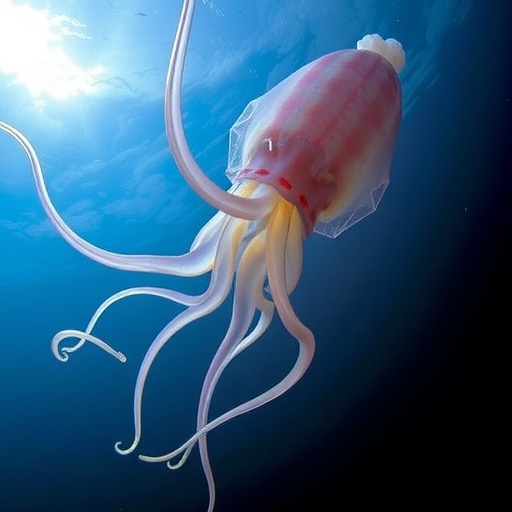
The profound influence of strong El Niño events on marine ecosystems has long intrigued scientists, yet recent research has unveiled startling insights into how these climatic anomalies reshape the migratory behavior and reproductive timing of the jumbo squid (Dosidicus gigas), a pivotal species in the Pacific Ocean’s ecological balance. A groundbreaking study published in Communications Earth & Environment in 2026 by Jiang, Dong, Liu, and colleagues meticulously documents how intensified El Niño occurrences are driving unprecedented shifts in the jumbo squid’s life history strategies, with broad implications stretching from oceanography to fisheries management.
Jumbo squid, known for their remarkable size and voracious appetite, play a crucial role in the marine food web, both as apex predators and key prey for larger oceanic species. Traditionally, these cephalopods undertake seasonal migrations spanning vast distances, synchronized with oceanographic features such as temperature gradients and prey availability. The new findings reveal that during strong El Niño episodes, anomalous warming of surface waters in the tropical and subtropical Pacific fundamentally disrupts these finely tuned migratory routes, compelling jumbo squid to explore previously uncharted latitudes and depths in search of optimal foraging conditions.
Such alterations extend beyond mere geography; the timing of critical reproductive events has also been shifted. The study highlights that the phenology of spawning—that is, the seasonal timing of reproduction—has advanced or delayed in response to fluctuating ocean temperatures induced by strong El Niño events. This phenological plasticity suggests an adaptive response to environmental stressors, yet it also portends potential mismatches with secondary ecological factors such as prey availability for hatchlings, which may jeopardize recruitment success and long-term population stability.
Delving into the mechanistic drivers, the researchers employed a multidisciplinary approach combining satellite telemetry, oceanographic monitoring, and in situ biological sampling across multiple El Niño cycles. Tracking data demonstrated that jumbo squid trajectories during these periods exhibited significant deviations from historical baselines. Instead of following their customary north-south corridors along the eastern Pacific coast, squid extended eastward into the previously cooler central Pacific waters. Concurrently, vertical migration patterns evolved, with individuals inhabiting warmer surface layers longer than usual, likely to optimize metabolic processes and reproductive physiology under temperature stress.
Moreover, the reproductive phenology adjustments appear interlinked with these migratory shifts. Spawning grounds, traditionally located along nutrient-rich continental shelf regions, showed signs of displacement towards pelagic zones influenced by El Niño-induced oceanographic anomalies. Egg deposition and hatching periods were similarly modulated, altering the availability and vulnerability windows for both juveniles and their predators. This phenological realignment has cascading effects on trophic interactions and biogeochemical cycles, illustrating the complex feedback loops triggered by climatic extremes.
The implications for ecosystem dynamics and fisheries are profound. Jumbo squid are commercially harvested across multiple nations, and the El Niño-driven changes in migration and reproduction necessitate revisions in stock assessment models and management policies. The unpredictability introduced by climate variability complicates sustainable harvesting practices, calling for adaptive frameworks that incorporate environmental drivers alongside biological data. Recognizing jumbo squid as sentinel species, the study underscores their utility as bioindicators for ocean health amidst accelerating climate change.
Further, the research contributes vital data towards understanding the resilience and vulnerability of marine organisms in a warming sea. It paints a nuanced picture where life history traits exhibit considerable flexibility, but not without energetic costs and ecological trade-offs. The authors suggest that persistent or increasingly frequent strong El Niño events—predicted under climate change scenarios—could result in long-term shifts in species distribution, community assemblages, and ecosystem functioning, reshaping the Pacific marine landscape.
The findings also prompt questions about the evolutionary consequences of such rapid environmental perturbations. Will jumbo squid populations undergo genetic selection favoring enhanced adaptability to thermal variability? Or might these pressures lead to population bottlenecks and local extirpations? Addressing these inquiries warrants further longitudinal and genomic investigations, advancing our predictive understanding of marine biodiversity responses to global change.
Importantly, the study exemplifies the integration of advanced tracking technologies, remote sensing, and ecological modeling to unravel complex phenomena at oceanic scales. By linking physical oceanography with biological responses, it sets a precedent for holistic climate impact assessments that transcend disciplinary boundaries, facilitating more robust forecasting and conservation strategies.
This research also highlights the urgency of international collaboration in monitoring migratory species whose ranges transcend jurisdictional waters. The transboundary nature of jumbo squid migrations during El Niño underscores the need for coordinated management to mitigate overexploitation risks exacerbated by environmental disturbances.
In summary, the extensive work by Jiang and colleagues illuminates the dynamic interplay between climatic extremes and marine life, revealing how strong El Niño events reconfigure both the spatial ecology and reproductive rhythms of jumbo squid. Their study pushes the frontier of marine climate science, demonstrating that understanding organismal responses at fine scales is crucial for anticipating broader ocean ecosystem shifts in an era of rapid environmental change.
As the climate crisis accelerates, insights from such research become indispensable for safeguarding marine resources and ecosystem integrity. The jumbo squid’s story is a clarion call to the scientific community, policymakers, and stakeholders: fostering resilience in ocean systems demands deep knowledge of species’ adaptive capacities and vulnerabilities to ephemeral yet powerful climate phenomena like El Niño.
Ultimately, the evolving narratives of marine megafauna like the jumbo squid will continue to enrich our grasp of the ocean’s intricate web of life, challenging us to craft innovative approaches to marine stewardship that coexist harmoniously with Earth’s changing climate rhythms.
Cite Scienmag News
Violet Maxwell. (April 15, 2026). Strong El Niño Alters Jumbo Squid Migration, Reproduction. Scienmag. https://scienmag.com/strong-el-nino-alters-jumbo-squid-migration-reproduction/
Violet Maxwell. "Strong El Niño Alters Jumbo Squid Migration, Reproduction." Scienmag, 15 April 2026, https://scienmag.com/strong-el-nino-alters-jumbo-squid-migration-reproduction/. Accessed 3 September 2026.
Violet Maxwell. "Strong El Niño Alters Jumbo Squid Migration, Reproduction." Scienmag. April 15, 2026. https://scienmag.com/strong-el-nino-alters-jumbo-squid-migration-reproduction/


