


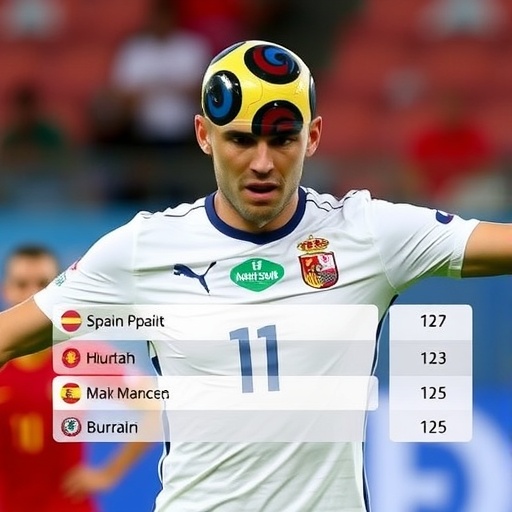
As the 2026 FIFA World Cup approaches, anticipation about potential outcomes is reaching fever pitch. A distinguished research team led by Achim Zeileis from the University of Innsbruck and Andreas Groll from TU Dortmund University has developed a sophisticated predictive model to estimate each participating nation’s chances of winning the tournament. This comprehensive analysis, underpinned by advanced statistical methodologies and machine learning, reveals a remarkably competitive field. Spain currently emerges as the narrow favorite, boasting a 14.5% probability of claiming the championship title, with England and France both close behind at 12.4%, followed by Germany at 11.2%. Other formidable contenders include Portugal at 8.9% and Argentina at 8.2%, while the Netherlands and Brazil have probabilities of 5.6% and 4.7%, respectively. Such a tight distribution underscores the intensifying unpredictability and competitiveness of this global sporting event.
The foundation of this forecasting model lies in the seamless integration of a vast and diverse data set, meticulously curated to ensure precise and robust predictions. The data corpus encompasses historical performance metrics from international matches, pre-tournament bookmaker odds, detailed player evaluations based on both club and national team performances, alongside the average market valuations of the squads. To harness the predictive power of this heterogeneous data, the team employed an advanced machine learning algorithm adept at synthesizing varying data types and scales. The complexity of this task was compounded by the timing of information availability; for instance, the final rosters of the tournament’s 48 teams were only publicly confirmed in the days immediately preceding the analysis, necessitating agile data integration and dynamic model updating.
Balancing the statistical rigor with domain-specific insights was paramount in constructing an accurate simulation framework capable of modeling the World Cup’s progression through all its stages. The research team, including Rouven Michels from TU Dortmund University who currently serves as a visiting researcher at the University of Innsbruck, incorporated tournament-specific factors such as the FIFA competition rules and the sequential nature of matches laid out in the official draw. The model probabilistically simulated the tournament a staggering 100,000 times, game by game, to capture the inherent randomness and variance typical of football competitions. This Monte Carlo simulation approach allows for the generation of nuanced probability distributions for each team’s likelihood of advancing through specific rounds and ultimately winning the title.
Crucially, these probabilities should not be mistaken for certainties. Historical validation of the model shows that while the team identified as the favorites often secured victory—such as Spain in the 2010 World Cup, the winners of Euro 2012, and the champions of the 2019 Women’s World Cup—the typical top favorite’s chance of winning rarely exceeds 20%. This reflects the innate unpredictability of knockout tournaments and the sport itself, where tactical decisions, player form fluctuations, and even momentary environmental factors can tip the balance. Andreas Groll emphasizes that from a statistical perspective, the value lies not in guaranteed outcomes, but in whether the teams predicted to progress further actually do so with a frequency consistent with their modeled probabilities. This validation framework enhances confidence in the model’s reliability.
Achim Zeileis himself is an avid football enthusiast, and his personal passion fuels his professional dedication to this analytical endeavor. He views the World Cup as an unparalleled opportunity to engage a broad audience in understanding probabilistic reasoning and uncertainty quantification, bringing statistical literacy into the realm of public discourse through the universal language of sport. The excitement generated by this high-stakes competition serves as a compelling backdrop for disseminating the principles of statistical modeling, while demonstrating the practical applications of data science in predicting complex real-world phenomena.
The research employed a hybrid modeling technique, integrating classical statistical processes with state-of-the-art machine learning. This approach allowed the team to leverage expert domain knowledge embedded in historical performance and bookmaker odds while harnessing the pattern-recognition capabilities of machine learning algorithms to detect subtle trends and interactions in player and team data. By simulating the full tournament structure multiple times and factoring in contingencies such as group-stage rankings, knockout pairings, and FIFA-specific regulations, the model effectively captures how each game’s outcome influences subsequent rounds and overall tournament dynamics.
Beyond the headline probability rankings, detailed insights emerge from the simulations. For instance, the model can estimate the likelihood of each team reaching various tournament stages, providing a multifaceted view of their prospects. Such granular forecasting serves not only fans and media but can inform strategic preparations by national teams and coaching staff. The inclusion of dynamic data inputs—like player fitness and late roster changes—enhances the model’s precision and adaptability, reflecting the fluid nature of sporting events where last-minute factors often sway outcomes.
The methodology masterfully addresses challenges inherent to sporting event predictions—namely, data incompleteness, evolving team compositions, and the non-linear complexities of competition formats. By feeding continuous data updates into a flexible statistical framework, this research exemplifies how data science can keep pace with rapidly changing contexts. Moreover, by producing probabilistic rather than binary forecasts, the model promotes a sophisticated understanding of risk and opportunity inherent in competitive sports.
Participation from researchers at the Technical University of Munich and Molde University College in Norway added further expertise, broadening the analytical perspectives and reinforcing the model’s scientific robustness. This international, interdisciplinary collaboration reflects the multifarious nature of data-driven sports analytics, combining insights from statistics, computer science, and domain-specific expertise to tackle challenges at the confluence of theory and application.
In sum, this research represents a landmark in probabilistic sports forecasting, marrying colossal datasets with advanced analytics to illuminate the dynamics of the 2026 FIFA World Cup. By embracing uncertainty while grounding predictions in rigorous computation, the study provides a blueprint for future tournament analyses and highlights the transformative potential of data science in understanding and anticipating the outcomes of complex, high-variance sporting phenomena.
For those eager to explore the full spectrum of winning probabilities and simulation results based on this hybrid model—one that synthesizes data, expert judgment, and cutting-edge statistical approaches—the researchers have made the comprehensive forecast accessible online, enriching both public engagement and academic discourse around this much-anticipated sporting event.
News Publication Date: 3-Jun-2026
Web References: https://www.zeileis.org/news/fifa2026/
Cite Scienmag News
Reid Dalton. (June 3, 2026). 2026 World Cup: Spain Takes Early Lead, Yet Championship Outcome Remains Uncertain. Scienmag. https://scienmag.com/2026-world-cup-spain-takes-early-lead-yet-championship-outcome-remains-uncertain/
Reid Dalton. "2026 World Cup: Spain Takes Early Lead, Yet Championship Outcome Remains Uncertain." Scienmag, 3 June 2026, https://scienmag.com/2026-world-cup-spain-takes-early-lead-yet-championship-outcome-remains-uncertain/. Accessed 3 September 2026.
Reid Dalton. "2026 World Cup: Spain Takes Early Lead, Yet Championship Outcome Remains Uncertain." Scienmag. June 3, 2026. https://scienmag.com/2026-world-cup-spain-takes-early-lead-yet-championship-outcome-remains-uncertain/


