


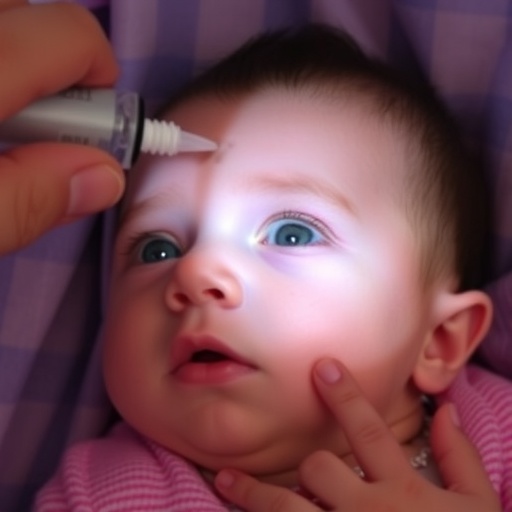
A simple eye drop may help protect extremely premature infants from the most dangerous form of retinopathy of prematurity, according to a randomized clinical trial published in JAMA Pediatrics. The study found that treatment-requiring, or type 1, retinopathy of prematurity (ROP) developed in 20.0% of infants given topical dexamethasone compared with 38.0% of infants who received placebo drops. Although the difference was substantial in numerical terms, it did not reach statistical significance, meaning the findings cannot yet establish that dexamethasone prevents severe ROP.
ROP is a potentially blinding disorder that affects the developing blood vessels of the retina in infants born prematurely. The retina, a light-sensitive layer at the back of the eye, normally receives its blood supply during the final weeks of gestation. When birth occurs extremely early, retinal vessels are immature and exposed to an unstable environment involving fluctuations in oxygen, inflammation, and growth signals. This disruption can cause abnormal blood vessel growth, which may damage the retina and, in advanced cases, lead to retinal detachment and permanent vision loss.
The trial included 100 preterm infants with severe ROP and randomly assigned them to receive either dexamethasone eye drops or placebo. Randomization is designed to distribute known and unknown risk factors evenly between treatment groups, allowing researchers to assess whether differences in outcomes are likely to be associated with the intervention. In this study, 10 infants in the dexamethasone group developed type 1 ROP, compared with 19 infants in the placebo group. The resulting absolute difference was 18 percentage points.
Type 1 ROP is defined by retinal findings that indicate a high risk of progression and generally require invasive treatment. Current interventions may include laser photocoagulation, which destroys abnormal peripheral retinal tissue, or injections of anti-vascular endothelial growth factor drugs, which suppress signals driving pathological vessel growth. These procedures can preserve vision but may require specialized equipment, anesthesia or sedation, and repeated monitoring. A topical therapy that could slow disease progression would therefore represent an attractive, noninvasive addition to neonatal eye care.
Dexamethasone is a synthetic corticosteroid that suppresses inflammation and alters the activity of multiple genes involved in immune responses, vascular signaling, and tissue growth. In premature infants, inflammation is believed to contribute to abnormal retinal vascular development. Corticosteroids may also influence pathways involving vascular endothelial growth factor, or VEGF, a protein that promotes blood vessel formation. Excessive or poorly regulated VEGF activity is central to the abnormal vessel growth seen in severe ROP, although the biological effects of applying corticosteroids directly to the eye in this vulnerable population remain complex.
The study’s numerical results suggest a possible benefit: the proportion of infants progressing to treatment-requiring disease was nearly twice as high in the placebo group as in the dexamethasone group. Expressed relatively, the dexamethasone group experienced approximately a 47% lower rate of type 1 ROP. However, statistical significance depends not only on the size of an observed difference but also on the number of participants and the variability in the data. With only 100 infants, the trial may not have had enough statistical power to distinguish a true treatment effect from a chance finding.
That distinction is crucial for families and clinicians. A result that does not reach statistical significance is not proof that the treatment has no effect, but it also cannot be treated as reliable evidence that the treatment works. Larger trials would be needed to determine whether the apparent reduction persists across different neonatal intensive care units, gestational ages, oxygen-management strategies, and stages of ROP. Researchers would also need to identify the optimal dose, timing, and duration of treatment and determine whether the drops are effective when administered before the disease reaches a severe stage.
No differences in adverse events were observed between the dexamethasone and placebo groups in the trial. This finding provides early reassurance about the safety of the approach, but safety monitoring remains particularly important in extremely premature infants. Even medications delivered as eye drops can potentially be absorbed into the bloodstream, and corticosteroids may influence blood pressure, glucose regulation, infection risk, and growth. The immature eye may also respond differently from the eyes of older children or adults, making long-term follow-up essential.
The investigators, led by Ann Hellström, MD, PhD, of the Institute of Neuroscience and Physiology at the University of Gothenburg in Sweden, describe topical dexamethasone as a potentially safe strategy for reducing progression to treatment-requiring ROP. The findings offer a promising signal in a disease where prevention and early intervention are urgently needed, but they stop short of changing clinical practice. Until larger, adequately powered studies confirm the benefit, dexamethasone eye drops should be regarded as an investigational approach rather than an established replacement for the screening, monitoring, and invasive treatments currently used to protect premature infants’ vision.
Web References: https://doi.org/10.1001/jamapediatrics.2026.3247
References: JAMA Pediatrics study, DOI: 10.1001/jamapediatrics.2026.3247
Cite Scienmag News
Harold Sullivan. (August 4, 2026). Dexamethasone Eye Drops May Prevent Treatment-Requiring Retinopathy of Prematurity. Scienmag. https://scienmag.com/dexamethasone-eye-drops-may-prevent-treatment-requiring-retinopathy-of-prematurity/
Harold Sullivan. "Dexamethasone Eye Drops May Prevent Treatment-Requiring Retinopathy of Prematurity." Scienmag, 4 August 2026, https://scienmag.com/dexamethasone-eye-drops-may-prevent-treatment-requiring-retinopathy-of-prematurity/. Accessed 4 September 2026.
Harold Sullivan. "Dexamethasone Eye Drops May Prevent Treatment-Requiring Retinopathy of Prematurity." Scienmag. August 4, 2026. https://scienmag.com/dexamethasone-eye-drops-may-prevent-treatment-requiring-retinopathy-of-prematurity/


