


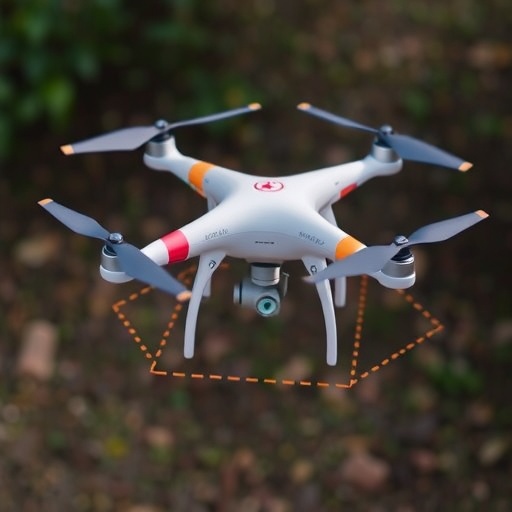
A lost hiker, a failing power line, and a field of crops under stress may seem unrelated, but they can all create the same problem for an autonomous machine: where should it go next when the most useful information is still unknown? A new study led by Rohan Ghuge of The University of Texas at Austin’s McCombs School of Business suggests that robots do not always need to rethink their routes after every observation. Instead, they may achieve nearly the same decision-making quality by updating their plans only a small number of times. The approach could make autonomous search and monitoring systems substantially faster while preserving most of the benefits associated with fully adaptive planning.
The research addresses a problem known as informative path planning. Unlike ordinary navigation, in which a vehicle travels from one known location to another, informative path planning requires a robot to choose a route that will collect valuable information. An unmanned aerial vehicle searching for a missing person, for example, must decide which regions to photograph, how to arrange those observations, and when the evidence gathered so far justifies changing direction. The vehicle is not merely moving through space; it is selecting a sequence of measurements that may reduce uncertainty about the world. Every decision therefore has two consequences: it determines where the robot will travel and it influences what the robot will know when it arrives.
This challenge is becoming more urgent as unmanned vehicles spread into military surveillance, package delivery, scientific exploration, precision agriculture, infrastructure inspection, and emergency response. Market research company Grand View Research estimates that the unmanned systems market was worth $29.3 billion in 2025 and could reach $67.6 billion by 2033. As these systems operate in more complex environments, they must cope with incomplete maps, changing conditions, limited battery capacity, communication delays, and the high cost of transmitting or processing data. A drone surveying a forest may have only a rough estimate of where a person is located. Images collected during the first part of the mission can alter that estimate, but using every new image to immediately calculate a completely new route may consume time and energy that the robot cannot afford to waste.
At one end of the planning spectrum is a fully adaptive strategy. In this model, the vehicle follows a route for a short period, receives new observations, and then recomputes its next move whenever information becomes available. If a drone’s camera detects a possible signal, an unusual shape, or an area that appears more promising than expected, the system can react immediately. This flexibility can produce highly effective routes because the vehicle continually responds to evidence. However, the computational burden can be substantial. Replanning requires algorithms to evaluate possible future paths, compare their expected information value, account for travel costs, and often communicate new instructions to the vehicle. In a rapidly changing mission, repeated calculations may become a bottleneck rather than an advantage.
At the opposite extreme is a nonadaptive strategy. The operator or planning system calculates a route before the mission begins, and the vehicle follows it regardless of what it discovers. This approach is easier to execute and may be faster because it avoids repeated optimization. It can also reduce communication demands and make battery consumption easier to estimate. Its weakness is that it treats the future as if it were already known. A search drone could continue scanning low-probability areas even after early observations indicate that the missing person is likely elsewhere. A utility-inspection robot might persist along a predetermined sequence after detecting evidence that the fault lies in another direction. The result may be operationally simple but scientifically and practically inefficient.
Ghuge, working with Rayen Tan and Viswanath Nagarajan of the University of Michigan, investigated a middle path between these two extremes. Their proposed framework limits adaptivity by dividing a mission into a small number of sequential rounds. During the first round, the robot follows a designated route without changing it in response to observations collected along the way. At the end of that round, the system uses the accumulated information to recompute the next route. The process can then be repeated, allowing later stages of the mission to become increasingly responsive without requiring continuous replanning. Technically, the method separates data collection from major optimization decisions. Instead of solving a new path-planning problem after every observation, the system solves it only at selected checkpoints.
The researchers tested this limited-adaptivity strategy through computerized simulations and compared it with a fully adaptive model. Their results indicate that two adaptive rounds could be about 15 times faster than a continuously adaptive approach. That acceleration came with a relatively small financial or operational penalty: the cost of the two-round strategy was only 12% higher than that of a comparable fully adaptive search. The simulations also showed that additional rounds produced diminishing returns. After the first three rounds, accuracy did not increase markedly, suggesting that constant route revision may deliver little extra value once the system has incorporated the most important early information. In practical terms, the robot may need only a few opportunities to reconsider its mission rather than an unbroken stream of decisions.
The reason this compromise works is that early observations often provide the largest improvements in situational understanding. Before a mission begins, the robot may face broad uncertainty about the location of a target or the source of a problem. The first sweep can eliminate large portions of the search area or reveal patterns that change the probability distribution over possible locations. A second route can then focus on the most promising regions. By the third round, the remaining uncertainty may be narrower, while the cost of further optimization continues to accumulate. Limited adaptivity attempts to capture the high-value information gained early in a mission while avoiding the computational and logistical expense of reacting to every minor change in the data.
The implications extend beyond search-and-rescue operations. A drone inspecting power lines could fly an initial route, analyze signs of damage, and then direct a second pass toward the structures most likely to contain the source of an outage. In agriculture, an autonomous vehicle could survey a field, identify areas with unusual moisture or plant stress, and allocate later measurements more intelligently. Scientific robots exploring remote terrain could use staged planning to balance coverage with the need to investigate anomalies. In each case, the system must optimize more than geographic distance. It must weigh the expected value of information against flight time, battery use, sensor operation, data-transfer requirements, and the consequences of delaying a response.
The study does not suggest that continuous adaptation is never useful. In missions involving rapidly changing hazards, extremely valuable targets, or sudden safety threats, immediate replanning may justify its computational cost. Instead, the findings indicate that adaptivity should be treated as a limited resource and scheduled strategically. A robot that changes its solution only two or three times may retain most of the performance advantage of a fully adaptive system while operating much faster and with fewer communication demands. For organizations deploying autonomous vehicles, that balance could determine whether a system remains theoretical or becomes practical. In a winter search for a missing hiker, minutes matter; a route that is slightly less precise but can be executed far sooner may ultimately offer the better chance of success. The research, published as “Informative Path Planning with Limited Adaptivity” in INFORMS Journal on Computing, provides a mathematical and computational foundation for making that trade-off deliberately rather than assuming that more frequent decision-making is always better.
News Publication Date: 27-May-2026
Web References: https://www.mccombs.utexas.edu/faculty-and-research/faculty-directory/profile/?username=rg53727 ; https://www.grandviewresearch.com/industry-analysis/unmanned-systems-market-report ; https://pubsonline.informs.org/doi/abs/10.1287/ijoc.2024.0893
References: INFORMS Journal on Computing, DOI: 10.1287/ijoc.2024.0893
Cite Scienmag News
Reid Dalton. (August 25, 2026). Smarter Flight Paths Could Transform Drone Navigation. Scienmag. https://scienmag.com/smarter-flight-paths-could-transform-drone-navigation/
Reid Dalton. "Smarter Flight Paths Could Transform Drone Navigation." Scienmag, 25 August 2026, https://scienmag.com/smarter-flight-paths-could-transform-drone-navigation/. Accessed 3 September 2026.
Reid Dalton. "Smarter Flight Paths Could Transform Drone Navigation." Scienmag. August 25, 2026. https://scienmag.com/smarter-flight-paths-could-transform-drone-navigation/


