


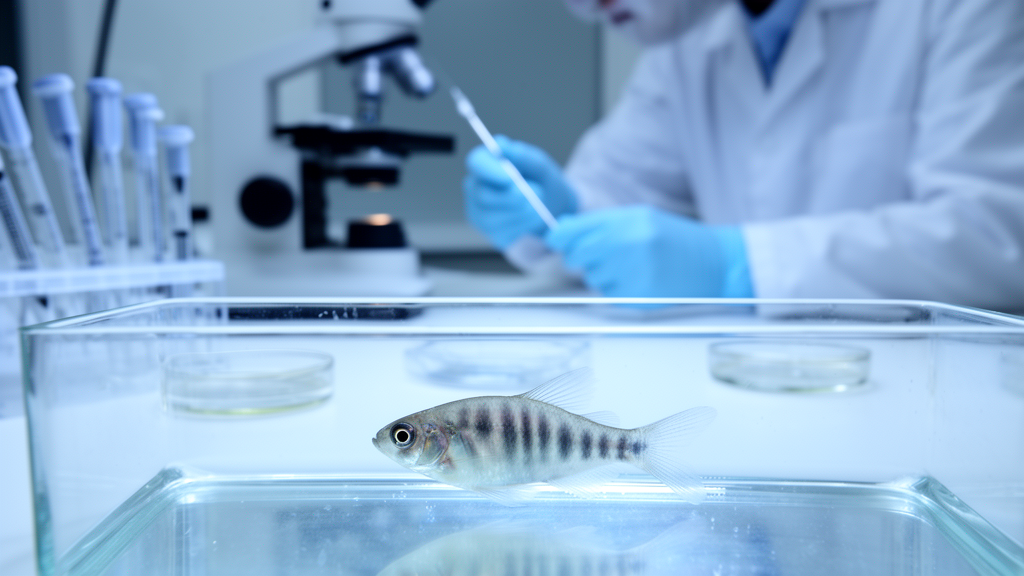
The zebrafish has quietly become one of the most powerful workhorses in modern biomedical research, and a new comprehensive review published in Frontiers in Aquaculture maps out exactly why. Danio rerio, a small freshwater fish barely a few centimeters long, shares roughly 70 percent of its genes with humans, a level of evolutionary conservation that has allowed scientists to dissect the molecular mechanisms of vertebrate development and human disease with astonishing speed. Now, according to a team of researchers from Sher-e-Kashmir University of Agricultural Sciences and Technology Kashmir, Central Agricultural University in Tripura, and Bihar Animal Science University, the fish is entering a new phase: a shift from blunt gene disruption toward precise, reversible control of gene activity.
Part of the zebrafish’s appeal lies in its sheer biological practicality. Its embryos develop externally and are optically transparent, meaning researchers can watch organs form in real time under a microscope. Gastrulation takes only about five hours, and by 18 hours after fertilization the embryo already displays a well-developed brain, eyes, ears, and segmenting muscles. Within a single day most primary organ systems are in place, and by 72 hours the embryo hatches from its chorion. Entire development takes just four days. Adults reach sexual maturity in roughly ten weeks and, under ideal laboratory conditions, a single female can produce up to 200 eggs per week, spawning continuously in high-density aquarium systems year-round. That torrent of transparent embryos makes the species ideal for large-scale genetic approaches, and its real-time imaging capability extends even to bone biology, since the first calcified vertebrae appear only five days after fertilization.
The review traces the technological arc that began decades before CRISPR became a household acronym. Chemical mutagenesis with N-ethyl-N-nitrosourea, or ENU, an alkylating agent that ethylates DNA bases to create random point mutations, has been a staple of zebrafish genetics since 1992. Those mutations, scattered across the genome, can produce missense or nonsense changes yielding null, hypomorphic, and occasionally hypermorphic alleles. The classic workflow involves exposing embryos to a carefully calibrated dose of ENU, raising them to adulthood, breeding out the induced germline mutations, and then screening offspring for visible, behavioral, or other phenotypic anomalies before mapping and sequencing the responsible gene. Knockout models of genes such as tp53 and apc emerged this way, cementing ENU screening’s role in forward genetics.
From the ENU pipeline came TILLING, or targeting induced local lesions in genomes, a reverse-genetic strategy that flips the logic of mutagenesis. Instead of hunting for a phenotype and tracing it back to a gene, TILLING deliberately searches mutagenized populations for point mutations in a preselected gene using engineered endonucleases that detect mismatches in DNA heteroduplexes. The technique proved its biomedical value with the psen1hu2547 mutant, which carries a truncated form of the conserved presenilin protein central to the gamma-secretase complex. Unlike psen1 null mice, which are not viable, the mutant zebrafish develops nearly normally and survives to adulthood, allowing long-term study of altered presenilin function in a vertebrate brain, including dramatic changes in histaminergic neuron numbers that echo the reduced neuronal histamine seen in Alzheimer’s disease patients.
Insertional approaches offered a different kind of power. Retroviral vectors, notably pseudotyped Moloney murine leukemia virus injected into embryos, integrate their DNA into the genome and pass through the germline, disrupting genes at the insertion site while leaving a molecular tag behind. A large-scale forward screen with this method uncovered more than 500 mutants at roughly 400 loci, most of which could be rapidly identified using linker-mediated polymerase chain reaction. Transposable elements such as Tol2, Sleeping Beauty, and Ac/Ds followed, introducing reporter constructs including green fluorescent protein to mark where and when trapped genes are active. The trade-off is mutagenic frequency: only about 4 percent of Tol2 insertions disrupt gene function enough to produce an early embryonic phenotype, so insertional screens demand far larger libraries than chemical mutagenesis.
Transient gene silencing brought yet another layer of flexibility. Morpholinos, synthetic antisense oligonucleotides with neutral non-ribose backbones introduced in 2000, bind target messenger RNA to block translation or pre-messenger RNA splicing, producing hypomorphic phenotypes in early embryos without any permanent genome change. They became the method of choice for rapid loss-of-function studies, illuminating processes from primordial germ cell migration to hematopoietic stem cell genesis and left-right asymmetry. But they carry well-documented caveats: morpholinos can activate the p53 apoptotic factor, masking true phenotypes with off-target cell death, and a comparison between morpholino-mediated suppression and a genuine pak4 null allele revealed a severe developmental defect only in the knockout, exposing a morpholino-generated pseudophenotype. RNA interference, meanwhile, has been rebuilt on the fish’s own microRNA scaffold to create stable transgenic knockdown lines, and injection of synthetic messenger RNA remains the standard tool for rapid gain-of-function studies and rescue experiments limited to early embryogenesis.
For durable genetic change, the review highlights the transposon-based transgenesis toolkit that has made stable zebrafish lines routine. Tol2 cis sequences are just 200 base pairs long, so they can be attached to virtually any transgene, and co-injection of synthetic messenger RNA encoding Tol2 transposase drives efficient germline integration. Conditional systems add temporal and spatial control: the Cre/loxP machinery borrowed from bacteriophage P1 enables tissue-specific knockout and lineage tracing with tamoxifen-inducible CreERT2 drivers, of which 47 lines are already catalogued in the CreZoo database. Gene-trap cassettes such as FlipTrap and the highly mutagenic RP2 construct, which reduces trapped gene expression to under 1 percent of normal, can be flipped or excised in vivo using Cre or Flp recombinases. On top of this sits the Gal4/UAS bipartite expression system, adapted from yeast, which couples a tissue-specific Gal4 driver line to a responder line carrying the gene of interest downstream of upstream activating sequences, enabling robust targeted expression including disease models of tauopathy.
The revolution, however, arrived with programmable nucleases. Zinc finger nucleases, first shown to work in zebrafish in 2008, fused arrays of DNA-binding zinc finger motifs to the FokI endonuclease domain, creating targeted double-strand breaks repaired error-pronely by non-homologous end joining. But their unpredictability and laborious assembly limited uptake to fewer than 30 genes. TALENs, adapted to zebrafish in 2011, changed that with a simple cipher: each conserved repeat binds one DNA base through independent repeat-variable residues, making custom nucleases cheaply assemblable in a few cloning steps. Zebrafish was the first vertebrate in which TALENs produced heritable mutations, and combining them with donor constructs enabled homologous recombination-directed knock-ins.
Then came CRISPR/Cas9, which the authors describe as the most efficient and widely adopted system of all. It requires only a guide RNA co-delivered with messenger RNA encoding Cas9, no custom DNA-binding protein design at all. Demonstrated in zebrafish in 2013, it enabled simultaneous multiplex targeting of many genes, high-throughput gene targeting across the genome by 2015, and rapid stable mutant allele generation in weeks rather than years. Recent refinements push further: all-in-one vectors using the native zebrafish U6 promoter now work in fish cell lines, base editing and prime editing allow nucleotide-level changes without double-strand breaks, and catalytically inactive dCas9 fused to repressor or activator domains has delivered optimized CRISPR interference and activation systems, validated in 2024, that reversibly tune gene expression from promoter regions. F0 screening approaches, including the multiplex MIC-Drop platform and a 2025 pipeline for enteric nervous system genes, deliver phenotypic readouts directly in injected first-generation embryos, and paired guide RNAs can even generate large deletions or chromosomal inversions.
The translational payoff is already visible. CRISPR-edited zebrafish now model cancer, cardiovascular, metabolic, and infectious diseases while feeding whole-organism drug discovery pipelines that assess efficacy and toxicity simultaneously. Knocking out the antiviral regulator FTR42 increased survival against viral infection by strengthening type I interferon immunity, while loss of tnf-alpha1 heightened susceptibility to both Edwardsiella piscicida and viral hemorrhagic septicemia virus, pinpointing immune genes relevant to aquaculture and vaccine development. An ehd3 knockout boosted highly unsaturated fatty acid content in muscle, hinting at genetic routes to more nutritious fish. Challenges remain, including off-target effects, mosaic editing, variable efficiency, and genetic compensation, and base editing, prime editing, and CRISPRi/a still require optimization. But as the review concludes, the combination of high-fidelity Cas9 variants, automated high-throughput screens, and integration with live imaging positions the humble zebrafish as a central platform for precision medicine, functional genomics, and sustainable aquaculture in the decade ahead.
Subject of Research: Molecular techniques for genetic modification and targeted mutagenesis in zebrafish
Article Title: Comprehensive insights into molecular techniques and applications for genetic modification and targeted mutagenesis in zebrafish
Article References: Quyoom, N., Iqbal, G., Singh, L. S., Mushtaq, S., & Dar, S. A. (2026). Comprehensive insights into molecular techniques and applications for genetic modification and targeted mutagenesis in zebrafish. Frontiers in Aquaculture, 5, Article 1820777. https://doi.org/10.3389/faquc.2026.1820777
Image Credits: AI Generated
DOI: 10.3389/faquc.2026.1820777
Keywords: zebrafish, CRISPR/Cas9, genome editing, mutagenesis, transgenesis, TILLING, morpholino, TALEN, CRISPRi/a, disease modeling, functional genomics, aquaculture
Cite Scienmag News
Juliet Wilcox. (October 15, 2026). Zebrafish Genetic Engineering Enters a New Era of Precision Gene Control. Scienmag. https://scienmag.com/zebrafish-genetic-engineering-enters-a-new-era-of-precision-gene-control/
Juliet Wilcox. "Zebrafish Genetic Engineering Enters a New Era of Precision Gene Control." Scienmag, 15 October 2026, https://scienmag.com/zebrafish-genetic-engineering-enters-a-new-era-of-precision-gene-control/. Accessed 15 October 2026.
Juliet Wilcox. "Zebrafish Genetic Engineering Enters a New Era of Precision Gene Control." Scienmag. October 15, 2026. https://scienmag.com/zebrafish-genetic-engineering-enters-a-new-era-of-precision-gene-control/


