


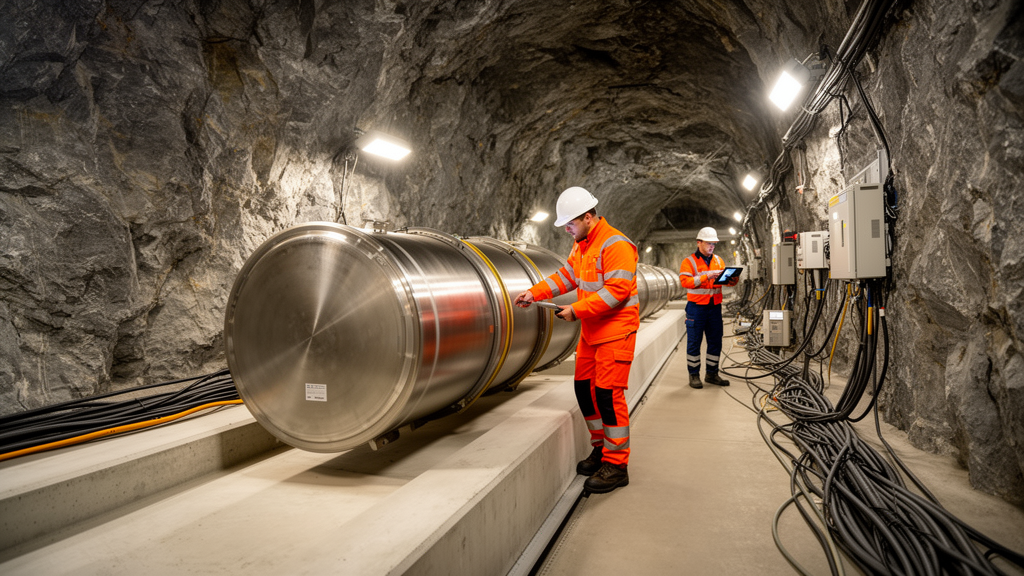
Deep beneath the rolling landscapes of northern Switzerland, engineers and geoscientists have spent decades designing what is essentially a time capsule designed to outlast entire civilizations: a repository for the nation’s most dangerous radioactive waste, sealed hundreds of meters underground and expected to remain safe for a million years. Now, a team at Nagra, Switzerland’s national cooperative for radioactive waste disposal, has published the performance assessment workflow underpinning the safety case for a general license application at the Haberstal site, offering one of the most detailed public accounts yet of how such a claim can actually be proven rather than merely asserted.
The repository concept rests on a staggered system of passive, redundant barriers, each performing a specific safety function with no maintenance, monitoring, or human intervention required after closure. Waste is to be emplaced roughly 900 meters underground within the Opalinus Clay, a low-permeability host rock that, together with similarly favourable geological units above and below, forms what Nagra calls the containment-providing rock zone. The seven so-called pillars of safety include the deep underground location itself, this geological barrier, the waste matrices, the disposal canisters, the bentonite buffer surrounding high-level waste, the cementitious near-field of the low- and intermediate-level waste caverns, and the closure system of seals and backfills that ultimately plugs the entire underground structure.
What makes the new work distinctive is its methodological rigour. Rather than relying on a single monolithic model, the team deployed a claims-arguments-evidence framework in which every high-level claim about barrier performance is substantiated by multiple arguments, each backed by evidence drawn from three broad categories: empirical knowledge from other scientific disciplines and natural or archaeological analogues, project-specific experimental databases from rock laboratories and site investigations, and model-supported analyses of the provisional repository design. This auditable structure is designed to withstand the scrutiny of regulators, international reviewers, and future generations of scientists who may reassess the repository with new tools and data.
Uncertainty, the great nemesis of any million-year prediction, is handled with unusual discipline. The team decomposed it into conceptual, parametric, and scenario uncertainties. Conceptual uncertainties, such as simplifications in geometry or process representation, are treated as reducible and mitigated through benchmarking and validation exercises. Parametric uncertainties, including the inherent variability of material properties, are propagated through Monte Carlo simulations with sample sets of up to 1,000 realisations. Scenario uncertainties, arising from different possible evolutionary paths of the repository system, are screened through more than 20 explicitly defined perturbation scenarios covering everything from undetected faults and earthquakes to upper-bound gas generation and loss of overburden through erosion.
The model chain itself is layered. Deterministic three-dimensional models represent the entire repository in stylised form, providing a comprehensive picture of flow and transport, while more detailed component models capture the emplacement rooms and the three classes of seals with greater geometric fidelity. Simplified two-dimensional probabilistic models then propagate parametric uncertainty into a set of quantifiable performance indicators, which are compared against performance targets derived from the known physical and chemical behaviour of repository materials. A dimensionless performance index, calculated by dividing indicator by target, allows margins to be expressed on scales ranging from very favourable to unfavourable.
The long-term evolution of the system unfolds in two characteristic phases. In the early post-closure period of roughly the first few hundred years, a thermal pulse radiates outward from the heat-emitting high-level waste, raising temperatures near the canisters to around 135 degrees Celsius within the first decade. In the later phase, stretching from thousands to tens of thousands of years, gas generated by corrosion of metals and degradation of organics accumulates in the pore volume of the repository, building pressure against the surrounding low-permeability clay. The simulations show these two perturbations peak at different times, excluding any detrimental superposition of thermal and gas-related stresses on the barrier system.
The numbers emerging from the probabilistic analysis are striking. For the dose-relevant, non-sorbing radionuclide iodine-129, assumed to be released instantaneously from the high-level waste, the maximum calculated dose of approximately 7 times 10 to the minus 5 millisieverts per year sits more than three orders of magnitude below the Swiss regulatory limit of 0.1 millisieverts per year. For chlorine-36 released from the low- and intermediate-level waste, margins exceed six orders of magnitude, and for volatile carbon-14 escaping through the shaft seals, calculated doses fall more than seven orders of magnitude below the limit. Bentonite temperatures remain below the 150-degree performance target in every simulation, and the potential for shear failure of the host rock under thermal or gas loading shows median performance indices of roughly 0.31 to 0.37, well below the threshold of 1.0.
Perhaps most importantly, the assessment does not stop at the expected case. Twenty-two perturbation scenarios evaluate what happens when individual barrier components fail to perform their assigned functions, from canisters breaching at the moment of closure to pessimistic gas generation rates and undetected faults running parallel to the waste drifts. In the pessimistic gas scenario, for example, pressures peak earlier at 9 to 11 megapascals, yet the failure potential remains low, and the tracer flux into the regional aquifers is practically indistinguishable from the expected case. The inherent redundancy of the multibarrier concept means that the failure of any single component is partially compensated by the others, so that adequate margins persist across the entire suite of deviations, with only hypothetical scenarios producing a less favourable rating.
Several favourable effects were deliberately excluded from the calculations to keep the assessment conservative. Molecular diffusion of dissolved hydrogen, water consumption during anaerobic corrosion, and microbial gas consumption would each independently reduce peak pressures by more than a megapascal in some sections, yet none were credited in the main analysis. This conservatism, combined with the breadth of the scenario space and the transparency of the claims-arguments-evidence structure, is precisely what the team hopes will build confidence among regulators and the public.
The verdict of the assessment is unambiguous: the geological repository for high-level and low- and intermediate-level waste at the Haberstal site is safe over the entire million-year assessment period, with significant margins under both expected and adverse conditions. Beyond Switzerland, the methodology offers a template for any nation grappling with the ultimate question of nuclear waste disposal, demonstrating that even the most audacious safety promises in modern engineering can be made traceable, testable, and, above all, honest about their uncertainties.
Subject of Research: Performance assessment for the safety case of Switzerland's deep geological repository for radioactive waste at the Haberstal site
Article Title: The safety case for a deep geological repository in Switzerland: system evolution and performance assessment
Article References: Papafotiou, A., Guillemot, T., Martin, L., Diomidis, N., & Marschall, P. (2026). The safety case for a deep geological repository in Switzerland: system evolution and performance assessment. Frontiers in Nuclear Engineering, 5, Article 1845169. https://doi.org/10.3389/fnuen.2026.1845169
Image Credits: AI Generated
DOI: 10.3389/fnuen.2026.1845169
Keywords: deep geological repository, radioactive waste disposal, Opalinus Clay, Nagra, performance assessment, multibarrier system, uncertainty quantification, Monte Carlo simulation, Opalinus Clay host rock, high-level waste, bentonite buffer, gas pressure buildup
Cite Scienmag News
Denise Maddox. (October 15, 2026). Switzerland’s Nuclear Waste Vault Passes Its Toughest Safety Test Yet. Scienmag. https://scienmag.com/switzerlands-nuclear-waste-vault-passes-its-toughest-safety-test-yet/
Denise Maddox. "Switzerland’s Nuclear Waste Vault Passes Its Toughest Safety Test Yet." Scienmag, 15 October 2026, https://scienmag.com/switzerlands-nuclear-waste-vault-passes-its-toughest-safety-test-yet/. Accessed 15 October 2026.
Denise Maddox. "Switzerland’s Nuclear Waste Vault Passes Its Toughest Safety Test Yet." Scienmag. October 15, 2026. https://scienmag.com/switzerlands-nuclear-waste-vault-passes-its-toughest-safety-test-yet/


