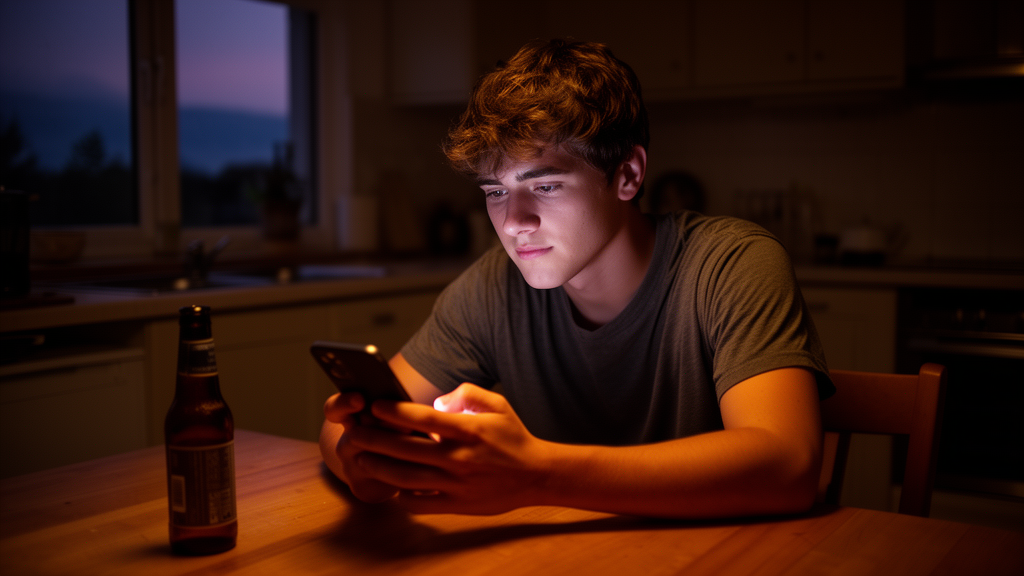
For decades, addiction researchers have argued that the sight of a beer bottle, the smell of a favorite bar, or the clink of glasses can pull people with alcohol use disorder back toward drinking. But proving that these conditioned cues actually drive drinking in the messy, unpredictable environment of everyday life has been surprisingly difficult. Now, a team of German scientists has delivered some of the strongest real-world evidence yet, using smartphone-based momentary sampling to show that encountering alcohol-related cues dramatically raises the odds that a person will drink within moments — even after accounting for everything else happening around and inside them at the time.
The study, published in Translational Psychiatry, was led by Ali Ghadami and Heike Tost of the Central Institute of Mental Health in Mannheim, together with colleagues at Charité-Universitätsmedizin Berlin and partner institutions. The researchers used a technique called ecological momentary assessment, or EMA, in which participants carry a smartphone that buzzes them repeatedly throughout the day, asking in real time what they are experiencing, whom they are with, how they feel, and whether they are drinking. This approach sidesteps the recall bias and temporal smearing that plague retrospective questionnaires, capturing behavior at the exact moments it unfolds.
The team analyzed data from two independent cohorts of non-treatment-seeking individuals. The discovery cohort comprised 73 adults aged 17 to 62 with, on average, mild-to-moderate DSM-5 alcohol use disorder, drawn from the German Collaborative Research Center TRR265. The replication cohort included 56 young adults aged 19 to 35, recruited from the community in Mannheim and Berlin and screened for risky drinking using the AUDIT-C questionnaire. After quality control, the analysis rested on 19,579 individual prompts across 129 participants, with average compliance rates of roughly 66 percent in both groups — a remarkably high figure for such intensive protocols.
The EMA schedules were demanding. In the discovery cohort, participants completed six weeks of assessment, beginning with eight prompts per day — a randomized morning prompt and seven daytime prompts spaced at least an hour apart — before tapering to four daily prompts in the second half. The replication cohort completed four weeks with seven prompts per day, including fixed morning and evening prompts. At each prompt, participants reported whether they were drinking at that moment and whether they had been exposed to alcohol-related cues since the last prompt, using a set of 11 images depicting alcoholic beverages and alcohol-present contexts. They also rated their social company, contact with people they typically drink with, affective valence, energetic arousal, calmness, guiltiness, irritability, loneliness, anxiousness, and their appraisal of recent positive and negative events.
The statistical approach was deliberately conservative. The researchers used logistic mixed-effects models in which every time-varying predictor was decomposed into a within-person component — how a given moment deviated from that individual’s own average — and a between-person component capturing stable individual differences. All predictors were entered simultaneously, meaning the cue-drinking association had to survive adjustment for social context, affective states, arousal, and event appraisal all at once. Models were further adjusted for age, sex, and time of day, with participant-specific random intercepts absorbing stable traits. This design directly addresses the central weakness of earlier real-world studies, which typically examined cue exposure alongside only a narrow subset of co-occurring influences.
The results were striking and reproducible. In the discovery cohort, within-person exposure to alcohol cues was associated with an odds ratio of 1.32 per 0.1-unit increase (95 percent confidence interval 1.29 to 1.35), and in the replication cohort the corresponding figure was 1.40 (95 percent confidence interval 1.36 to 1.44), both highly significant. Expressed as the full contrast from cue absence to cue presence, the odds of momentary drinking were 16.19 times higher in the discovery cohort and 29.17 times higher in the replication cohort. Crucially, the association survived two sensitivity analyses designed to address temporal ordering: one restricted to prompts preceded by non-drinking, focusing on transitions into drinking episodes, and another in which cue exposure was lagged by one prompt so that prior exposure prospectively predicted later drinking. In both cases the association remained significant at p below 0.001.
Alcohol cues were not alone. Three other time-varying predictors showed replicable within-person associations with drinking in both cohorts: being in company, exposure to drinking companions, and higher energetic arousal, all significant at p below 0.002. These findings align with social facilitation and opportunity models of drinking and with prior EMA work linking social settings and elevated arousal to increased consumption. Perhaps more telling was what did not replicate: negative affective states such as guiltiness, irritability, loneliness, and anxiousness showed no consistent within-person association with drinking. This absence echoes recent meta-analytic evidence that daily affect-drinking links are heterogeneous and often smaller than the popular negative-reinforcement narrative would suggest.
Beyond average effects, the team explored whether individuals differ in what triggers their drinking. They refitted the models in the pooled sample with participant-specific random slopes for the replicated predictors — alcohol cue exposure, being in company, and drinking companion exposure — and then applied k-means clustering to the standardized individual slope estimates, guided by the elbow criterion and average silhouette width. A two-cluster solution emerged along a clear axis: one group of individuals for whom drinking was primarily related to alcohol cues, and another for whom drinking was primarily related to social context. Post-hoc comparisons revealed that the alcohol cue-reactive cluster was significantly older, met more DSM-5 criteria for alcohol use disorder, scored higher on the AUDIT, and reported more stressful life events than the social context-reactive cluster, which comprised relatively younger and less severely affected individuals.
The authors interpret these profiles through the lens of established heterogeneity in alcohol cue-reactivity. Laboratory and neuroimaging work has distinguished reward-related from relief-related drinking phenotypes with distinct striatal cue-reactivity patterns, as well as appetitive, aversive, and mixed neural subtypes. The cue-reactive profile observed here may correspond to relief- or severity-related drinking, whereas the social context-reactive profile may better match reward- and socially motivated drinking. If validated prospectively, such daily-life phenotyping could complement efforts to match individuals to mechanism-targeted interventions — for example, cue-focused approaches for one group and context- or social-focused strategies for another — and could inform just-in-time adaptive interventions delivered through mobile technology at the moments of greatest risk.
The researchers are careful about the limits of their evidence. The within-person associations are correlational and observational, and even the temporal-ordering sensitivity analyses cannot establish that cue exposure causally triggers drinking. The cluster analysis was exploratory, and k-means imposes a discrete partition on continuously distributed slope estimates that were shrunk toward the mean by empirical-Bayes estimation, so the two profiles should be treated as hypothesis-generating poles rather than established diagnostic categories. The two cohorts also used somewhat different response formats for affect and arousal items, harmonized through within-person standardization, which cautions against over-interpreting cross-cohort differences in effect sizes. Measurement reactivity — the possibility that frequent prompting itself alters behavior — cannot be fully excluded, although prior work suggests such effects are typically absent, modest, or short-lived in substance-use monitoring, and the person-mean-centered models absorb stable individual-level shifts.
Even with those caveats, the study delivers something the field has long needed: a replicated, real-world demonstration that conditioned alcohol cues carry specific, momentary information about drinking risk that is not reducible to social context, mood, arousal, or how a person appraises events. The findings provide ecological support for incentive-sensitization theory, which holds that drug-associated cues acquire motivational salience, bias attention, and evoke craving and approach behavior. They also hint that the relative weight of conditioned motivational processes versus social opportunity may shift across age and disease stage, with cue-driven drinking emerging as drinking problems deepen. For the millions of people worldwide affected by alcohol use disorder, the message is that risk is written not only in who they are but in where they are, whom they are with, and what they see — and that a smartphone buzzing in the pocket may one day know precisely when to intervene.
Subject of Research: Real-world alcohol cue exposure and momentary drinking risk in alcohol use disorder measured with ecological momentary assessment
Article Title: Real-world alcohol cue exposure and drinking risk in alcohol use disorder
Article References: Ghadami, A., Sreepada, A., Reinhard, I., Ganz, M., Boehmer, J., Meyer-Degering, K., Walter, H., Andoh, J., Lenz, B., Bach, P., Kiefer, F., Schwarz, E., Reichert, M., Ebner-Priemer, U. W., Meyer-Lindenberg, A., Heim, C., & Tost, H. (2026). Real-world alcohol cue exposure and drinking risk in alcohol use disorder. Translational Psychiatry, 16(1), Article 537. https://doi.org/10.1038/s41398-026-04506-4
Image Credits: AI Generated
DOI: 10.1038/s41398-026-04506-4
Keywords: alcohol use disorder, alcohol cues, ecological momentary assessment, cue reactivity, drinking behavior, incentive sensitization, social context, energetic arousal, risk profiles, mHealth, addiction, Translational Psychiatry
Cite Scienmag News
Glenn Wilkins. (October 8, 2026). Your Phone Knows When You’ll Drink: Real-World Cues Predict Drinking in Daily Life. Scienmag. https://scienmag.com/your-phone-knows-when-youll-drink-real-world-cues-predict-drinking-in-daily-life/
Glenn Wilkins. "Your Phone Knows When You’ll Drink: Real-World Cues Predict Drinking in Daily Life." Scienmag, 8 October 2026, https://scienmag.com/your-phone-knows-when-youll-drink-real-world-cues-predict-drinking-in-daily-life/. Accessed 8 October 2026.
Glenn Wilkins. "Your Phone Knows When You’ll Drink: Real-World Cues Predict Drinking in Daily Life." Scienmag. October 8, 2026. https://scienmag.com/your-phone-knows-when-youll-drink-real-world-cues-predict-drinking-in-daily-life/