


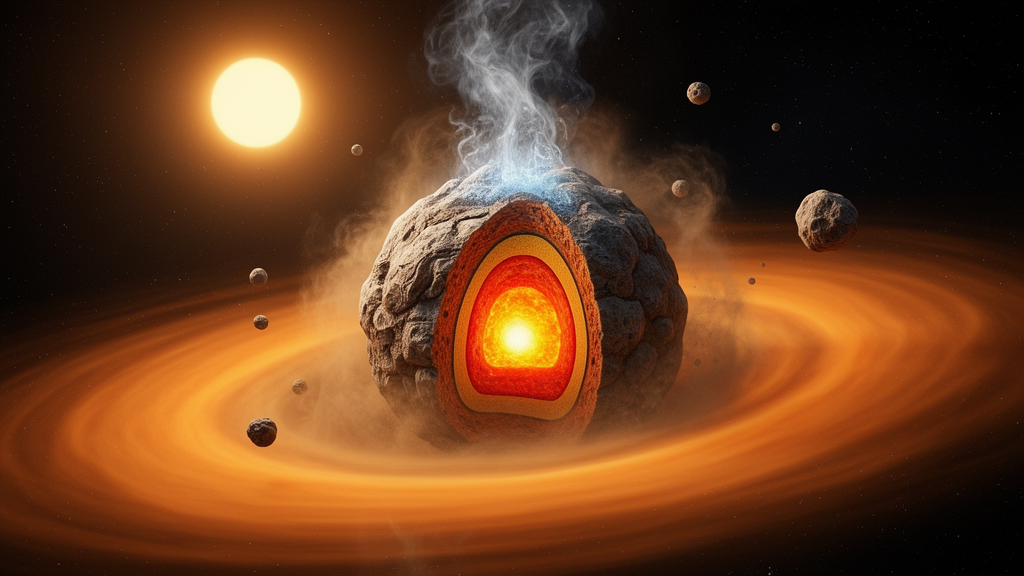
Earth and Mars are missing something, and scientists have long wondered what took it away. Compared with the Sun and the primitive meteorites that preserve the raw ingredients of the early Solar System, the rocky planets are strikingly poor in moderately volatile elements such as sodium, potassium, zinc and lithium. These are elements that evaporate at temperatures lower than the main rock-forming elements but higher than water and other ices, and their systematic scarcity in planetary mantles has been one of the most stubborn puzzles in cosmochemistry. A new study published in Nature Astronomy argues that this depletion is not the residue of some single catastrophic process, but a chemical fingerprint of how the planets were actually assembled, recording a hybrid of two very different growth mechanisms.
The research team, led by Haiyang S. Wang of the University of Copenhagen together with planet-formation theorist Anders Johansen and colleagues across Europe and the United States, combined models of pebble accretion with collisional growth from volatile-depleted planetesimals. Pebble accretion is the process by which young planets sweep up millimetre-to-centimetre-sized particles of dust and ice drifting through the protoplanetary disk, a mechanism known to be extraordinarily fast. Planetesimal accretion, by contrast, is the slower, more chaotic route in which larger rocky bodies collide and merge over millions of years. Rather than pitting these two theories against each other, the team asked whether both could have contributed, and whether the resulting mixture could be read directly from the planets’ chemistry.
The key insight is that each growth channel leaves a distinct thermal signature. Pebbles falling onto a growing protoplanet must pass through a hot hydrogen and helium gas envelope that surrounds the embryo. Using a one-dimensional model of this envelope, the researchers calculated what happens to elements of different volatility during the descent. Elements whose sublimation temperatures fall below the temperature at the bottom of the envelope are vaporized, and once vaporized they are efficiently carried away. The team validated this assumption with three-dimensional hydrodynamical simulations of the convective envelope, tracking nearly a million tracer particles. Within a single year only about thirty percent of the released volatiles remained in the envelope, and after five years less than three percent survived, because large-scale recycling flows continuously exchange envelope gas with the surrounding disk.
Crucially, this thermal processing is selective. Refractory elements such as aluminium, calcium and titanium, along with the moderately refractory magnesium and silicon, are protected. When silicates sublimate deep in the envelope, they form a dense vapour atmosphere in equilibrium with the underlying magma ocean, and an inner radiative zone where silicate clouds form strongly suppresses convection, preventing these vapours from diffusing upward and escaping. The moderately volatile lithophile elements, by contrast, are lost almost completely once the growing protoplanet becomes massive enough for its envelope base to exceed their sublimation temperatures. The result is a characteristic volatility pattern: a sharp drop in abundance for elements more volatile than roughly the lithium and manganese threshold, with refractory elements essentially untouched.
The second ingredient in the hybrid recipe comes from meteorites. The asteroid Vesta, often regarded as a surviving planetary embryo, shows strong depletion of elements with sublimation temperatures below about 1,200 kelvin, a pattern likely produced when short-lived radioactive isotopes such as aluminium-26 melted early-formed planetesimals and boiled away their volatiles. The angrite meteorite group shows an even more extreme depletion, losing even silicon and magnesium, which suggests that thermal processing of the first generation of planetesimals was widespread. The team adopted Vesta’s composition as representative of this population of baked planetesimals, which then contributed their volatile-poor material to the growing planets through collisions.
With these building blocks characterized, the researchers turned to Bayesian inference, a statistical framework that weighs competing models by how well they explain the data while penalizing unnecessary complexity. For Earth, the best-fitting model describes a three-component mixture: a proto-Earth and a giant impactor, both grown by pebble accretion and therefore stripped of their moderately volatile elements, plus a contribution from Vesta-like planetesimals. The analysis indicates that at least about seventy-five percent of Earth’s mass came from the two pebble-grown bodies, with up to roughly twenty-five percent from the baked planetesimals. If the planetesimal population is allowed to have a hypothetical depletion pattern not observed among known meteorite parent bodies, its contribution could rise to around forty percent. Models lacking the pebble-grown components were disfavoured decisively, and adding volatile-rich, carbonaceous-chondrite-like material improved nothing, contributing no more than ten percent of Earth’s mass.
The impactor component is particularly intriguing because it connects naturally to the Moon-forming giant impact. The inferred mass fraction of the impactor, between eight and forty-three percent of Earth’s mass, comfortably brackets both the canonical Theia mass of about ten to fifteen percent and the larger masses required in scenarios where a giant impact disrupts an early resonant chain of planets. The team also tested scenarios with two or three impactors. A second, small impactor remains statistically plausible, but a third is disfavoured, and its mass would be negligible. Notably, the preferred number of giant impacts is lower than the average of about three seen in classical N-body simulations, which the authors attribute to pebble accretion needing fewer planetary seeds to build a terrestrial-mass world, and therefore producing fewer embryos to collide.
Mars tells a complementary story. Because isotopic evidence indicates that Mars formed and differentiated its core rapidly, within the lifetime of the protoplanetary disk, the researchers modelled it as a combination of pebbles and planetesimals accreted early. The Bayesian solution assigns twenty-seven plus or minus five percent of Mars’s mass to pebble accretion and seventy-three plus or minus five percent to Vesta-like planetesimals, a result consistent with independent silicon isotope constraints. Allowing the planetesimal composition to vary freely reveals that an even more volatile-depleted population, more extreme than Vesta, could also fit the data. In every scenario tested, planetesimals dominate Mars’s budget while pebble accretion never falls below about ten percent, reinforcing that even the smaller terrestrial planet grew by hybrid means. The contrast with Earth, where pebble accretion was dominant, suggests Mars’s pebble supply was comparatively sluggish, perhaps because gravitational stirring by larger neighbouring protoplanets perturbed its orbit.
The implications extend well beyond the two planets we know best. The hybrid-accretion framework makes testable predictions about core chemistry: because moderately volatile siderophile elements such as sulfur can hide in the iron cores of planetesimals, the model yields sulfur abundances for bulk Earth and Mars that align with recent geophysical estimates of core composition rather than with older, lower values inferred from volatility trends alone. The model also dovetails with hafnium-tungsten chronometry, since a three-component Earth with substantial planetesimal input naturally explains our planet’s low tungsten-182 excess in the mantle. And because the same thermal physics operates around other stars, the framework offers a general tool for interpreting the volatile depletion observed in polluted white dwarf atmospheres and in Sun-like stars that have ingested planetary material, evidence that devolatilization may be a universal feature of rocky planet formation.
Perhaps most profoundly, the study reframes the origin of the ingredients for life. Carbon, hydrogen, nitrogen, oxygen, phosphorus and sulfur would have been largely stripped away during the pebble accretion phase, even for planets growing just outside the water ice line. Their delivery to rocky worlds must therefore have come through other channels: early accretion of volatile-rich pebbles before the protoplanet grew hot enough to expel them, impacts with smaller differentiated bodies, and late arrival of primitive planetesimals that escaped thermal processing. Reading the volatility patterns of rocky planets as accretion histories in this way transforms planetary chemistry from a static inventory into a dynamic record, one that astronomers can now begin to apply to the growing catalogue of rocky exoplanets as they assess which distant worlds might have retained the volatile inventory that habitability demands.
Subject of Research: Volatile element depletion in Earth and Mars as a record of hybrid pebble and planetesimal accretion
Article Title: Volatile depletion in rocky planets as a chemical fingerprint of hybrid accretion
Article References: Volatile depletion in rocky planets as a chemical fingerprint of hybrid accretion. (n.d.). https://doi.org/10.1038/s41550-026-02984-6
Image Credits: AI Generated
DOI: 10.1038/s41550-026-02984-6
Keywords: pebble accretion, planetesimals, volatile elements, Earth formation, Mars, protoplanetary disk, Bayesian inference, Vesta, giant impact, cosmochemistry, rocky exoplanets, planetary differentiation
Cite Scienmag News
Grant Pearson. (October 8, 2026). Earth’s Missing Volatiles Reveal a Hybrid Recipe for Building Rocky Planets. Scienmag. https://scienmag.com/earths-missing-volatiles-reveal-a-hybrid-recipe-for-building-rocky-planets/
Grant Pearson. "Earth’s Missing Volatiles Reveal a Hybrid Recipe for Building Rocky Planets." Scienmag, 8 October 2026, https://scienmag.com/earths-missing-volatiles-reveal-a-hybrid-recipe-for-building-rocky-planets/. Accessed 8 October 2026.
Grant Pearson. "Earth’s Missing Volatiles Reveal a Hybrid Recipe for Building Rocky Planets." Scienmag. October 8, 2026. https://scienmag.com/earths-missing-volatiles-reveal-a-hybrid-recipe-for-building-rocky-planets/


