


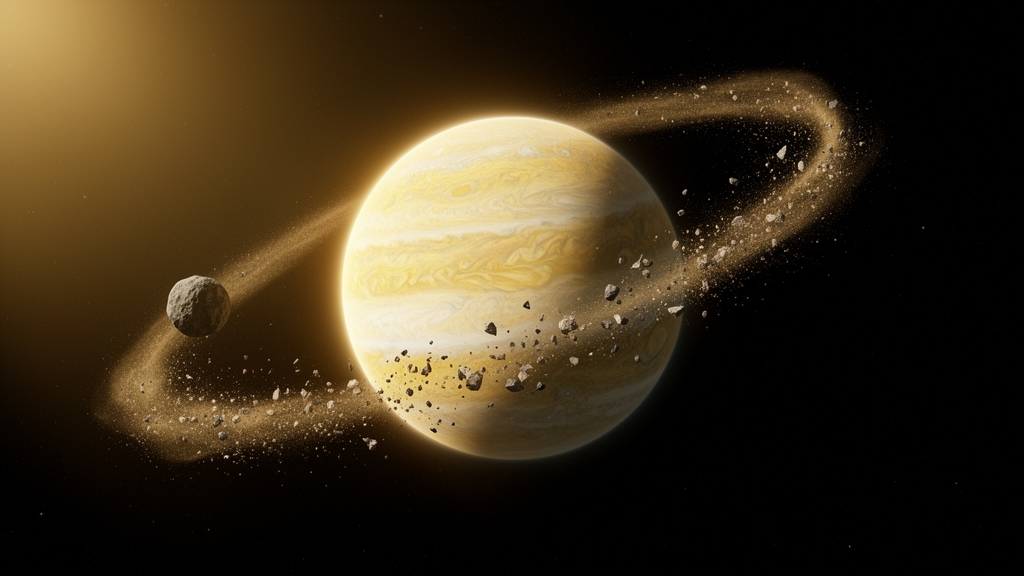
Venus has long been Earth’s unsettling mirror image. The two planets are nearly identical in size, mass, and internal structure, yet one cradles a luminous companion in its night sky while the other hangs alone. For decades, planetary scientists have wrestled with a deceptively simple question: why does Venus, Earth’s so-called twin, have no moon? A new study from the University of California, Riverside, published in The Astrophysical Journal, offers a striking answer. Venus did not necessarily need a cataclysmic impact to lose a satellite, nor did it need to be spared the moon-forming collision that shaped Earth’s history. Instead, the planet’s own gravity, combined with its extraordinarily sluggish rotation, would have dragged any moon it ever had into a fatal spiral, ending with the satellite crashing into the planet itself. In short, Venus may have eaten its moon.
The research was led by Stephen Kane, a UC Riverside astrophysicist who has spent much of his career probing the boundaries of planetary habitability. His starting point was the two leading explanations that scientists had previously floated. One held that Venus once had a moon that was obliterated by a massive impact. The other suggested that Venus simply never experienced the kind of giant collision that is thought to have spawned Earth’s moon roughly 4.5 billion years ago. Kane’s modeling shows that neither scenario is required to explain what we observe today. The slow, backward-turning spin of Venus is enough on its own to guarantee that any satellite would eventually be doomed.
To understand why, it helps to look at how Earth and its moon behave. Scientists can measure the Earth-moon distance with extraordinary precision because NASA’s Apollo 11 astronauts left mirrors on the lunar surface, allowing laser ranging from Earth. Those measurements reveal that the moon is receding from our planet at a rate of roughly four centimeters per year. The reason lies in Earth’s rotation. Our planet completes a spin in 24 hours, a comparatively brisk pace, and the energy of that rotation is transferred through tides raised in the oceans and the solid Earth to the moon. The result is a slow but relentless outward migration, a dynamic that has kept our satellite safely aloft for billions of years.
Venus presents the exact opposite situation. The planet takes 243 Earth days to complete a single rotation, making it the slowest-spinning world in the solar system. Rather than pushing a moon outward, that languid spin combined with the planet’s powerful gravity would cause a satellite to spiral inward toward a collision. Tidal forces that, on Earth, act as an escalator carrying the moon away from its planet instead act on Venus as a vise, tightening the orbit with every pass. Any moon Venus ever possessed would have been on a one-way descent from the moment it formed.
Kane tested this idea by writing computer models based on the physics of how planetary bodies interact through gravity. The first step was a crucial sanity check: he reproduced the evolution of Earth and its moon to confirm that the model accurately represented a system we know well. Only then did he turn to Venus, varying the planet’s rotation rate and the size of its hypothetical moons. He tested satellites with masses ranging from half to ten times the mass of Earth’s moon, a broad sweep designed to capture nearly any plausible scenario. In most simulations, the outcome was the same. The moon crashed into Venus. And, counterintuitively, the more massive the moon, the faster it fell.
The uniformity of the results surprised even the researcher. Kane described being shocked by the discovery, having assumed that such a wide range of scenarios would produce a variety of outcomes. Instead, every path led in the same direction, toward the surface of the planet. That consistency is what gives the finding its force. It means the absence of a moon at Venus does not demand a rare catastrophe or an unusual formation history. It follows naturally, almost inevitably, from the planet’s own rotation and gravity. Venus didn’t require a disaster to arrive at what we see today; the physics did the work on its own.
It is important to note what the study does and does not claim. The research does not prove that Venus ever had a moon. Kane believes it may have, but whether a satellite ever formed around the planet in the first place remains an open question, one that hinges on the details of Venus’s early history and its collisional past. What the study does establish is that if Venus had a moon, it could not have survived indefinitely. The slow spin of the planet would have sealed the satellite’s fate, converting any lunar companion into a devastating impact over time.
Finding physical evidence of such a collision would be difficult. Roughly 80 percent of Venus’s surface appears to be of similar age, the signature of a major resurfacing event about a billion years ago that wiped away much of the planet’s earlier geological record. Any surface scars from an ancient lunar impact would likely have been erased in that global renewal. The evidence, if it exists, may instead lie deep beneath the surface. On Earth, scientists believe the moon formed after a massive collision early in the planet’s history, and seismic studies have revealed unusual structures deep within our planet that may be remnants of that formative event. Similar measurements on Venus, probing the planet’s interior, could offer clues about whether it once absorbed a moon of its own.
The stakes of that question extend far beyond lunar archaeology. A moon crashing into Venus would have transferred enormous energy and angular momentum to the planet, potentially reshaping its rotation, its geology, and its climate. If Venus once hosted oceans or other conditions favorable to life, such an impact could have fundamentally altered the course of the planet’s evolution, perhaps helping to transform it from a potentially habitable world into the scorching inferno we observe today. In this sense, the fate of a hypothetical Venusian moon is entangled with one of the most enduring mysteries in planetary science: whether Earth’s nearest neighbor was ever capable of supporting life.
The implications reach out to other star systems as well. Scientists searching for potentially habitable worlds around distant stars often focus on planets that resemble Earth, and the presence of a large moon is frequently cited as a factor that could influence habitability. Earth’s moon drives the tides, may have helped keep the planet geologically active, and has profoundly shaped the evolution of life here. Yet scientists still do not know whether a large moon is strictly necessary for life. Kane’s own view is that there are benefits to having a moon, but that it is not required for habitability; the moon has clearly changed the way Earth has evolved through time, but its full importance remains uncertain. What his findings do suggest is that even planets capable of forming moons may not be able to keep them. Slowly rotating worlds could send their moons spiraling toward their surfaces, dramatically transforming the planets in the process. For astronomers weighing whether an Earth twin around another star has a moon, the answer may often be grim: if such planets do not rotate fast enough, their moons will crash down, and that impact would change the course of history for those worlds.
Subject of Research: The tidal evolution and likely demise of a hypothetical moon of Venus
Article Title: Venus ate its moon
Article References: Venus ate its moon. (n.d.). Original publication
Image Credits: AI Generated
DOI: Not provided
Keywords: Venus, moon, tidal evolution, planetary science, Stephen Kane, The Astrophysical Journal, Earth-moon system, habitability, exoplanets, planetary rotation, giant impact, UC Riverside
Cite Scienmag News
Grant Pearson. (October 8, 2026). Venus Likely Devoured Its Own Moon, New Study Suggests. Scienmag. https://scienmag.com/venus-likely-devoured-its-own-moon-new-study-suggests/
Grant Pearson. "Venus Likely Devoured Its Own Moon, New Study Suggests." Scienmag, 8 October 2026, https://scienmag.com/venus-likely-devoured-its-own-moon-new-study-suggests/. Accessed 8 October 2026.
Grant Pearson. "Venus Likely Devoured Its Own Moon, New Study Suggests." Scienmag. October 8, 2026. https://scienmag.com/venus-likely-devoured-its-own-moon-new-study-suggests/


