


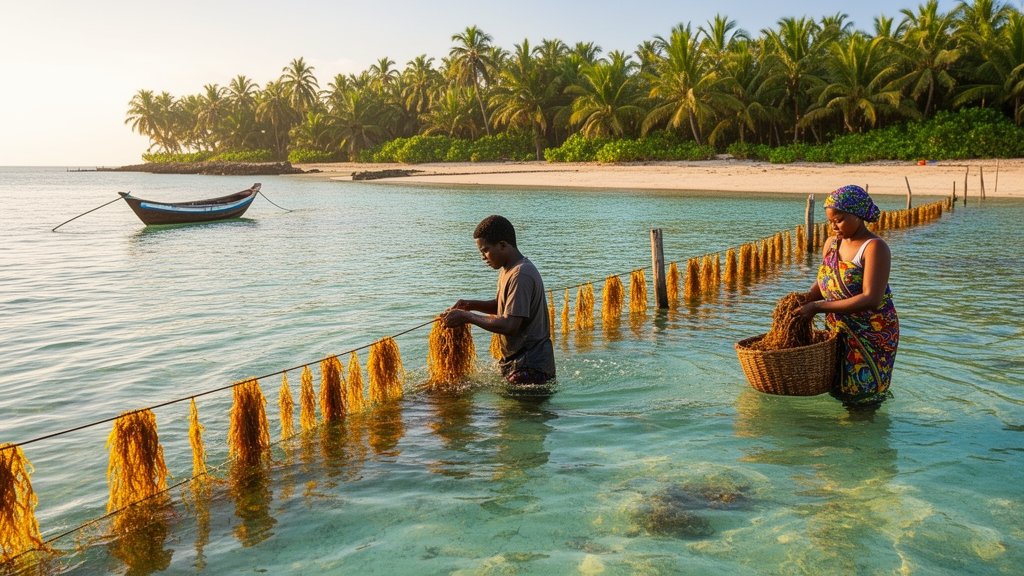
On the small island of Nosy Boraha, off Madagascar’s northeastern coast, an unusual agricultural boom is unfolding beneath the surface of a shallow turquoise lagoon. Farmers wade through water barely five meters deep, tying fragments of a reddish seaweed known locally as cottonii to lines anchored in the sand. The crop, Kappaphycus alvarezii, is prized worldwide as a source of carrageenan, a gelling agent that ends up in everything from ice cream to toothpaste. As wild fish stocks around the island decline, seaweed farming has emerged as a vital supplementary income for villagers such as those of Ilampy, and it has been folded into Madagascar’s national blue economy strategy as a flagship of sustainable coastal development. Yet a new interdisciplinary study published in PLOS Sustainability and Transformation suggests that the story of this booming aquaculture is far more intricate than a simple success narrative, weaving together ecology, anthropology, and environmental law in a single portrait of a lagoon under change.
The research, led by Isabel Urbina-Barreto of the IRD and colleagues including Rindra Razandriarison, Aline Tribollet, and a team spanning French and Malagasy institutions, set out in 2024 to answer questions that most single-discipline studies leave unasked. What does seaweed cultivation actually do to the benthic habitats of a tropical lagoon? How do the farmers themselves experience this new livelihood? And which rules, formal or customary, govern who may farm where? The team combined marine ecological surveys, remote sensing from satellites and drones, nutrient chemistry, anthropological fieldwork, and legal analysis into one integrated assessment. This kind of triangulation is rare in aquaculture research, where environmental monitoring and social science often proceed on separate tracks, and it allowed the researchers to see connections that would otherwise remain invisible.
The physical stage for this activity is the north reef lagoon of Nosy Boraha, an environment the team mapped in detail using satellite and drone imagery. They estimated its extent at roughly 600 hectares, a shallow basin sheltered by a coral reef crest and floored predominantly by sandy substrates colonized by macrophytes. Within the zones used for seaweed cultivation, the ecologists identified four genera of seagrass and three genera of macroalgae, while coral communities, made up of approximately four genera, were found mainly concentrated near the reef crest, at some distance from the main farming areas. This spatial arrangement matters: the corals that give the reef its structural complexity and its role as a fish nursery occupy a distinct band of the lagoon, and understanding whether farming activities encroach on them is central to judging the sustainability of the industry.
The scale of cultivation is more modest than the headline numbers might suggest. The company Nosy Boraha Seaweed holds rights to operate across about 300 hectares of the lagoon, an area that sounds enormous until one learns that the actual cultivation plots cover only 8.3 percent of that concession. The rest remains, for now, untouched lagoon bottom. This gap between leased area and farmed area is a crucial detail for managers, because it means the ecological footprint of the industry today is far smaller than its legal footprint, but also that there is substantial room for expansion within existing permits. Whether that expansion proceeds without degrading the lagoon will depend on the environmental safeguards that accompany it, a question the study addresses directly.
To probe those safeguards, the researchers measured nutrients in the water, comparing dissolved inorganic nitrogen and phosphate levels inside farming zones with control areas where no seaweed was grown. The results were nuanced. Nutrient uptake was detected both within the cultivation areas and in the control zones, a pattern that complicates any simple claim that the seaweed farms are either cleaning or polluting the lagoon. Seaweeds are known to absorb dissolved nutrients as they grow, which is one reason aquaculture is often promoted as environmentally benign, but the presence of uptake signals outside the farms indicates that other processes, from seagrass metabolism to water exchange with the open ocean, also shape the lagoon’s nutrient budget. The finding underscores how much basic biogeochemical monitoring is still needed before broad ecological verdicts can be rendered.
On the social side, the anthropological component of the study painted a picture of opportunity shadowed by hardship. For residents of Ilampy and neighboring villages, seaweed farming provides an important supplementary livelihood at a time when fisheries resources are declining, offering cash income in a region where alternatives are scarce. But farmers reported challenging working conditions, and many expressed concerns about the potential impacts of the farms on coral reefs and on traditional fishing grounds. These worries are not abstract. In a coastal community, the same lagoon that hosts seaweed lines also sustains the gillnets and hand lines that have fed families for generations, and any perceived competition for space or perceived degradation of habitat strikes at the heart of local food security. The researchers found that these anxieties coexist with genuine enthusiasm for the income the crop brings, producing a community negotiating its own relationship with a new industry in real time.
Perhaps the most distinctive contribution of the study lies in its legal analysis, which examined not only national legislation but also the local customary law known as Dina. In Nosy Boraha, the Dina is grounded in the Fihavanana principle, a deeply rooted Malagasy ethic of solidarity and reciprocity that governs relationships within and between communities. The researchers found that the Dina plays a central role in managing marine resources on the island, operating alongside formal governance structures led by local fisheries committees and by Madagascar’s Ministry of Environment and Ministry of Fisheries and the Blue Economy. This layered system means that the fate of the lagoon is not decided solely in ministries in Antananarivo, but also in village assemblies where customary norms carry real weight. For conservation planners, the message is clear: any sustainable management scheme for seaweed aquaculture must engage the Dina, not merely the statute books.
The interplay between customary and formal law is particularly significant because Madagascar’s blue economy strategy envisions seaweed farming as a growth sector, and pressure to expand concessions is likely to increase. The study’s findings suggest both promise and caution. The industry’s current physical footprint is small, the farmed plots sit largely away from the coral-rich reef crest, and the crop requires no feed, no fertilizer, and no freshwater, making it inherently less burdensome than many forms of aquaculture. At the same time, the nutrient signals detected across the lagoon, the farmers’ own concerns, and the sensitivity of coral communities near the crest all argue for careful spatial planning, continued monitoring, and genuine community participation before the cultivated area grows toward the full 300-hectare concession.
What makes the Nosy Boraha case resonate far beyond Madagascar is the method itself. By bringing ecologists, anthropologists, and legal scholars to the same lagoon at the same time, the research produced a picture in which satellite maps, nutrient measurements, farmers’ testimonies, and customary rules each illuminate the others. A purely ecological study might have concluded that the farms pose limited risk to corals; a purely social study might have celebrated a welcome new livelihood; a purely legal study might have catalogued the statutes without noticing that the Dina does much of the real governing. Only together do these lenses reveal the true texture of a coastal transformation in progress, with all its tensions and trade-offs intact.
As global demand for carrageenan continues to rise and tropical nations search for blue economy opportunities, Nosy Boraha offers an early and instructive test case. The island’s farmers, its reef, and its customary institutions are together writing the rules of an industry that could either support coastal communities for decades or erode the very resources they depend upon. The study by Urbina-Barreto and colleagues does not deliver a final verdict, and it is candid that key questions, from long-term nutrient dynamics to the cumulative effects of expansion, remain open. But it demonstrates something equally valuable: that sustainable aquaculture in places like Nosy Boraha will be built not from a single scientific discipline or a single legal instrument, but from the patient integration of ecology, livelihood, and law, anchored in the principle of Fihavanana that has long held the island’s communities together.
Subject of Research: Interdisciplinary assessment of the environmental, social, and legal dimensions of Kappaphycus alvarezii seaweed farming in the Nosy Boraha lagoon, Madagascar
Article Title: Towards sustainable seaweed aquaculture in Nosy Boraha, Madagascar: Insights from social and ecological sciences
Article References: Urbina-Barreto, I., Razandriarison, R., Ralison Andrianantoandro, O. N. A., Chauvin, A., Solofoharimanana, H., Lagoutte, E., Stoica, G., David, V., Cuet, P., Andrianaivoravelona, D., Museux, M., Jan, S., & Tribollet, A. (2026). Towards sustainable seaweed aquaculture in Nosy Boraha, Madagascar: Insights from social and ecological sciences. PLOS Sustainability and Transformation, 5(5), e0000241. https://doi.org/10.1371/journal.pstr.0000241
Image Credits: AI Generated
DOI: 10.1371/journal.pstr.0000241
Keywords: seaweed aquaculture, Kappaphycus alvarezii, Madagascar, Nosy Boraha, blue economy, coral reefs, seagrass, customary law, Dina, Fihavanana, lagoon ecology, coastal livelihoods
Cite Scienmag News
Gavin Prescott. (October 8, 2026). Seaweed Farming on a Madagascar Island Balances Livelihoods and Lagoon Health. Scienmag. https://scienmag.com/seaweed-farming-on-a-madagascar-island-balances-livelihoods-and-lagoon-health/
Gavin Prescott. "Seaweed Farming on a Madagascar Island Balances Livelihoods and Lagoon Health." Scienmag, 8 October 2026, https://scienmag.com/seaweed-farming-on-a-madagascar-island-balances-livelihoods-and-lagoon-health/. Accessed 8 October 2026.
Gavin Prescott. "Seaweed Farming on a Madagascar Island Balances Livelihoods and Lagoon Health." Scienmag. October 8, 2026. https://scienmag.com/seaweed-farming-on-a-madagascar-island-balances-livelihoods-and-lagoon-health/


