


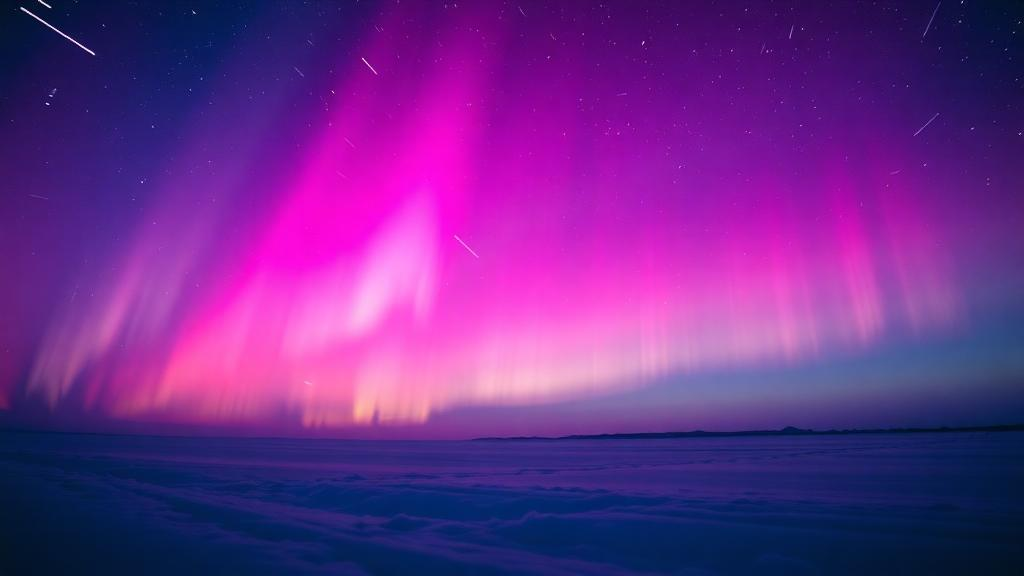
For centuries, the northern lights have dazzled observers with curtains of green and red light that ripple across polar skies. But beneath the slow, majestic dance visible to the naked eye lies a far more frantic performance: a phenomenon known as flickering aurora, in which patches of light blink on and off several times per second. Now, a team of space physicists has captured this rapid shimmering across an unprecedented swath of sky, revealing that different stretches of the same auroral arc can pulse to entirely different beats at the same moment — and that these rhythms travel along with the arc itself. The findings, published in the journal Annales Geophysicae, offer a rare window into invisible processes unfolding thousands of kilometers above our heads.
The study, led by Sota Nanjo of the Swedish Institute of Space Physics in Kiruna, together with colleagues from Kyoto University, Nagoya University, and the Okinawa Institute of Science and Technology, relied on a scientific CMOS camera fitted with a diagonal fisheye lens at the Poker Flat Research Range in Alaska. On 8 February 2016, the system recorded 512-by-512-pixel images at a blistering 80 frames per second, covering a full 180-degree field of view. That combination of speed and breadth is what makes the new observations special. Earlier studies of flickering aurora almost always used narrow-field cameras, which resolve the tiny, kilometer-scale flickering patches in exquisite detail but lose all context of how the blinking is organized along an auroral arc that can stretch for hundreds of kilometers.
Flickering aurora was first identified in 1968 as a rapid, roughly 10-hertz fluctuation within bright auroral displays. The modulation is subtle — typically only 10 to 20 percent of the background brightness — and the blinking patches are small, just a few kilometers across. Decades of rocket, radar, and optical work have converged on a compelling explanation: the flickering is driven by electromagnetic ion cyclotron waves, or EMIC waves, generated in the auroral acceleration region at altitudes of roughly 4,000 to 8,000 kilometers. Sounding-rocket measurements have caught field-aligned bursts of electrons oscillating in step with the optical flickering, and the cyclotron frequencies of oxygen-ion EMIC waves at those altitudes match the observed blink rates remarkably well.
The exact mechanism remains debated. One influential model, proposed by Michael Temerin and colleagues in 1986, suggests that EMIC waves create an oscillating electric potential that resonantly accelerates low-energy electrons downward, modulating the electron flux at the wave frequency. A competing picture, advanced by J. P. McFadden and co-workers a year later, holds that the waves periodically perturb and release cold electrons trapped in the acceleration region, letting them fall through the auroral potential drop. More recent theoretical work by K. Sakanoi and colleagues, along with numerical simulations by Björn Gustavsson’s team, has emphasized that the complex spatiotemporal patterns of flickering arise from interference among multiple dispersive Alfvén or EMIC waves rather than from any single wave. The new wide-field observations speak directly to this interference-based framework.
During the Alaskan observing campaign, a faint east–west arc appeared around 06:20 Universal Time and intensified into a classic discrete auroral arc by about 06:30. From that point onward, patch-like blinking regions became detectable within the arc, and the display persisted for roughly an hour before fading as a bright bulge propagated westward. Applying fast Fourier transforms to the pixel-by-pixel brightness time series, the researchers found that flickering occurred intermittently across a frequency range of 3 to 20 hertz, with most of the power concentrated between 4 and 12 hertz — squarely within the band expected for oxygen-ion cyclotron waves generated several thousand kilometers up.
The most striking discovery came from mapping the dominant flickering frequency across the sky. Rather than flickering randomly, the arc organized itself into coherent clusters of similar periodicity, some extending more than 10 kilometers. In one particularly revealing second of data, a region flickering at around 8 hertz coexisted simultaneously with another region pulsing at about 13 hertz, separated by roughly 150 kilometers along the same arc. The team argues that such a large separation is difficult to reconcile with a single localized wave source feeding one resonance cone. Instead, multiple wave sources appear to be distributed along the arc, each shaped by its own local plasma environment — electron density, ion composition, and the field-aligned potentials known as inverted-V structures that power discrete aurora.
Remarkably, some of these frequency clusters moved together with the background arc. Comparing frequency maps separated by just four seconds, the researchers tracked a 7-to-8-hertz cluster drifting eastward in lockstep with the auroral form it accompanied. This co-migration suggests that the wave frequencies are not dictated simply by large-scale parameters such as magnetic latitude, but are tightly bound to the local plasma conditions and potential structures hosted by the arc at any given moment. If the dominant frequency reflects the local oxygen-ion cyclotron frequency, the 8- and 13-hertz bands would correspond to wave sources at altitudes of roughly 6,000 and 3,800 kilometers respectively — neighboring field lines hosting waves born at different heights.
To probe the relationship between patch size and blink rate, the team developed an automated detection scheme based on keograms, time-stacked cross sections of the images. Individual case studies initially hinted at a dispersion-like behavior: during stable intervals, larger patches tended to flicker more slowly, with 7-to-11-kilometer patches pulsing near 4 hertz while 3-to-5-kilometer patches some 20 kilometers away blinked near 14 hertz. But when the researchers compiled statistics on 23,704 detected patches over the full hour, the trend evaporated. The mean flickering frequency held steady at about 8 plus-or-minus 4 hertz regardless of patch size, and the typical apparent north–south patch dimension was 4.4 plus-or-minus 2.4 kilometers when projected to an assumed emission altitude of 110 kilometers. Robustness checks on viewing geometry, detection thresholds, and projection altitude confirmed the null result.
That statistical absence of a frequency–size relation is itself scientifically meaningful. If flickering were produced by a single wave mode, the dispersion relation of obliquely propagating EMIC waves should imprint a clean connection between frequency and perpendicular wavelength. The fact that it does not persist supports the interference picture, in which the optical scale reflects the standing-wave pattern formed by multiple superposed waves — a scale plausibly set by the electron inertial length in the acceleration region. Intriguingly, during moments when the arc was stable and a single frequency dominated, the observed frequency–size combinations did not conflict with the oxygen-EMIC dispersion relation, hinting that the patch scale could even serve as a diagnostic of the modulation altitude, mapping to electron inertial lengths of order 100 to 400 meters in the source region.
The observations also captured when flickering refuses to appear. As the arc narrowed and surged equatorward in the minutes before a substorm onset, the blinking vanished — even as the aurora brightened sharply. Meanwhile, a broader, latitudinally wider discrete aurora on the poleward side continued to flicker. The authors suggest that the growth of EMIC waves, driven by instabilities in the precipitating electron beam, depends sensitively on plasma parameters such as background electron density, which may have shifted unfavorably along the onset arc, while resonance conditions were maintained along the broader polar-side display. Because the study rests on optical imaging alone, without conjugate in-situ wave measurements, the EMIC interpretation remains a consistency argument rather than a direct wave identification. Still, by extending flickering aurora research from narrow keyholes to a mesoscale panorama, the work demonstrates that the visible shimmer of the northern lights encodes the microscopic physics of wave–particle interactions — and that reading it requires nothing more than a fast camera, a fisheye lens, and a polar night.
Subject of Research: Mesoscale structure and EMIC wave generation of flickering aurora observed by wide-field high-speed imaging
Article Title: Mesoscale structure of flickering aurora from wide-field high-speed imaging
Article References: Mesoscale structure of flickering aurora from wide-field high-speed imaging. (n.d.). https://doi.org/10.5194/angeo-44-959-2026
Image Credits: AI Generated
DOI: 10.5194/angeo-44-959-2026
Keywords: flickering aurora, aurora, EMIC waves, space physics, magnetosphere, auroral acceleration region, high-speed imaging, sCMOS camera, Poker Flat Research Range, electron precipitation, substorm, ionosphere
Cite Scienmag News
Violet Maxwell. (October 8, 2026). High-speed camera reveals the hidden rhythms of flickering aurora. Scienmag. https://scienmag.com/high-speed-camera-reveals-the-hidden-rhythms-of-flickering-aurora/
Violet Maxwell. "High-speed camera reveals the hidden rhythms of flickering aurora." Scienmag, 8 October 2026, https://scienmag.com/high-speed-camera-reveals-the-hidden-rhythms-of-flickering-aurora/. Accessed 8 October 2026.
Violet Maxwell. "High-speed camera reveals the hidden rhythms of flickering aurora." Scienmag. October 8, 2026. https://scienmag.com/high-speed-camera-reveals-the-hidden-rhythms-of-flickering-aurora/


