

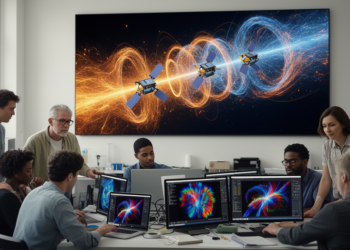
Citizen Scientists Help Classify Eight Years of Earth’s Magnetosheath Data From MMS
Volunteers on the Zooniverse platform helped classify 35,483 one-minute intervals of MMS magnetosheath data, yielding a large labeled dataset for ...
Volunteers on the Zooniverse platform helped classify 35,483 one-minute intervals of MMS magnetosheath data, yielding a large labeled dataset for ...

By detecting solar electrons reflected from Earth's bow shock, scientists using the ACE spacecraft have measured the curvature and wandering ...
Using high-speed cameras and hierarchical machine learning, researchers have for the first time quantified the rapid internal flicker within pulsating ...
For the first time, scientists have directly observed ultra-low frequency waves in Earth's magnetosphere driving ions upward from the polar ...
The first statistical survey of the mysterious dune aurora, built from 308 citizen science reports, shows the phenomenon favors the ...
New kinetic modeling and Monte Carlo simulations reveal that radio-wave heating drives D region electrons into sharply non-Maxwellian distributions, undermining ...
Wide-field, high-speed imaging in Alaska has revealed that flickering aurora organizes into distinct frequency clusters along a single arc, supporting ...
NASA's Juno spacecraft has revealed that Jupiter's magnetodisk current sheet is crumpled into a rippling, wave-like structure by numerous small-scale ...
Two rocket missions organized by NASA are set to explore the enigmatic phenomena of auroras over Alaska, opening a window ...

Embark on a thrilling journey of discovery with Scienmag.com—your ultimate source for cutting-edge breakthroughs. Immerse yourself in a world where curiosity knows no limits and tomorrow’s possibilities become today’s reality!