


Few things in the solar system are genuinely invisible, yet the long, winding paths of magnetic field lines in the solar wind come close. These open field lines, rooted in the Sun and stretched into vast Parker spirals by the solar rotation, do not hold still. They wander, kink, and braid as they sweep past the planets, and those motions matter enormously: they shape how energetic charged particles race outward from solar storms, how cosmic rays scatter through the heliosphere, and how the Sun’s magnetic architecture is threaded through interplanetary space. The trouble has always been measurement. A single spacecraft crossing this shifting magnetic landscape records only a one-dimensional slice of a three-dimensional phenomenon, and inferring the true length scales of field-line wandering along the direction of the mean magnetic field has been a notoriously stubborn problem for decades.
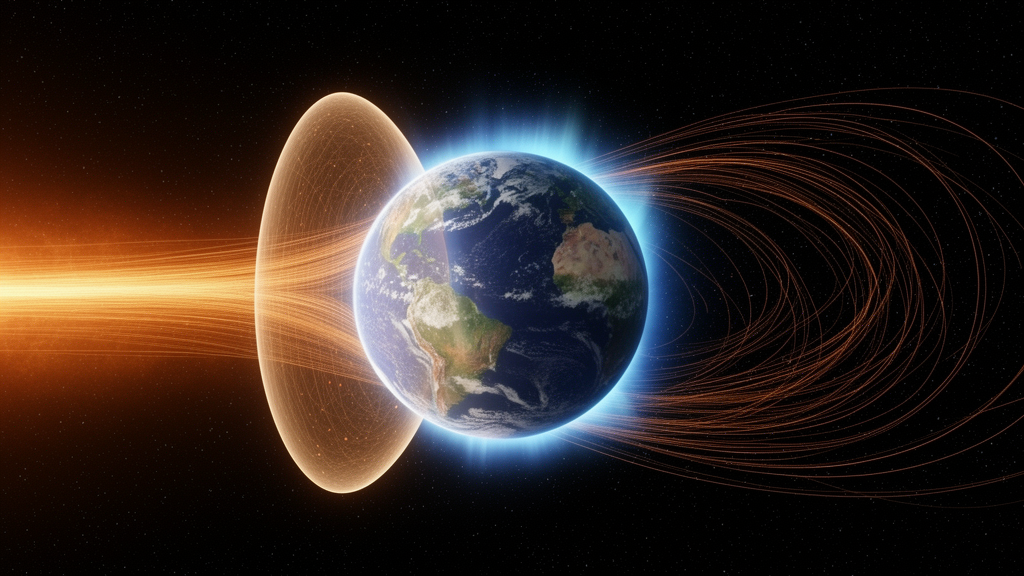
A new study by Joseph E. Borovsky of the Space Science Institute and John T. Steinberg has turned an elegant trick to overcome that limitation. Their insight is that Earth itself provides a beacon. On rare but frequent-enough occasions, a solar-wind magnetic field line happens to thread simultaneously through a spacecraft stationed a million and a half kilometers sunward of Earth and through our planet’s bow shock, the great magnetic barrier where the solar wind slams into Earth’s magnetosphere. When that happens, electrons streaming along the field line bounce off the shock and travel back upstream to the spacecraft, announcing the connection in unmistakable fashion. The researchers exploited exactly that signature, harvesting a remarkable catalog of 12,625 magnetic-connection events recorded by NASA’s Advanced Composition Explorer, or ACE, during sixteen months of measurements spanning 1998, 2006, and 2007.
The key diagnostic is a population of suprathermal electrons known as the strahl. These field-aligned beams originate in the solar corona and stream outward through the solar wind almost continuously, and the ACE SWEPAM instrument routinely detects them at an energy of 272 electron-volts. When a field line links ACE to the bow shock, some of those outward-streaming electrons strike the shock, are reflected, and head back toward the Sun along the same line. The result at ACE is a telltale pattern of counterstreaming electron beams, with bursts of sunward-traveling electrons appearing opposite the ever-present solar strahl in the measured pitch-angle distributions. Because counterstreaming can also arise in coronal mass ejections, at interplanetary shocks, near sector boundaries, and in corotating interaction regions, the team rigorously excluded those circumstances, screening out intervals within twelve hours of such plasma regions and twenty-four hours around known interplanetary shocks.
Once a connection is established, the geometry becomes a solvable puzzle. The event hands the researchers two points known to lie on the same field line, ACE and Earth, together with the magnetic-field direction measured at one of them. In their first analysis, the team approximated the field-line shape as a circular arc connecting the two points, with the tangent at ACE fixed by the measured field. A circle passing through two points with a specified tangent at one is unique, so the radius of curvature can be computed for every event. It is admittedly a crude simplification, since real field lines are more like tangled spaghetti than clean arcs, but the circle yields the weakest estimate of the local curvature that ACE would see, making it a conservative choice. Fitting this model across the full event catalog produced a median radius of curvature of about 370 Earth radii, or roughly 0.016 astronomical units, with a mean of about 513 Earth radii.
The second analysis pushed from local curvature toward a more global measure of the wandering. Here the team modeled the field line as a sinusoidal perturbation superimposed on the Parker-spiral direction, a wave-like wiggle propagating away from the Sun along the spiral while being carried radially outward by the solar-wind flow. No one believes the real field lines take the shape of perfect sine waves, and the authors are candid that a sharper, hyperbolic-tangent-like kink would better describe the displacement expected from magnetic reconnection events in the corona. But the sine model is analytically tractable, and it captures the essential length scale. By fixing the wave amplitude at 0.6 times its wavelength, a choice anchored in the observed statistics of magnetic-field-direction fluctuations about the Parker spiral at 1 AU, the researchers could solve for the wavelength in each event using three measured quantities: the ACE-to-Earth distance, the angle between the measured field and the Parker spiral, and the angle between the Earth-line and the spiral.
Of the many connection events, 998 yielded valid sine-wave solutions, and the resulting distribution of wavelengths skews long with a pronounced tail. The median wavelength came out at about 1,700 Earth radii, equivalent to roughly 0.072 AU, or about ten million kilometers. The mean, at 2,300 Earth radii or 0.097 AU, is inflated by that tail, and the authors argue the median better represents the bulk of the field-line population. Encouragingly, the two independent approaches corroborate one another: for a sine wave with amplitude 0.6 times its wavelength, the expected median radius of curvature should be about 0.39 times the wavelength, and the measured ratio of 370 Earth radii to 1,700 Earth radii lands within a factor of two of that expectation. That internal consistency gives the coarse geometric models real credibility.
The assumptions deserve scrutiny, and the authors examine them directly. Earth’s bow shock is not a point target; viewed from the L1 region it subtends an angular radius of several degrees, so field lines hitting anywhere on its sunward face could produce backstreaming electrons, which would bias the curvature estimates toward smaller values. The team also considered where on the shock the reflections occur. A global magnetospheric simulation shows the bow shock’s density compression ratio, a proxy for how effectively it dissipates energy and reflects particles, falls from nearly 4 at the nose to about 1.6 far down the flanks, suggesting that most detectable backstreaming comes from the shock nose, consistent with the paper’s central assumption. The study also found that connection events cluster heavily in coronal-hole and streamer-belt plasma, the two most common solar-wind types, and are rare in ejecta and sector-reversal regions, where pre-existing counterstreaming strahl or weak strahl make terrestrial backscatter hard to spot. During connections, the angle between the measured field and the Earth-line was less than 30 degrees in 70 percent of samples, matching earlier ISEE-3 results from the 1980s.
What makes the numbers compelling is how they stack up against completely independent length scales. The wandering scale of 0.072 AU sits right at the bottom of the well-established Palmer consensus range of 0.08 to 0.3 AU for the field-aligned mean free path of cosmic rays scattering in interplanetary space, a tantalizing hint that field-line geometry may underpin particle transport. It also falls within the range of braiding lengths expected from solar surface motions. Advection of granule lifetimes of a few hundred seconds outward at typical solar-wind speeds gives scales far shorter than observed, but supergranule lifetimes of roughly 19 hours yield braiding lengths around 0.19 AU, squarely in range. Still more suggestive are estimates based on interchange reconnection, the process by which open coronal flux tubes repeatedly reconnect with closed loops. Flux-recycling timescales in the low corona ranging from about 1.4 hours to 40 hours, advected outward, produce parallel scales from 0.013 to 0.38 AU, bracketing the measured wandering scale, and a detailed analysis of the kink geometry from coronal reconnection simulations even reproduces the adopted amplitude-to-wavelength ratio of 0.6.
The big picture is that the braided, wiggling heliospheric magnetic field appears to carry the imprint of processes occurring millions of kilometers away, at the churning solar surface and in the low corona, and it preserves that imprint all the way to Earth’s orbit. Where earlier single-spacecraft studies could reliably measure fluctuations perpendicular to the mean field but struggled along it, often being fooled by tilted current-sheet walls of magnetic flux tubes, this technique converts Earth’s bow shock into a reflector beacon that illuminates the structure parallel to the spiral. The method is coarse, the geometry deliberately simple, and the scatter in individual estimates large, but with more than twelve thousand events the statistics become robust. As a demonstration that particles and fields from a single spacecraft can probe structures along the mean heliospheric field, the work opens a genuinely new observational window, one that future missions studying the Sun-Earth connection, from space-weather monitoring to energetic-particle hazard assessment, may find increasingly valuable as they seek to trace the invisible highways along which the Sun’s influence travels.
Subject of Research: Length scales of magnetic-field-line wandering in the solar wind measured via ACE–Earth magnetic-connection events
Article Title: Estimating the length scales of magnetic-field-line wandering in the solar wind at 1 AU: ACE–earth magnetic-connection events
Article References: Borovsky, J. E., & Steinberg, J. T. (2026). Estimating the length scales of magnetic-field-line wandering in the solar wind at 1 AU: ACE–earth magnetic-connection events. Frontiers in Astronomy and Space Sciences, 13, Article 1916524. https://doi.org/10.3389/fspas.2026.1916524
Image Credits: AI Generated
DOI: 10.3389/fspas.2026.1916524
Keywords: solar wind, magnetic field lines, Parker spiral, electron strahl, bow shock, ACE spacecraft, space physics, turbulence, cosmic ray scattering, interchange reconnection, heliophysics, L1 Lagrange point
Cite Scienmag News
Katie Riggs. (October 16, 2026). Earth’s Bow Shock Doubles as a Cosmic Ruler for Wandering Solar Wind Field Lines. Scienmag. https://scienmag.com/earths-bow-shock-doubles-as-a-cosmic-ruler-for-wandering-solar-wind-field-lines/
Katie Riggs. "Earth’s Bow Shock Doubles as a Cosmic Ruler for Wandering Solar Wind Field Lines." Scienmag, 16 October 2026, https://scienmag.com/earths-bow-shock-doubles-as-a-cosmic-ruler-for-wandering-solar-wind-field-lines/. Accessed 16 October 2026.
Katie Riggs. "Earth’s Bow Shock Doubles as a Cosmic Ruler for Wandering Solar Wind Field Lines." Scienmag. October 16, 2026. https://scienmag.com/earths-bow-shock-doubles-as-a-cosmic-ruler-for-wandering-solar-wind-field-lines/


