

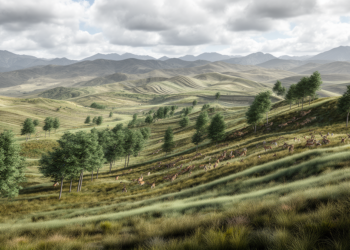
Landscape thinking models adaptation in turbulent environments
A computational NK-landscape study shows how variable interdependencies, early positions and changing local options can shape organizational adaptation under turbulence.
A computational NK-landscape study shows how variable interdependencies, early positions and changing local options can shape organizational adaptation under turbulence.

Simulations driven by Oklahoma wind farm measurements reveal that turbine wakes shift from coherent swaying to chaotic multi-mode turbulence within ...
A tethered balloon instrument flown over Finnish Lapland in September 2022 has produced an open, high-resolution dataset of turbulence and ...
By detecting solar electrons reflected from Earth's bow shock, scientists using the ACE spacecraft have measured the curvature and wandering ...
A new analytical study presents an explicit vortex solution of the compressible Euler equations at large Mach numbers in which ...
Wind-tunnel experiments in Inner Mongolia reveal that fine dust particles settle most efficiently at a gentle breeze of about 2 ...
A new quantitative application of non-isothermal sound generation theory to the Sun's convection zone shows that temperature gradients leave total ...
A new open-source C++ library called FFTM brings portable distributed 3D and 4D fast Fourier transforms to CUDA and HIP ...
A detailed radio map of molecular gas in Stephan's Quintet shows that turbulent gas motions suppress star formation even where ...
New simulations benchmarked against aircraft observations over New Zealand show that resolving mountain waves and their turbulence demands kilometer-scale grids ...

Embark on a thrilling journey of discovery with Scienmag.com—your ultimate source for cutting-edge breakthroughs. Immerse yourself in a world where curiosity knows no limits and tomorrow’s possibilities become today’s reality!