
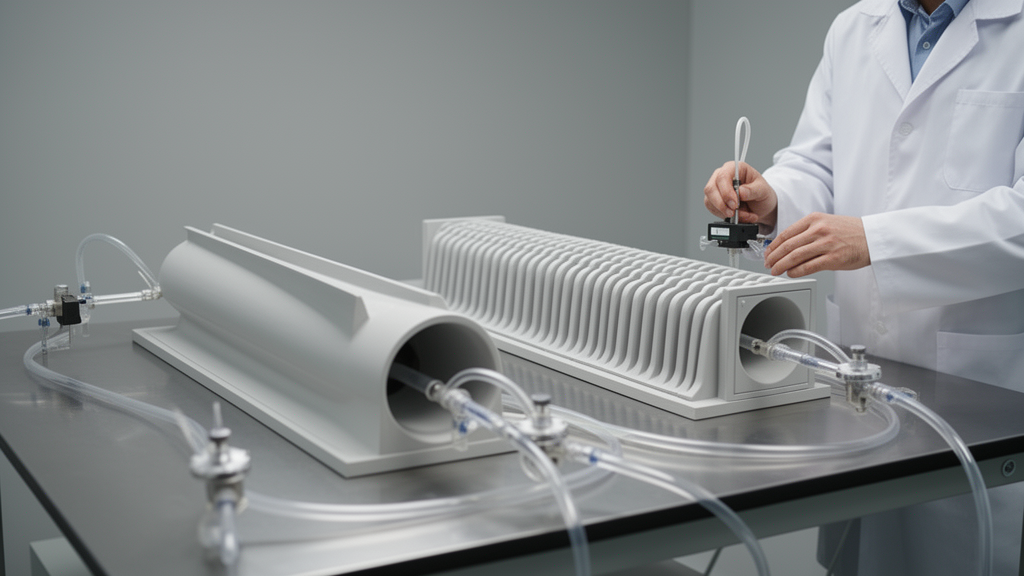
Turbulence has resisted a century of attempts at tidy mathematical description, yet engineers still need to measure it in the laboratory, where budgets and floor space force them to shrink their experiments. A new study argues that the familiar practice of building one scaled-down model is fundamentally limited, and that a second, differently scaled model can be combined with the first to recover full-scale turbulent behaviour with striking accuracy. The work, published in Discover Fluid Mechanics, develops a scaling theory called finite similitude and demonstrates it on pipe flow, a dam break, fluid mixing and weir overflow.
The problem the paper targets is scale effects. When engineers build a smaller version of a full-scale system, the behaviour of the flow and any associated machinery changes under scaling, which makes scaled models unrepresentative in many situations. For roughly a hundred years, scaled experiments in fluid mechanics have been underpinned by dimensional analysis, in which equations are written in dimensionless form under the assumption that those equations do not change form under scaling. The authors argue that the presence of scale effects means the form of the dimensional equations has changed, which is a major problem for that approach, because dimensional analysis effectively neglects scale effects rather than embracing them.
Finite similitude takes a different route. The theory is founded on a metaphysical concept that cannot be physically enacted: space scaling, an imagined smooth process in which experimental facilities are scaled down or up by space contraction or expansion. Although infeasible in practice, the process can be represented mathematically, allowing its effect on governing equations to be gauged. A positive real parameter called beta quantifies length-scale differences between the physical space, where the full-scale equipment sits, and the trial space, where the scaled equipment resides. Contraction corresponds to beta less than one, expansion to beta greater than one, and no scaling to beta equal to one.
The machinery of the theory rests on control volumes, which are central to fluid mechanics generally. Moving control volumes in the trial and physical spaces are synchronised by a similitude rule, and the physics described in the trial space is projected onto a new space called Omega-beta. This projected space matches the physical space both spatially and temporally, so it can be treated as a real physical space in its own right, furnished with physics projected from the trial space. Crucially, the theory shows that Omega-beta and the physical space are identical dimensionally, which links finite similitude to an extended form of dimensional analysis while exposing all possible scale dependencies that dimensional analysis hides.
The similitude rules themselves are exact differential identities, and each rule connects a particular number of scaled experiments. The rule for one scaled experiment is called zeroth-order finite similitude and is equivalent to dimensional analysis in the sense that both are restricted to proportional fields. First-order rules involve two scaled experiments, and the paper proves an extraordinary result: the first-order finite-similitude rule applies exactly to a Newtonian fluid in a gravitational field. Although the momentum equation appears to contain a second-order term, because convection introduces a product of two velocity fields, the authors show it behaves as a first-order term when constrained by the governing equations. The upshot is a theorem stating that turbulent flow of a Newtonian fluid in a gravitational field can be perfectly replicated by two scaled models, with material properties such as density, viscosity and gravity matched across the scales.
The authors also checked whether popular turbulence models survive scaling intact. They examined Reynolds-averaged Navier-Stokes approaches with k-epsilon and k-omega closures, and large eddy simulation. Under the theory, the Boussinesq hypothesis, the most commonly applied closure rule, is consistent with first-order scaling, with turbulence eddy viscosity of order one. The k-epsilon and k-omega models are likewise consistent with first-order scaling, returning first-order turbulent kinetic energy in both cases, while the dissipation rates epsilon and omega are first and approximately zeroth order respectively. LES models are also consistent, with order-one returns for turbulent kinetic energy and eddy viscosity. This consistency matters because it means scaled designs can be analysed with standard modelling tools rather than bespoke ones.
The case studies put the two-experiment claim to the test. The first revisits the empirical Darcy-Weisbach law for head loss in a pipe, using the Haaland formula for the friction factor in fully developed turbulent flow. A full-scale pipe carrying oil, 500 metres long with a 0.2-metre diameter and an average velocity of 5 metres per second, was represented by two trial models scaled to 0.6 and 0.5 of full size. When each trial model’s results were projected individually, they missed the full-scale head loss badly, with errors of 363 percent and 700 percent. The virtual model, formed by combining the two projected results with a weighting derived from the theory, returned zero error, exactly as the first-order rule predicts.
The second case study tackled a dam break, a benchmark problem in which a sudden release of water poses risks to surroundings, structures and people. Gravity-driven flows pose a unique challenge because velocity and acceleration cannot simply be adjusted at the boundaries to compensate for scaling. Using the OpenFOAM code with a k-epsilon turbulence model, validated against a published experiment, the team found that the individually projected trial models, scaled to 0.8 and 0.5 of full size, carried errors of roughly 50 to 52 percent and 88 to 90 percent in replicating the full-scale pressure distribution. The virtual model cut pressure errors to between 2 and 5 percent at five measurement points. Turbulent kinetic energy errors of 51 and 89 percent fell to around 3 percent, and eddy-viscosity errors of 23 and 49 percent fell to 9 percent, all with no adjustable parameters in the combination rule.
The remaining studies extended the demonstration. For the gravity-driven mixing of two initially stationary liquids of different densities, a classical stability problem in which turbulence emerges from shear at the interface, projected models showed errors of 80 and 89 percent in pressure, which the first-order rule reduced to less than 2 percent; turbulent kinetic energy errors fell from about 66 percent to about 5 percent and eddy-viscosity errors from about 77 percent to about 6 percent. Two weir overflow studies, simulated with large eddy simulation in OpenFOAM and benchmarked against published experiments, showed double-digit percentage errors in the individual projections that collapsed to low single digits, between 0.8 and 3.6 percent for velocity and between 0.24 and 2.89 percent for eddy viscosity and turbulent kinetic energy, when the first-order rule was applied.
The practical message is that a laboratory equipped with two scaled models, rather than one, may be able to reproduce full-scale turbulent behaviour that neither model could capture alone. The authors note that the scaling factors are typically constrained by practical considerations such as the size of the system and laboratory facilities, and that although the similitude rule is exact, numerical or experimental errors can diminish its value if the two scales are placed too close together. The theory makes no reference to constitutive laws, yet accommodates them, and it applies to compressible and incompressible flows alike. Whether the approach transfers from these numerical and empirical demonstrations to the full messiness of real experimental campaigns remains the obvious next question, but the paper’s central claim, that one additional scaled experiment is sufficient for good replication of turbulent behaviour, now carries a formal proof and a set of consistent demonstrations behind it.
Subject of Research: A mathematical scaling framework for designing scaled experiments that replicate turbulent fluid flows
Article Title: A mathematical framework for the design of scaled experiments featuring turbulence
Article References: Davey, K., Al-Tarmoom, A., & Sadeghi, H. (2026). A mathematical framework for the design of scaled experiments featuring turbulence. Discover Fluid Mechanics, 2(1), Article 9. https://doi.org/10.1007/s44369-026-00013-7
Image Credits: AI Generated
DOI: 10.1007/s44369-026-00013-7
Keywords: turbulence, finite similitude, scaled experiments, fluid mechanics, dimensional analysis, scale effects, Navier-Stokes, RANS, large eddy simulation, OpenFOAM, dam break, eddy viscosity
Cite Scienmag News
Audrey Campbell. (October 28, 2026). Two Scaled Models Could Tame Turbulence in the Lab. Scienmag. https://scienmag.com/two-scaled-models-could-tame-turbulence-in-the-lab/
Audrey Campbell. "Two Scaled Models Could Tame Turbulence in the Lab." Scienmag, 28 October 2026, https://scienmag.com/two-scaled-models-could-tame-turbulence-in-the-lab/. Accessed 28 October 2026.
Audrey Campbell. "Two Scaled Models Could Tame Turbulence in the Lab." Scienmag. October 28, 2026. https://scienmag.com/two-scaled-models-could-tame-turbulence-in-the-lab/