


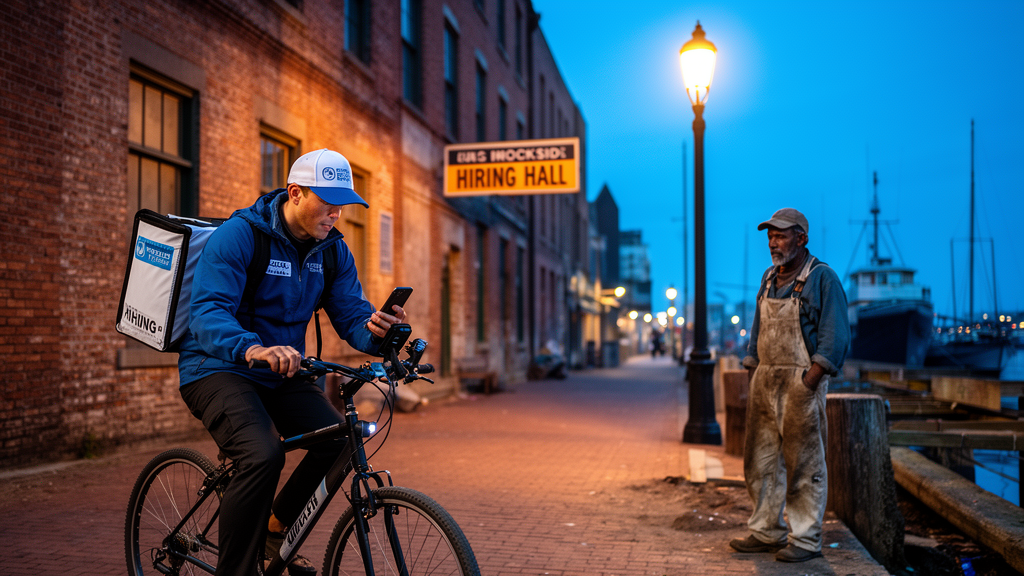
Digital platforms love to present themselves as revolutionaries. Uber, Deliveroo, Amazon Mechanical Turk and their countless siblings brand themselves as tech-driven disruptors that invented new ways of working almost out of thin air. But a new study by sociologist Moritz Altenried of the Technical University of Berlin and Mira Wallis of Humboldt University’s Berlin Institute for Empirical Integration and Migration Research argues that this story of radical novelty is largely a myth. Published in Geographica Helvetica, their paper traces the labour model of today’s platforms back through centuries of precarious work, showing that home-based labour, piece wages, day hiring and labour middlemen all existed long before the first smartphone app. What platforms have actually done, the authors contend, is reconfigure and radicalize these old techniques through digital technology.
The starting point of the argument is a challenge to the standard critique of the gig economy. Critics usually measure platform work against the benchmark of “standard employment” – the stable, full-time job with social protections that supposedly defined the post-war decades. Yet historical research, particularly Marxist feminist scholarship on social reproduction from the 1960s and 1970s onward, has shown that Fordist employment was never a universal experience, even in the Global North. It always rested on segmented, gendered and racialized labour markets marked by precarity at their margins. Seen from a global or long-term perspective, the authors argue, precarity and contingency have been the norm of waged labour throughout the history of capitalism, and the Fordist compromise was the exception. The researchers are careful to note that this does not invalidate political demands for workers’ rights – stable employment remains a powerful normative aspiration – but it does mean platforms are not disrupting a golden age that most workers ever enjoyed.
To make this case, Altenried and Wallis examine four central elements of platform labour through historical snapshots. The first is home-based labour. Today, an estimated 14 to 52 million people work from their kitchens and bedrooms on digital platforms, annotating images for artificial intelligence systems, recording sample sentences or performing remote services. The authors’ interviews with women crowdworkers reveal fragmented working days in which time becomes fluid and elastic, stretched between the demands of the global just-in-time economy and the rhythms of childcare and domestic work. This arrangement has an uncanny precedent. In the mid-nineteenth century, journalist Henry Mayhew documented London’s “sweating system”, in which clothing and shoe production ran through networks of intermediaries and subcontractors, with private homes serving as key sites of production. One widow and cloakmaker he interviewed described working from nine in the morning until eleven at night, fourteen hours being her usual day, because she could not leave her young family and had to buy all her materials in advance with no guarantee of sale.
Even Karl Marx, writing around two decades after Mayhew, recognized that home-based work was not a pre-capitalist relic but a component of industrial capitalism itself. In the first volume of Capital he described how capital sets in motion, by means of invisible threads, an army of outworkers in domestic industries scattered across towns and countryside, calling them an “external department of the factory”. Far from disappearing with the rise of the factory, home-based work recurred in cycles throughout the twentieth century – in garment stitching, candy packaging and electronics assembly within global supply chains – pushed back by trade union struggles but never eliminated, and revived repeatedly by globalization, decentralized production and, eventually, the home computer and the commercial internet. What the online gig economy adds is scale: digital technology creates what researchers call a “planetary labour market”, in which workers compete on prices at an unprecedented global level.
The second element is the piece wage. Whether a courier is paid per delivery or a crowdworker per annotated image, most platform workers are compensated for each distinct task rather than by the hour. This creates a well-documented contradiction: speeding and running red lights become a courier’s direct economic interest while simultaneously increasing their risk of injury. The authors find a striking parallel in late-twentieth-century Silicon Valley, described by David Pellow and Lisa Sun-Hee Park, where subcontracted homeworkers – largely women, people of colour and migrants from the Philippines, Vietnam, Korea, Cambodia and South America – assembled cables and inserted chips into circuit boards in their living rooms and kitchens, sometimes working around the clock at poverty wages, in some cases earning as little as a penny per component. Piecework has always served to control spatially dispersed workers without supervisors, to scale the workforce flexibly, to tap labour pools of women with children or the elderly, and to bypass labour regulations.
Marx already noted that piece wages drive workers toward self-exploitation, since it is in the worker’s interest to strain their labour-power as intensely as possible, allowing employers to raise the normal intensity of work. Frederick Taylor later refined this logic with scientifically calculated piece rates designed to eliminate unproductive time. The gig economy revives all of this but adds a decisive new component: algorithmic management. Networked apps enable constant monitoring of the labour process through activity and location tracking, so workers are not only incentivized to be efficient but can also be disciplined for low performance. Piece rates and algorithmic surveillance thus combine to intensify labour beyond anything the sweating system could achieve.
The third element is day labour – the short duration of employment and the uncertainty of future work. Amazon Flex drivers, for example, must secure “delivery blocks” of two to four hours in an app, sometimes only hours in advance, spending unpaid hours refreshing their screens in the hope that the algorithm will offer them work. In nineteenth-century Hamburg, the role of the algorithm was played by pub owners, who each morning funnelled the requested number of dock workers to employers, with selection depending heavily on how generously a worker had bought drinks the night before. Ending this arbitrary system was a central demand of the great Hamburg dock strike of 1896, in which more than 16,000 workers took part; the strike ended in near-total defeat, though it had been preceded by a more successful walkout of several hundred female coffee sorters. In New York, the notorious “shape-up” system forced dockers to compete in semicircles at the pier twice a day, while West Coast hiring halls with rotation systems became prizes won through union struggle, most famously in the 1934 waterfront strike that founded the International Longshore and Warehouse Union.
The independent contractor, the key legal figure of the gig economy, also has a pre-digital history. As US trucking was deregulated from the 1970s onward, port drivers were reclassified from employees into “owner-operators”, shifting insurance, social security and the risks of traffic jams onto the drivers themselves, who were typically paid per container. By 2014, roughly 50,000 of the 75,000 drivers at US ports were independent contractors. What has changed today is the timescale of hiring: from a full day at the docks to a few minutes for an Uber ride or seconds for a micro-task.
The fourth element is the labour intermediary. Platforms like Helpling position themselves as mere middlemen between customers and cleaners, avoiding direct contractual relationships and shifting tax and social security obligations onto workers. This model was pioneered by the temporary-labour industry. William Russell Kelly founded Kelly Office Service in postwar Detroit in 1946, hiring out “Kelly Girls” – young, white, middle-class women marketed as suitable for housewives with spare time. A 1971 advertisement famously touted the “Never-Never Girl” who never took a vacation, never asked for a raise and never cost the employer unemployment taxes. As Erin Hatton’s research shows, framing temp work as women’s work was essential to normalizing flexibilized, subcontracted labour and undermining union resistance. In 1990s Chicago, geographers Jamie Peck and Nik Theodore documented how staffing agencies deliberately clustered in poor Latino neighbourhoods to supply cheap manual labour, while Manpower’s then-director Mitchell Fromstein boasted that his industry was delivering “just-in-time employment” – the workforce as an ATM of the job market. The digital platform, the authors argue, is the temp agency’s leaner, algorithmically supercharged descendant.
The study’s conclusion is not that nothing is new. Digital platforms genuinely reconfigure historical practices, and the interplay of old labour forms with new algorithmic capacities enables a profound radicalization: demand-oriented, flexibly scalable allocation of work combined with an ever-greater shifting of costs and risks onto workers and their households. The authors situate this within a structural crisis of social reproduction – Ursula Huws’s “domestic time squeeze” – which produces the heterogeneous pools of workers that platforms absorb. Crucially, they show that platform labour is deeply intertwined with migrant labour: the migrant workers they interviewed in Berlin saw platforms not as a digital exception but as one more stop in a landscape of precarious work. With platforms in Germany now abandoning bogus self-employment in favour of sprawling subcontractor networks – where formally contracted riders may still be paid piece rates and work undocumented – the authors argue that regulating platforms as “digital exceptions” misses the point. What is needed instead, they conclude, is a broader regulation of precarious labour itself, from rising minimum wages to questions of ownership and platform cooperativism, and a reckoning with how migration regimes and the crisis of care structurally produce the workforces of the platform economy.
Subject of Research: The historical genealogy of digital platform labour and its roots in centuries of precarious work
Article Title: Landscapes of precarious labour: on the long prehistory and contingent future of digital platforms
Article References: Altenried, M., & Wallis, M. (2026). Landscapes of precarious labour: on the long prehistory and contingent future of digital platforms. Geographica Helvetica, 81(3), 535-546. https://doi.org/10.5194/gh-81-535-2026
Image Credits: AI Generated
Keywords: gig economy, platform labour, precarious work, algorithmic management, piece wages, home-based labour, day labour, labour intermediaries, temporary work, migrant labour, social reproduction, labour regulation
Cite Scienmag News
Violet Maxwell. (October 8, 2026). The Gig Economy Is Older Than You Think: Platforms Refashion Centuries of Precarious Work. Scienmag. https://scienmag.com/the-gig-economy-is-older-than-you-think-platforms-refashion-centuries-of-precarious-work/
Violet Maxwell. "The Gig Economy Is Older Than You Think: Platforms Refashion Centuries of Precarious Work." Scienmag, 8 October 2026, https://scienmag.com/the-gig-economy-is-older-than-you-think-platforms-refashion-centuries-of-precarious-work/. Accessed 8 October 2026.
Violet Maxwell. "The Gig Economy Is Older Than You Think: Platforms Refashion Centuries of Precarious Work." Scienmag. October 8, 2026. https://scienmag.com/the-gig-economy-is-older-than-you-think-platforms-refashion-centuries-of-precarious-work/


