


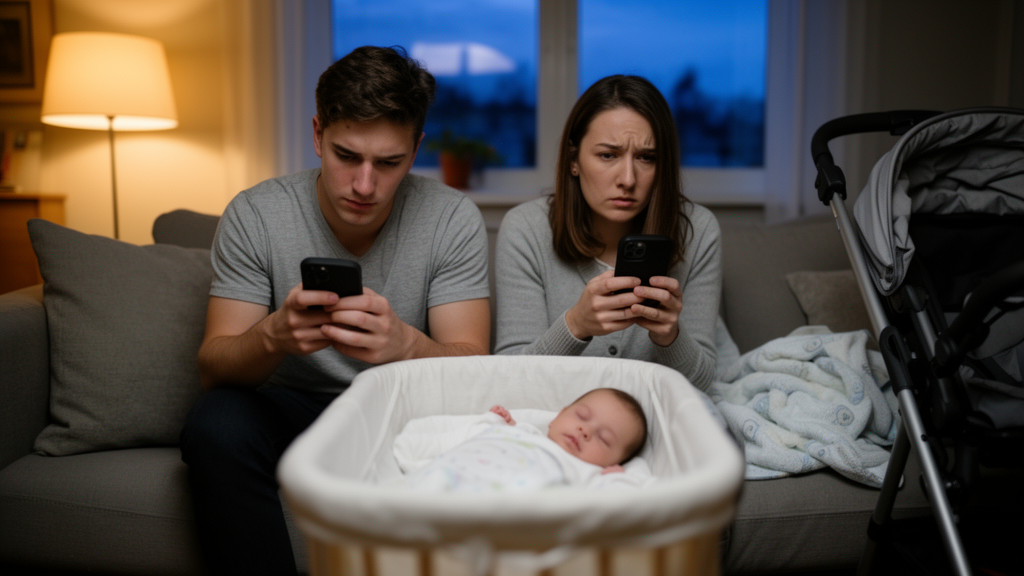
For most of the history of psychology, emotions were treated as strictly private events, unfolding inside a single skull and measurable only by asking one person at a time how they felt. A new study published in Communications Psychology challenges that picture at the most emotionally charged moment of adult life: the arrival of a first child. Researchers at Aarhus University in Denmark tracked new mothers and fathers six times a day for a week, once during maternity leave and once during paternity leave, and found that the emotional lives of new parents are not merely individual experiences but coupled dynamical systems, rising and falling in relation to one another in patterns that depend on who is at home with the baby.
The research team, led by Christopher Martin Mikkelsen Cox, Niels Værbak, Pernille Højlund Brams and Christine E. Parsons, recruited 88 mothers on maternity leave and 56 fathers on paternity leave in Denmark, a country whose generous and gender-flexible leave policies make it possible to observe both parents in the same caregiving role at different times. Each participant answered brief surveys on their smartphone six times per day, reporting their current emotional state along two fundamental dimensions: valence, which captures whether an emotion is pleasant or unpleasant, and arousal, which captures how activated or calm the body feels. This intensive sampling approach, known as experience sampling, allows scientists to reconstruct the moment-to-moment trajectory of feelings far more faithfully than retrospective questionnaires, which are notoriously distorted by memory biases.
The analytical heart of the study is a family of Bayesian multilevel coupled-oscillator models, a mathematical framework borrowed in spirit from physics, where oscillating systems such as pendulums or circuits can become synchronized when coupled. In this context, each parent’s emotional state is modeled as a dynamic process that tends to return toward its own baseline while being continuously influenced by the partner’s state. The coupling parameters estimate whether one person’s emotions amplify the partner’s feelings, dampen them, or lag behind them in time. Fitting these models in a Bayesian framework allowed the researchers to quantify uncertainty and to capture the substantial variation they observed from couple to couple, rather than averaging away the individual differences that turned out to be one of the most striking findings.
One of the clearest results concerned self-regulation. Arousal, the intensity dimension of emotion, amplified parents’ self-regulation dynamics specifically for the partner who was not on leave. In practical terms, when a father was at work while his partner was on maternity leave, or vice versa, the parent away from the baby showed stronger intrinsic regulatory dynamics in their arousal states. The authors interpret this as evidence that the demands and structure of the working day may shape how intensely the emotional system oscillates, with the off-leave parent’s arousal states showing more pronounced self-driven dynamics than those of the parent immersed in round-the-clock infant care.
Physical proximity proved to be a decisive ingredient for emotional synchrony. The study verified co-location objectively using GPS data from participants’ phones, rather than relying on self-report about when couples were together. When partners were genuinely in the same place, their emotional states showed synchrony in both valence and arousal, meaning their pleasantness and activation levels moved in concert over the course of the day. Critically, the researchers ran a control analysis pairing each participant with a randomly selected other parent, and the synchrony vanished entirely. This random-pairing test is a powerful safeguard against statistical artifacts: it demonstrates that the coordinated emotional fluctuations were specific to actual couples sharing space, not a generic rhythm shared by all new parents in the same society, such as common sleep schedules or circadian patterns.
The most nuanced findings emerged when the researchers examined how each partner responded to the other’s emotional states across the two leave periods. Mothers’ regulatory responses to fathers shifted systematically with the leave arrangement. During maternity leave, mothers weakly followed fathers’ emotions, their states drifting in the same direction as their partner’s. During paternity leave, however, the pattern reversed: mothers counterbalanced fathers’ emotions, their emotional states moving in the opposite direction. Fathers, by contrast, provided weak counterbalancing responses across both periods, regardless of who was on leave. The asymmetry suggests that the emotional division of labor in new-parent couples is not fixed by gender alone but is reconfigured by the caregiving context each parent inhabits.
What might this counterbalancing mean in everyday life? The researchers frame couples as mutually regulating systems, in which one partner’s emotional state can serve as an input that the other partner’s system works to offset. During paternity leave, when both parents are typically at home together navigating shared infant care, a mother whose partner is experiencing a spike in negative mood may herself shift toward a calmer or more positive state, potentially stabilizing the emotional climate of the household. Such compensatory dynamics have been described in broader work on interpersonal emotion regulation, but observing them unfold in naturalistic conditions, six times a day, with GPS-verified proximity, across two distinct leave configurations, represents an unusually direct window into how co-parenting couples function as emotional units rather than as two independent individuals.
The Danish context matters for interpreting these results. Denmark’s parental leave system allows families to split leave in flexible ways, which is precisely what enabled the researchers to study the same kinds of transitions, into and out of full-time infant care, for both mothers and fathers. In countries where leave is available almost exclusively to mothers, the question of how fathers’ emotion dynamics change on paternity leave would be nearly impossible to investigate. The findings therefore carry implications well beyond Denmark: if leave configuration systematically reshapes how partners regulate one another, then family policy decisions about who takes leave, and for how long, may have measurable consequences for the emotional architecture of new families.
Equally important is the study’s emphasis on couple-level variation. The Bayesian models revealed substantial differences between couples in the strength and direction of their coupling, meaning that some pairs operate as tightly synchronized systems while others show weaker or more asymmetric links. This heterogeneity cautions against one-size-fits-all narratives about new parenthood. It also opens a promising avenue for future research: identifying which characteristics of couples, such as relationship satisfaction, sleep quality, infant temperament or the division of night-time care, predict stronger synchrony or more effective counterbalancing. If couples function as mutually regulating systems, then clinical interventions aimed at preventing postpartum distress might one day target the dyad rather than the individual, leveraging the partner’s regulatory influence as a therapeutic resource.
The study, published open access in Communications Psychology on 23 September 2026 and funded by the Carlsberg Foundation, arrives amid a growing scientific interest in the paternal brain, postpartum anxiety and the plasticity of the parental mind. Its technical contribution lies in demonstrating that experience-sampling data, coupled-oscillator modeling and objective location tracking can be combined to capture interpersonal emotion regulation as it actually happens, in the messy and sleep-deprived weeks of early parenthood. Its human contribution is simpler and more resonant: when a baby arrives, two emotional systems do not merely coexist under one roof. They lock together, amplify and steady each other, and reorganize their dance each time the household’s caregiving arrangement changes. Understanding that dance, the authors suggest, is essential to understanding how first-time parents weather one of life’s most demanding transitions.
Subject of Research: Emotion dynamics and interpersonal emotion regulation in first-time parents across maternity and paternity leave
Article Title: New mothers and fathers show distinct emotion dynamics across maternity and paternity leave
Article References: New mothers and fathers show distinct emotion dynamics across maternity and paternity leave. (n.d.). https://doi.org/10.1038/s44271-026-00536-2
Image Credits: AI Generated
DOI: 10.1038/s44271-026-00536-2
Keywords: emotion regulation, new parents, maternity leave, paternity leave, experience sampling, coupled oscillator models, emotional synchrony, GPS tracking, co-parenting, Bayesian multilevel modeling, interpersonal emotion regulation, Communications Psychology
Cite Scienmag News
Glenn Wilkins. (October 8, 2026). New Parents’ Emotions Rise and Fall Together, GPS-Tracking Study Reveals. Scienmag. https://scienmag.com/new-parents-emotions-rise-and-fall-together-gps-tracking-study-reveals/
Glenn Wilkins. "New Parents’ Emotions Rise and Fall Together, GPS-Tracking Study Reveals." Scienmag, 8 October 2026, https://scienmag.com/new-parents-emotions-rise-and-fall-together-gps-tracking-study-reveals/. Accessed 8 October 2026.
Glenn Wilkins. "New Parents’ Emotions Rise and Fall Together, GPS-Tracking Study Reveals." Scienmag. October 8, 2026. https://scienmag.com/new-parents-emotions-rise-and-fall-together-gps-tracking-study-reveals/


