


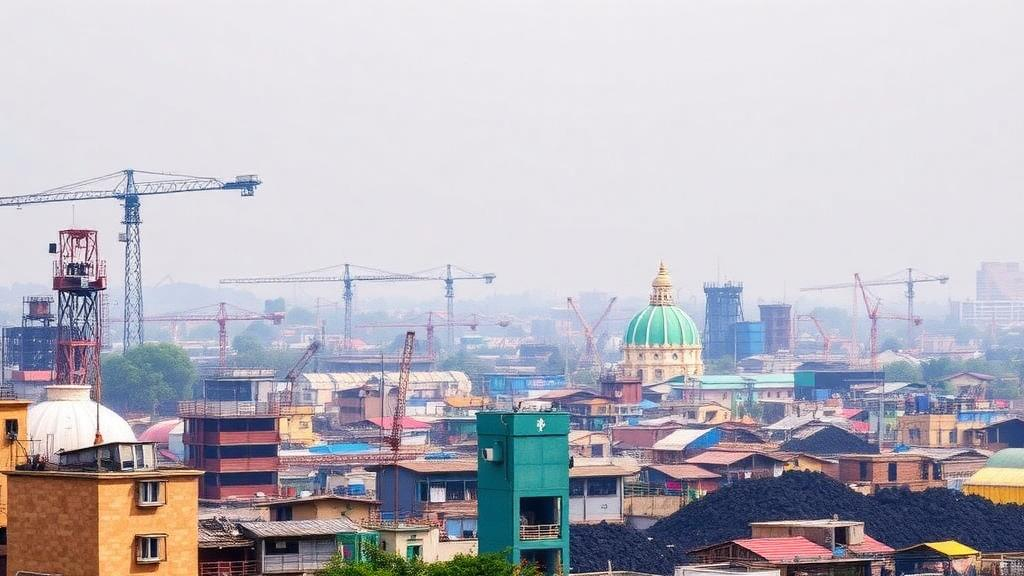
India’s economic miracle has an atmospheric bill, and a new study has finally tallied it. Since the landmark reforms of 1991 flung open the country’s markets, India’s gross domestic product per capita has roughly tripled, climbing from around 600 to 700 US dollars in 2000 to more than 2,000 dollars by 2020. Yet that prosperity was built on a power system overwhelmingly fueled by coal, and researchers now report that the resulting sulfur emissions have doubled urban aerosol loading across the subcontinent, contributing to a rise in urban fine-particle deaths from roughly 0.7 million in 2000 to 0.9 million in 2020. The analysis, published in Nature Cities, is the first to trace a single quantitative thread from economic growth through electricity demand, coal combustion, sulfate aerosol chemistry and, ultimately, mortality in India’s cities.
The numbers behind the boom are striking. Electricity demand rose nearly fourfold over two decades, from approximately 450 terawatt-hours to almost 2,000 terawatt-hours, while coal consistently supplied about 76 percent of total generation. In 2020, coal accounted for 75.9 percent of the electricity mix, dwarfing hydropower at 7.7 percent, wind at 6.6 percent, solar at 4.0 percent and nuclear at 2.8 percent. To keep pace, the country commissioned 182 new coal-fired power plants between 2001 and 2024, on top of the 71 that operated before 2000, bringing the fleet to 253 facilities. Crucially, these plants cluster in the Indo-Gangetic Plain and the Horseshoe Belt, the very corridors where population, urbanization and economic activity have surged, with population density rising by more than 300 to 500 people per square kilometer in several areas.
The statistical coupling between prosperity and power is remarkably tight. A log-linear regression of electricity demand against GDP per capita yields an elasticity of 1.139, meaning each 1 percent increase in per-capita income was associated with roughly a 1.14 percent rise in electricity consumption, with the model explaining 99.6 percent of the variance. In other words, India’s economy has been electrifying faster than it has been growing, and the grid has answered with coal. As demand fluctuated, thermal plants expanded generation along the extensive margins of the system, often running at higher capacity utilization, spewing sulfur dioxide, nitrogen oxides, black carbon and organic carbon into the atmosphere.
Why does sulfur dioxide matter so much? Once emitted, it undergoes atmospheric oxidation to form sulfate aerosols, one of the dominant components of fine particulate matter known as PM2.5, particles smaller than 2.5 micrometers that penetrate deep into the lungs and bloodstream. Sulfate aerosols persist in the air and travel over vast distances, spreading regional haze far beyond power-plant smokestacks. Incomplete coal combustion also releases black carbon and organic carbon, which darken skies, degrade visibility and compound cardiopulmonary risks. Together, these primary emissions and secondary aerosol chemistry tie coal-based electricity to pollution across entire regions, not merely the neighborhoods adjacent to power stations.
To quantify this chain, the team assembled an unusually broad evidence base. They drew on the MERRA-2 aerosol reanalysis, the MODIS Multi-Angle Implementation of Atmospheric Correction satellite product at one-kilometer resolution, CMIP6 Earth-system simulations reaching back to 1850, and sector-resolved simulations from the GEOS-Chem chemical transport model. Validation against ground-based AERONET sun photometers showed strong agreement, with MERRA-2 reproducing observed aerosol optical depth at a correlation of 0.73 and GEOS-Chem matching available observations at 0.92. The two main products also agreed closely with each other, correlating at 0.84 for aerosol optical depth and 0.81 for surface PM2.5, giving the researchers confidence that the long-term trends were robust rather than artifacts of any single dataset.
The trends themselves are unambiguous. Urban aerosol optical depth, a measure of how much sunlight particles block, hovered around 0.15 to 0.18 before 1950 and climbed gradually through 1990. After 2000 it rose sharply, crossing 0.3 by the mid-2000s and reaching approximately 0.42 to 0.45 by 2024. Sulfate led the charge: its share of total urban aerosol loading grew from 35.5 percent in 2000 to 46.4 percent in 2020, while dust actually declined from 30.4 to 21.5 percent. Spatially, aerosol loading increased 30 percent to more than 100 percent across major urban corridors, with statistically significant trends of 0.02 to 0.04 optical depth units per decade concentrated over the Indo-Gangetic Plain and central and eastern India. A temporary dip during the 2020 COVID-19 lockdowns, followed by a rapid rebound, underscored the human fingerprint on the haze.
Sector attribution sharpened the story further. GEOS-Chem simulations that remove individual emission sources showed the power sector’s contribution to urban aerosol optical depth jumping from about 16 percent in 2000 to 36 percent in 2020, making it the largest anthropogenic contributor, with industry second at roughly 32 percent. Power-sector aerosol loading increased by about 125 percent and industrial loading by 130 percent, while transportation changed comparatively little. Independent satellite observations from the TROPOMI instrument on Sentinel-5P confirmed the mechanism, revealing sulfur dioxide hotspots exceeding 0.3 to 0.5 Dobson units across the same regions, with local enhancements above 0.5 Dobson units near clusters of plants larger than 1,500 megawatts. Surface PM2.5 followed suit, rising from roughly 35 to 38 micrograms per cubic meter in 2000 to more than 40 to 45 by 2020, with power-sector PM2.5 increasing by approximately 400 percent, the largest relative increase of any sector, and reaching 10 to 20 micrograms per cubic meter across northern and eastern India.
The health consequences were estimated using the Global Exposure Mortality Model, which combines gridded PM2.5 concentrations, population exposure and cause-specific concentration-response functions for chronic obstructive pulmonary disease, lung cancer, ischemic heart disease, stroke and lower respiratory infections. Total urban PM2.5-attributable deaths climbed about 30 percent, from approximately 0.67 million in 2000 to 0.87 million in 2020. More dramatic still, deaths attributable specifically to power-sector emissions surged from roughly 0.015 million to nearly 0.30 million, an increase of around 1,800 percent, while industrial-attributable deaths rose about 350 percent to 0.14 million. The authors caution that MERRA-2 may underestimate absolute PM2.5 in dense urban areas, making these mortality figures conservative, though the trends are well supported by independent satellite and ground observations.
Paradoxically, the same economic growth that fouled the outdoor air cleaned up Indian kitchens. Rising incomes propelled households up the so-called energy ladder, from wood, dung and coal toward liquefied petroleum gas, natural gas, electricity and cleaner cookstoves. Access to clean cooking fuels and technologies expanded from about 25 percent of the population in 2000 to nearly 75 percent by 2023, and household air-pollution deaths fell from roughly 1.25 million to about 1.0 million per year. The middle-income population swelled from under 10 percent to nearly 40 percent, meaning several hundred million people gained access to modern energy. But the econometric analysis reveals the trade-off in stark terms: electricity demand was strongly associated with power-sector sulfur dioxide emissions, which in turn tracked urban aerosol loading and PM2.5, and urban PM2.5 was positively associated with outdoor air-pollution deaths, which climbed from about 0.3 million in 1990 to nearly 1.0 million by 2023.
The implications extend well beyond India. For any rapidly developing economy leaning on coal, the study suggests that gains in household energy access can be quietly erased by deteriorating ambient air, shifting the pollution burden from indoor hearths to city streets and lungs. The researchers argue that decarbonizing electricity generation is now urgent not only for climate reasons but as a direct public-health intervention, particularly across the Indo-Gangetic Plain and the Horseshoe Belt where coal plants, booming cities and dense populations collide. As India pursues one of the world’s largest socioeconomic and energy transitions, the message of this analysis is clear: sustained prosperity will depend on whether the grid that powers growth can stop poisoning the air that its people breathe.
Subject of Research: Coal-dependent electricity demand from India's economic boom and its links to urban air pollution and public health
Article Title: Economic-boom-driven electricity demand linked to urban air pollution and health in India
Article References: Swain, B., Singh, A., Tripathy, D., Song, R., Deroubaix, A., Vountas, M., Shende, P., Huang, C., Lelli, L., & Tandon, A. (2026). Economic-boom-driven electricity demand linked to urban air pollution and health in India. Nature Cities. https://doi.org/10.1038/s44284-026-00518-9
Image Credits: AI Generated
DOI: 10.1038/s44284-026-00518-9
Keywords: India, coal-fired power plants, electricity demand, air pollution, PM2.5, sulfate aerosols, sulfur dioxide, economic growth, urbanization, clean cooking, public health, Nature Cities
Cite Scienmag News
Russell Cooper. (October 8, 2026). India’s Economic Boom Powered by Coal Is Claiming Lives in Its Cities. Scienmag. https://scienmag.com/indias-economic-boom-powered-by-coal-is-claiming-lives-in-its-cities/
Russell Cooper. "India’s Economic Boom Powered by Coal Is Claiming Lives in Its Cities." Scienmag, 8 October 2026, https://scienmag.com/indias-economic-boom-powered-by-coal-is-claiming-lives-in-its-cities/. Accessed 8 October 2026.
Russell Cooper. "India’s Economic Boom Powered by Coal Is Claiming Lives in Its Cities." Scienmag. October 8, 2026. https://scienmag.com/indias-economic-boom-powered-by-coal-is-claiming-lives-in-its-cities/


