


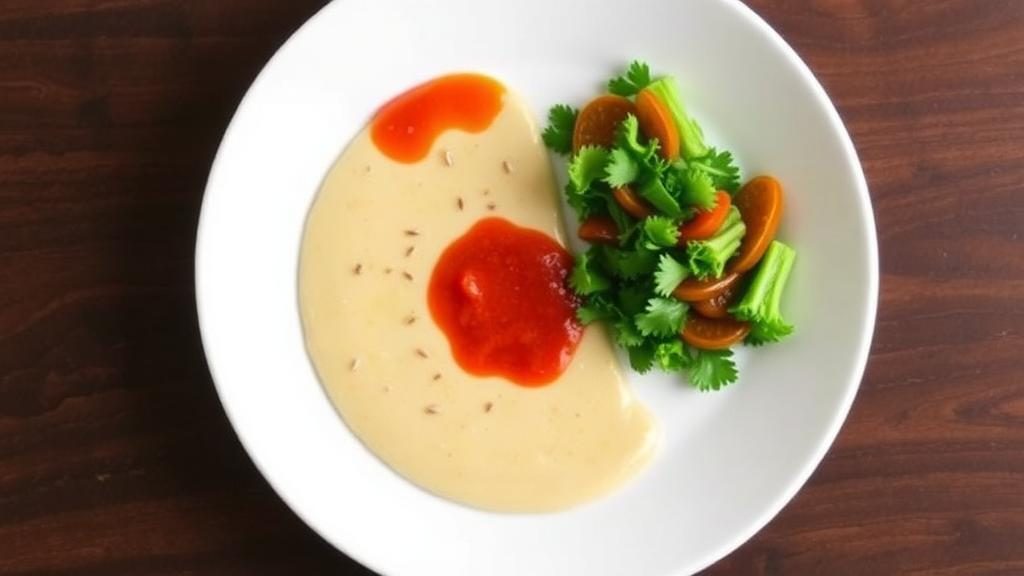
The way a dish looks before the first bite is never a neutral detail. Chefs, food stylists, and restaurateurs have long operated on the intuition that presentation shapes expectation, and a growing body of research in sensory and consumer science has been working to turn that intuition into measurable evidence. A new experimental study from Japan adds an unexpectedly practical data point to this effort: the placement of sauce on a plate, and nothing more than that, was enough to shift how healthy diners judged a dish to be. When the same sturgeon-filet dish was presented with sauces arranged separately on the plate rather than drizzled across it, participants in a real restaurant setting rated it as significantly healthier, even though the food itself was identical in both versions.
The research was led by Dr. Kosuke Motoki of the Faculty of Business and Commerce at Keio University, working in collaboration with Dr. Kohei Yamaguchi and Dr. Haruka Tohara of the Department of Dysphagia Rehabilitation at the Institute of Science Tokyo, Dr. Shin-ichi Ishikawa of the Department of Food Science and Business at Miyagi University, and Chef Tatsuya Noda of PLUM KNOT Co., Ltd. Their findings were published in Volume 15, Issue 17 of the journal Foods on August 31, 2026. The paper, titled How Chef-Designed Plating Shapes Consumer Evaluations of a Dish in a Real Restaurant Setting, is notable among plating studies for a simple reason: it was conducted in an operating restaurant rather than a laboratory booth, with dishes prepared by a professional chef whose restaurant holds a Michelin Green Star.
The study’s origins trace back to conversations among Dr. Motoki, Dr. Yamaguchi, Dr. Ishikawa, and Chef Noda about food artistry and plating at 8go, the restaurant at the Gastronomy Innovation Campus Tokyo, known as GIC Tokyo. The campus, developed in partnership with Tokyo Tatemono Co., Ltd., was designed as a collaborative environment where researchers, chefs, and industry partners can work side by side. That setting matters for the credibility of the results. Much of what is known about visual food perception comes from controlled experiments using photographs or simplified stimuli, which can behave differently from a real plate of food arriving at a real table. By embedding the experiment in an actual dining environment, the researchers aimed to test whether plating effects survive contact with the messier conditions of genuine hospitality.
The dish chosen for the test was a sturgeon-filet preparation, presented to participants in two distinct sauce arrangements. In the minimal plating condition, the sauces were placed separately on the plate, kept apart from the food and from each other. In the drizzle presentation condition, the sauces were distributed across the plate and around the food, the style more commonly associated with contemporary fine dining photography. Each of the 57 participants experienced both versions of the dish, a within-subjects design that allows each person to serve as their own comparison point and reduces the noise introduced by individual differences in taste preferences, appetite, and attitudes toward food. The choice of sturgeon was not incidental. As Dr. Motoki explained, sturgeon aquaculture is oriented primarily toward caviar production, while the meat remains commercially underused; fuller utilization of the fish could improve resource efficiency, situating the study within a sustainability-oriented culinary context.
Before tasting anything, participants rated the dish on a battery of measures: expected tastiness, perceived healthiness, intention to eat, overall liking, perceived artistic presentation, and willingness to pay. The results separated cleanly along one dimension. Minimal plating produced a perceived healthiness rating of 4.65 on a seven-point scale, compared with 4.05 for the drizzle presentation, and this difference remained statistically significant after the researchers applied corrections for multiple comparisons, a conservative statistical practice that guards against false positives when many measures are tested at once. On every other pre-tasting measure, including how tasty participants expected the dish to be and how much they were willing to pay for it, the two presentations were statistically indistinguishable.
That pattern is what makes the finding interesting from a scientific standpoint. If sauce placement had simply made the minimal plate look more attractive overall, one might expect the effect to spill over into expected tastiness, liking, or willingness to pay. Instead, the effect was specific to healthiness, suggesting that the visual cue operates on a distinct evaluative channel rather than through a general halo of aesthetic appeal. Dr. Motoki summarized the observation plainly: minimal plating made the same dish appear healthier, showing how small visual details can influence first impressions of food. For a restaurant, that specificity is potentially useful. A chef who wants a dish to read as wholesome can adjust sauce placement without altering flavor, portion size, or ingredients, and without necessarily sacrificing the perceived artistry of the plate.
After tasting, the picture became more tentative. The minimal presentation received higher ratings for overall liking and for intention to eat more, but neither of these differences survived the correction for multiple comparisons, and the researchers therefore classified them as preliminary. This is an honest and important distinction. Pre-consumption impressions are formed in seconds from visual information alone, and they are comparatively easy to measure with precision. Post-consumption evaluations, by contrast, are shaped by flavor, texture, temperature, and the diner’s own state, all of which introduce variability that a sample of 57 participants may not fully absorb. The authors are careful not to overclaim: the tasting data point toward a possible downstream benefit of minimal plating but do not establish one.
Why would separately placed sauces make a dish seem healthier? The researchers offer two candidate explanations, while noting that neither was directly measured in this study. The first is visual simplicity. A plate with sauces confined to discrete pools appears less visually dense than one streaked and splattered with sauce, and visual density may be unconsciously associated with heaviness, richness, or caloric excess, while simplicity and sparseness may evoke naturalness and restraint. The second is perceived control. When sauces sit separately, diners decide how much of each to apply, and the sense of control over a food’s composition has been linked in the broader literature to judgments of healthiness. A drizzled plate, by contrast, presents the sauce as already integrated, something the diner must accept as served. Both mechanisms are plausible, and both are testable in future work that measures them explicitly rather than inferring them from the pattern of ratings.
The practical implications extend beyond the dining room. The researchers frame the results as a step toward evidence-based food presentation in restaurants and hospitality, replacing inherited plating conventions with choices supported by consumer data. As Dr. Motoki put it, bringing together researchers, a professional chef, and 8go as a real-world research setting within GIC Tokyo made it possible to examine how chef-designed plating shapes diners’ evaluations both before and after tasting. The preliminary post-tasting results, he noted, provide a starting point for investigating whether presentation style and the way diners actually use the sauce may influence enjoyment. There is also a public health dimension worth considering. If visual presentation can nudge perceived healthiness without changing a single ingredient, the same principle could inform how institutional cafeterias, school lunch programs, and food service operations present dishes they hope diners will recognize as healthier options.
The researchers are equally clear about the limits of the finding. Looking healthier is not the same as being nutritionally healthier, and a plating technique that improves perception should not be mistaken for an intervention that improves the food itself. The study examined a single dish, a sturgeon-filet preparation, in a single restaurant, with a modest sample size, and the post-tasting effects did not withstand statistical correction. Whether the healthiness effect generalizes across cuisines, plating styles, portion sizes, and dining environments, from casual bistros to formal tasting menus, remains an open empirical question. What the study does establish is that one of the smallest decisions a chef makes, where the sauce goes, carries measurable weight in the diner’s first judgment of a plate. In the economics of attention that governs a restaurant table, that is a detail worth taking seriously, and it suggests that the science of plating is only beginning to map the territory between the kitchen and the eye.
Subject of Research: The effect of chef-designed sauce placement on diners' perception of a dish's healthiness in a real restaurant setting
Article Title: Plating matters: How sauce placement can make a dish appear healthier
Article References: Plating matters: How sauce placement can make a dish appear healthier. (n.d.). Original publication
Image Credits: AI Generated
DOI: Not provided
Keywords: food presentation, plating, sauce placement, consumer perception, healthiness, sensory science, Keio University, restaurant study, sturgeon, gastronomy, food psychology, Foods journal
Cite Scienmag News
Denise Maddox. (October 8, 2026). Sauce on the Side: Minimal Plating Makes a Dish Look Healthier, Study Finds. Scienmag. https://scienmag.com/sauce-on-the-side-minimal-plating-makes-a-dish-look-healthier-study-finds/
Denise Maddox. "Sauce on the Side: Minimal Plating Makes a Dish Look Healthier, Study Finds." Scienmag, 8 October 2026, https://scienmag.com/sauce-on-the-side-minimal-plating-makes-a-dish-look-healthier-study-finds/. Accessed 8 October 2026.
Denise Maddox. "Sauce on the Side: Minimal Plating Makes a Dish Look Healthier, Study Finds." Scienmag. October 8, 2026. https://scienmag.com/sauce-on-the-side-minimal-plating-makes-a-dish-look-healthier-study-finds/


