


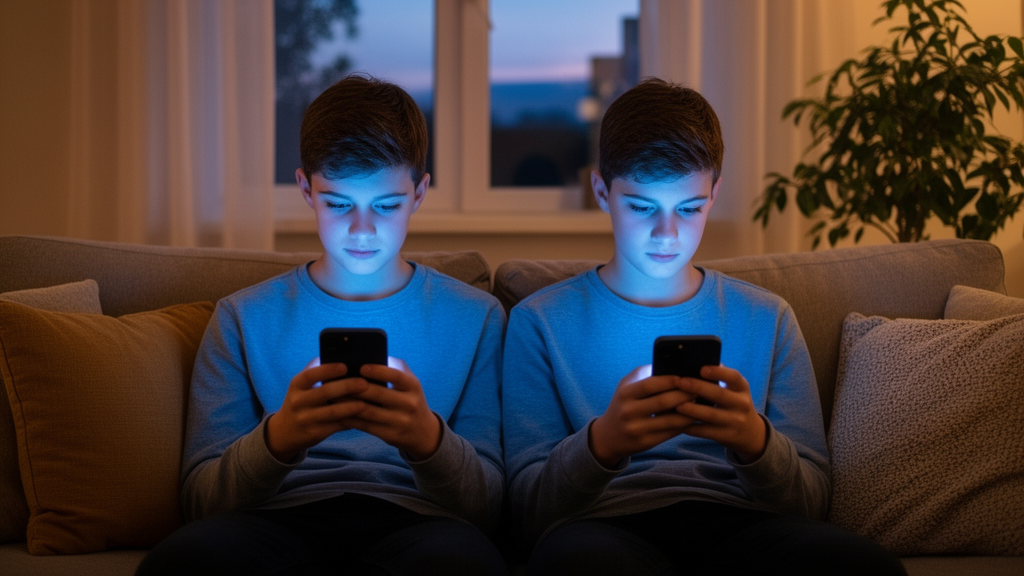
A sweeping new study of more than 21,000 Swedish twins suggests that the much-debated link between screen time and mental health problems in young people may be substantially weaker than previously believed, because shared family factors such as genetics and upbringing appear to explain a large part of the association. The research, conducted by scientists at Karolinska Institutet and published in Nature Human Behaviour, tracked participants from the age of nine through their teenage years and into adulthood, offering one of the most detailed longitudinal pictures to date of how leisure-time screen use relates to symptoms of depression and anxiety over the course of development.
The study’s central innovation lies in its co-twin comparison design. Rather than simply comparing unrelated individuals, the researchers examined pairs of twins raised in the same household where one twin used screens considerably more than the other. Because identical twins share essentially all of their genes and both identical and fraternal twins share much of their family environment, differences in mental health outcomes between twins within the same pair cannot easily be attributed to those shared factors. When the researchers applied this within-family comparison, most of the observed links between screen use and mental health problems weakened considerably, particularly among identical twins, a pattern that points strongly toward genetic and environmental influences shared within families.
The clearest associations in the conventional, between-family analyses emerged during adolescence and for interactive screen activities such as gaming, chatting and surfing the internet. In contrast, the links for passive activities such as watching television or videos were significantly weaker or absent altogether. This distinction between active and passive engagement is one of the study’s most striking findings, and it complicates the simple picture of screen time as a uniform risk factor. Fifteen-year-olds who spent more than six hours a day on interactive screen activities showed more symptoms of depression or anxiety and were more than twice as likely to be diagnosed with such a condition later in life, compared with peers who spent no more than two hours a day using screens.
Those headline numbers, however, tell only part of the story. When the researchers compared twins within the same family, the strength of these associations dropped markedly. The correlations did not disappear entirely, but they became significantly weaker, suggesting that both genes and upbringing play an important role in shaping the apparent relationship. According to Tong Gong, research specialist at the Department of Medical Epidemiology and Biostatistics at Karolinska Institutet and the study’s corresponding author alongside senior researcher Lu Yi, the results indicate that the association may in some cases have been overestimated because it has not been possible to fully account for shared family factors in earlier research.
The implications of this methodological insight extend well beyond the specific question of screens. Much of the existing literature on digital technology and youth mental health relies on observational comparisons between unrelated individuals, which are vulnerable to confounding by any factor that differs across families. Genetic predispositions to both heavy screen use and internalising problems, parenting styles, socioeconomic conditions and household routines could all contribute to a spurious association. Twin designs, by holding these shared influences constant, provide a natural experiment that can separate within-person effects from between-family differences. The attenuation observed in this study, especially among monozygotic pairs, suggests that a meaningful share of the reported screen-mental health connection in the broader literature may reflect such confounding.
At the same time, the researchers are careful to emphasise that the findings do not mean screen time is irrelevant to mental health. Interactive screen activities during adolescence were still linked to an increased risk of mental health problems later in life, although the uncertainty around the estimates increased when shared family factors were included in the analyses. In other words, the data cannot rule out a genuine effect of heavy interactive use; they simply show that the effect, if it exists, is smaller and harder to detect than raw population-level comparisons imply. For a field that has produced widely varying estimates of harm, this nuance matters. It shifts the scientific conversation from whether screens are good or bad toward a more precise question of which activities, in which contexts, and for which individuals, may carry risk.
The study also carries important limitations that the authors acknowledge. It is based on self-reported data on screen use, which does not capture exactly what young people were doing on their screens or why they were using them. Self-reports of media habits are known to be imperfect, and the coarse categories used in the study cannot distinguish, for example, between social gaming with friends and solitary late-night scrolling. Furthermore, the data were collected before social media and smartphones became as integral a part of young people’s everyday lives as they are today, raising questions about how the findings generalise to a generation for whom mobile, algorithmically curated content is the default mode of engagement.
The research team, which included collaborators from Sweden, Norway, Denmark, Germany and Australia, plans to address these gaps in the next phase of work. The researchers intend to examine different types of screen-based activities in greater detail, studying their content, the motivation behind their use, problematic use patterns, and the activities that screen time replaces. By mapping these dimensions, they hope to gain a better understanding of how the complex relationships between digital media and well-being vary across different age groups and between girls and boys. Emma Frans, senior research specialist at the Department of Medical Epidemiology and Biostatistics at Karolinska Institutet and co-author of the study, argues that future recommendations should not focus solely on how much time children and young people spend in front of screens. To be able to give good advice, she notes, we also need to understand what they are doing on their screens, why they are doing it, and which individual and family-related factors may affect their well-being.
For parents, educators and policymakers, the study offers a measured rather than alarmist message. Simple time-based screen limits, the findings suggest, may be a blunt instrument if the true drivers of risk lie in the nature of the activity, the motivation behind it, or pre-existing vulnerabilities that screens merely reflect. A teenager who games intensively may be doing so for reasons that also elevate their risk of depression, and reducing screen hours alone may not address the underlying issue. At the same time, the persistence of some association even within twin pairs leaves open the possibility that heavy interactive use contributes directly to poorer mental health, particularly during the sensitive adolescent period.
The study, titled Recreational Screen Use and Internalising Problems from Preadolescence to Young Adulthood in a Longitudinal Twin Cohort with Co-Twin Comparison, was primarily funded by the Marianne and Marcus Wallenberg Foundation and the Swedish Brain Foundation. The authors note that one co-author, Henrik Larsson, has received research grants, honoraria and consultancy fees from pharmaceutical companies outside the scope of this study, while the other researchers declare no conflicts of interest. As debates over youth mental health and digital technology continue to intensify worldwide, this large-scale twin analysis adds a crucial layer of methodological rigour, reminding researchers and the public alike that correlation between screen time and psychological distress may say as much about families and genes as it does about screens themselves.
Subject of Research: The relationship between recreational screen use and internalising mental health problems in young people examined through a longitudinal twin cohort study
Article Title: Twin study sheds new light on screen time and mental health
Article References: Twin study sheds new light on screen time and mental health. (n.d.). Original publication
Image Credits: AI Generated
DOI: Not provided
Keywords: screen time, mental health, twin study, adolescence, depression, anxiety, genetics, Karolinska Institutet, Nature Human Behaviour, gaming, longitudinal study, youth well-being
Cite Scienmag News
Glenn Wilkins. (October 8, 2026). Genes and upbringing may drive the screen time and mental health link, twin study finds. Scienmag. https://scienmag.com/genes-and-upbringing-may-drive-the-screen-time-and-mental-health-link-twin-study-finds/
Glenn Wilkins. "Genes and upbringing may drive the screen time and mental health link, twin study finds." Scienmag, 8 October 2026, https://scienmag.com/genes-and-upbringing-may-drive-the-screen-time-and-mental-health-link-twin-study-finds/. Accessed 8 October 2026.
Glenn Wilkins. "Genes and upbringing may drive the screen time and mental health link, twin study finds." Scienmag. October 8, 2026. https://scienmag.com/genes-and-upbringing-may-drive-the-screen-time-and-mental-health-link-twin-study-finds/


