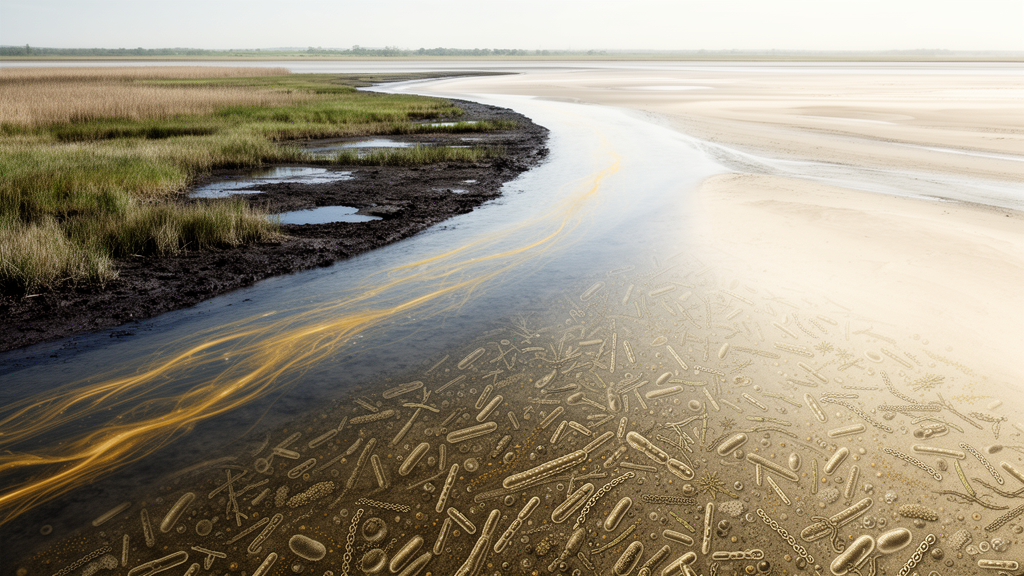
Meter-long sediment cores from the abandoned and present Yellow River estuaries reveal contrasting patterns of microbial assembly, reactive iron cycling and carbon-cycling potential below the seafloor. At the abandoned Diaokou course, surface communities were shaped mainly by heterogeneous environmental selection, whereas dispersal limitation became the dominant inferred process in deeper sediments. At the present Qingshuigou course, heterogeneous selection remained dominant through the core, alongside persistent reactive iron pools, sustained iron-redox-related functional potential and greater vertical continuity in microbial source pools.
The study compared two sites with different depositional regimes; it did not directly measure a before-and-after biological response to the river’s historical diversion. Researchers combined 16S rRNA gene sequencing, shotgun metagenomics and detailed porewater and sediment geochemistry in an observational study of the Yellow River Estuary. During an August 2023 expedition, they collected multicorer and gravity cores offshore near the Diaokou–Shenxiangou promontory at the abandoned estuary, designated YRM1, and the Qingshuigou promontory at the present estuary, designated YRM2.
The Diaokou course was active from 1953 to 1976, before the major diversion shifted the active delta lobe to Qingshuigou. The present estuary is characterized by continued accumulation of predominantly fine-grained sediment, while the abandoned site experiences reduced supply, erosion, reworking and sediment coarsening. Microbial community composition varied with both site and depth.
Proteobacteria represented 5–45% of relative abundance, Chloroflexi 1–25%, Desulfobacterota 7–20% and Acidobacteriota 4.3–13.4%. Nitrosopumilales, Steroidobacterales, Desulfobulbales and Anaerolineales generally declined with depth, whereas Thermoanaerobaculales, Desulfobacterales and Syntrophobacterales became more relatively abundant in subsurface sediments. Within sulfate-reducing bacterial assemblages, surface-enriched Desulfobulbales were gradually replaced by deeper-enriched Desulfobacterales.
Major community transitions occurred across 15–30 cm at YRM1 and 55–75 cm at YRM2. Only 29 amplicon sequence variants were shared by all four groups defined for the analysis. Removing all ASVs assigned to Nitrosopumilales did not remove the overall community separation, indicating that the pattern involved multiple microbial lineages rather than a single dominant taxon.
Phylogenetic-bin-based null-model analysis showed that microbial assembly followed different depth patterns at the two locations. In YRM1 surface sediments, heterogeneous selection accounted for 65.9% of inferred turnover, followed by drift and other undominated processes at 26.3% and homogenizing dispersal at 6.6%. In YRM1 subsurface sediments, dispersal limitation contributed 56.9%, heterogeneous selection 33.6% and drift and other undominated processes 8.3%.
At YRM2, heterogeneous selection accounted for 52.2% of surface turnover and 58.1% of subsurface turnover. Dispersal limitation increased from 14.4% in YRM2 surface layers to 24.7% in its subsurface interval, but remained secondary. The central result was therefore a site-specific shift in the dominant inferred assembly process at YRM1, not a uniform rise in stochasticity with depth at both estuaries.
Several complementary measures indicated stronger vertical continuity in the present estuary. Directional source-contribution analysis estimated clearer contributions from successively shallower sediment communities at YRM2, while several deeper YRM1 samples had larger unknown-source fractions. Exploratory association networks also differed between locations.
The YRM1 surface network contained 208 nodes and 284 edges, compared with 180 nodes and 399 edges for YRM2. Below the surface transition, the YRM1 network contracted to 28 nodes and 49 edges, whereas the YRM2 subsurface network retained 165 nodes and 214 edges. Positive community cohesion was higher at YRM1 in surface sediments but higher at YRM2 in subsurface sediments.
These networks were interpreted descriptively and were not used to infer keystone taxa or make inferential comparisons of individual taxa. Geochemical measurements showed contrasting vertical redox structures. At YRM2, porewater ferrous iron, Fe(II), rose rapidly near the sediment surface, reaching approximately 170 μM at 5.5 cm, and remained relatively high through much of the core.
Sulfate decreased from approximately 22 to 16 mM with depth, while ammonium and dissolved inorganic carbon increased. At YRM1, Fe(II) had a shallow maximum at 3.5 cm, declined rapidly by 15 cm and showed a secondary enrichment at about 40 cm. Reactive iron fractions were relatively enriched in surface and shallow subsurface sediments at YRM2, whereas YRM1 displayed greater vertical variation.
Pyrite-bound iron contributed only a minor fraction of highly reactive iron in both cores, consistent with limited net pyrite accumulation despite the detection of genes associated with both reductive and oxidative sulfur transformations. At YRM1, MtrC-like homolog abundance decreased by approximately 92% from the surface to the deepest sampled interval, while the broader module of Fe(III)-reduction and extracellular electron-transfer homologs declined by approximately 83%. That pattern contrasted with the secondary Fe(II) enrichment at depth.
At YRM2, MtrC-like abundance also decreased downward, but OmcS-like and OmcZ-like homologs remained detectable, making the broader iron-reduction and electron-transfer pool comparatively persistent. The mismatch in deeper YRM1 sediments leaves open contributions from incompletely characterized microbial reduction pathways, sulfur-mediated iron reactions or diagenetic redistribution among iron-bearing minerals; the study did not quantify the contribution of each possibility. Sulfur-cycling potential occurred in both reductive and oxidative forms throughout the sediment profiles.
Genes associated with dissimilatory sulfur metabolism, including aprAB and dsrAB, varied with depth and remained relatively abundant in deeper sediments, while sulfur-oxidation genes such as soxB, sqr and fccAB were generally enriched near the surface. Their presence is compatible with a pathway in which sulfate reduction generates reduced sulfur compounds that react with reactive Fe(III), but the analysis did not establish the magnitude of that contribution. A carbonate-corrected dissolved inorganic carbon to sulfate ratio exceeded the reference value of 2 in deeper YRM2 sediments, meaning that inorganic carbon accumulation was greater than expected from observed net sulfate depletion alone.
The authors identified additional carbon production, partial sulfate regeneration through reduced-sulfur oxidation, or both as possible explanations. As reactive iron contents declined in deeper YRM1 sediment, genes associated with methane and C1 metabolism—including mtaA, mttB and fwdE/fmdE—became more abundant. The methyl-coenzyme M reductase gene mcrA remained low overall, although it was relatively more abundant in deeper YRM1 samples.
In the YRM2 core, relatively persistent reactive iron and iron-redox-related potential coincided with generally lower methane- and C1-metabolism-related gene abundance. In the exploratory YRM1 subsurface network, taxa assigned non-peripheral topological roles included organisms affiliated with Sumerlaeota and Methyloceanibacter, groups with previously reported genomic traits associated with hydrogen and methylated-compound metabolism. These measurements describe relative functional potential rather than directly measured rates of methane production, methane oxidation or carbon burial.
Taken together, the cores show two contrasting sedimentary regimes. The present Qingshuigou estuary combined continued fine-grained deposition with persistent reactive iron, sustained iron-redox-related potential and stronger vertical continuity in microbial source pools. The abandoned Diaokou system showed more variable geochemistry, a shift from heterogeneous selection to dispersal limitation and a relative increase in methane- and C1-metabolism-related potential as reactive iron diminished with depth.
The researchers cautioned that erosion, reworking and discontinuous deposition prevented establishment of a robust age–depth relationship, so the microbial transition intervals should not be treated as precise chronological boundaries. Grain size, organic-matter characteristics, salinity, bottom-water oxygenation and sediment provenance may also have contributed to the observed differences. The evidence therefore links contrasting depositional settings with distinct microbial organization and iron–sulfur–carbon cycling potential, rather than proving that the historical diversion alone produced those patterns.
Subject of Research: Microbial assembly and iron–sulfur–carbon cycling under contrasting Yellow River estuary depositional regimes
Article Title: Contrasting microbial assembly and iron–sulfur–carbon cycling in the abandoned and present Yellow River estuaries
Article References: Yang, M., Li, Y., Cui, Q., Liu, F., Liu, X., Tang, C., Zhao, S., & Sun, X. (2026). Contrasting microbial assembly and iron–sulfur–carbon cycling in the abandoned and present Yellow River estuaries. Frontiers in Marine Science, 13, 1967717. https://doi.org/10.3389/fmars.2026.1967717
Image Credits: AI Generated
DOI: 10.3389/fmars.2026.1967717
Keywords: Yellow River Estuary, benthic microbiomes, microbial assembly, reactive iron, iron redox, sulfur cycling, carbon cycling, methane metabolism, estuarine biogeochemistry, sediment cores, Contrasting, microbial
Cite Scienmag News
Morgan Morrow. (October 21, 2026). Yellow River estuaries contrast in microbial assembly and carbon cycling. Scienmag. https://scienmag.com/yellow-river-estuaries-contrast-in-microbial-assembly-and-carbon-cycling/
Morgan Morrow. "Yellow River estuaries contrast in microbial assembly and carbon cycling." Scienmag, 21 October 2026, https://scienmag.com/yellow-river-estuaries-contrast-in-microbial-assembly-and-carbon-cycling/. Accessed 21 October 2026.
Morgan Morrow. "Yellow River estuaries contrast in microbial assembly and carbon cycling." Scienmag. October 21, 2026. https://scienmag.com/yellow-river-estuaries-contrast-in-microbial-assembly-and-carbon-cycling/