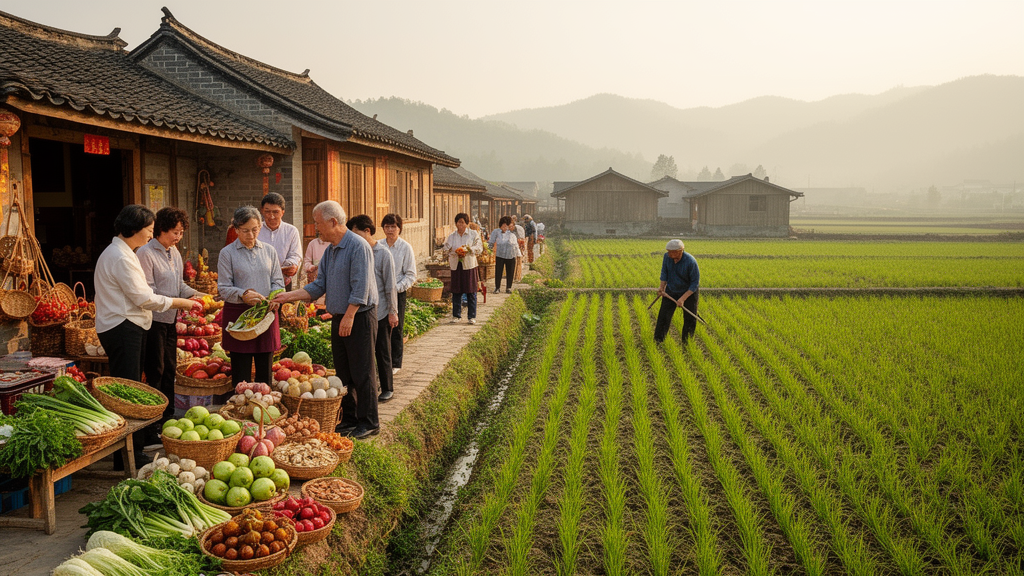
Rural tourism is often promoted as a route to prosperous villages, but a time-series study of China finds the opposite national pattern: higher spending by tourists in rural areas was associated with lower agricultural labor productivity, lower per-capita disposable income and reduced household food consumption. Researchers analyzed official annual data from 1994 to 2023 using three dynamic autoregressive distributed lag models, finding negative short- and long-run associations between rural tourism expenditure and all three indicators. The results challenge the assumption that tourism growth automatically strengthens farming communities, although the authors caution that the national time series cannot establish that tourism spending itself caused the declines.
The study, published in Frontiers in Sustainable Food Systems, treats rural prosperity as more than visitor numbers or tourism receipts. Its three outcomes capture distinct aspects of rural welfare: agricultural labor productivity, measured as value added per employed person; per-capita disposable income among rural residents; and per-capita household food expenditure. Rural tourism expenditure is defined as total tourist consumption expenditure in officially designated rural zones, including spending on accommodation, food and beverage, transportation, recreational activities and local products. It is not government spending on tourism promotion or subsidies, meaning the analysis does not directly evaluate any particular fiscal subsidy program.
The models separated outcomes associated with farming efficiency from those associated with household welfare. The agricultural productivity specification included rural tourism expenditure, total tourism expenditure, rural GDP per capita, urbanization, agricultural land, irrigated area and agricultural mechanization. The rural income model included rural tourism expenditure, total tourism expenditure, rural tourist trips, rural GDP per capita and urbanization. The food consumption model included rural tourism expenditure, total tourism expenditure, rural tourist trips, rural GDP per capita, urbanization and rural income. Thus, total tourism expenditure was represented in all three models, while rural tourist flow appeared in the income and food-consumption specifications.
After logarithmic transformation and adjustment for differences and lags, the data set provided 29 annual observations for estimation, covering 1995 through 2023. The researchers used several unit-root tests to examine stationarity, an ARDL bounds test to assess long-run relationships, and dynamic ARDL simulations to trace responses to unexpected 10% changes in rural tourism spending. The ARDL framework can accommodate variables that are stationary in levels or first differences, a requirement satisfied by the series used here. Diagnostic procedures included autocorrelation, heteroskedasticity, normality and parameter-stability checks, while the simulation approach produced counterfactual response paths for each prosperity indicator.
All three models supported a long-run relationship between rural tourism expenditure and the selected prosperity indicators. The estimated long-run elasticity for agricultural labor productivity was negative, at −0.084. In the model’s log-linear interpretation, a 1% increase in rural tourism expenditure was associated with a 0.084% reduction in agricultural labor productivity, while the estimated short-run coefficient was −0.192. Rural income showed a larger long-run elasticity of −0.461 and a short-run coefficient of −0.0909. Household food expenditure had a long-run coefficient of −0.4427 and a short-run coefficient of −0.1179. These are statistical associations estimated from national annual data, not measured causal effects or results from a randomized policy experiment.
The estimated error-correction terms were negative and statistically significant in all three models, consistent with the cointegration results. Agricultural labor productivity had the most negative adjustment coefficient, at −1.409, followed by household food expenditure at −0.2664 and rural income at −0.1971. The simulated shocks produced a similarly persistent pattern. A positive 10% shock to rural tourism spending produced an immediate and continuing negative deviation in agricultural labor productivity throughout the 20-year forecast horizon, without a return to baseline. A 10% reduction in rural tourism spending was associated with a sustained increase in labor productivity. Rural household food expenditure displayed the same broad symmetry: a positive tourism-spending shock generated a persistent negative response, whereas a negative shock generated a positive response.
The income simulation was less uniform at first, showing a modest short-term positive response to a positive shock before the effect diminished, turned negative and remained adverse over the longer horizon. A 10% negative shock to rural tourism expenditure generated a sustained positive response in rural income over the same period. The researchers also conducted Granger-causality tests, which indicated temporal ordering consistent with their framework: rural tourism expenditure preceded changes in agricultural labor productivity, rural income and household food consumption in the fitted series. This statistical result describes predictive ordering within the models and should not be interpreted as proof of a causal mechanism.
The paper’s proposed explanation is a set of reinforcing mechanisms. Tourism services may draw workers away from agriculture, especially where hospitality, transport and food services offer alternatives to farming, leaving farms with less available labor. Expansion can also place upward pressure on rural land and encourage conversion of arable or permanent-crop land into accommodation and recreational facilities. The authors further describe income leakage, in which tourism receipts leave the local economy through external ownership, imported supplies or franchise arrangements, and a reinvestment trap, where households receiving tourism income channel it into buildings, mechanization or other assets rather than immediate consumption. These mechanisms are theoretical interpretations of the model results rather than pathways directly observed in the dataset.
The findings sit uneasily beside research reporting that tourism can support farm incomes, food security, livelihood resilience, organic-farming adoption or local agricultural demand. One reason may lie in measurement: this study isolates spending in rural areas rather than relying only on broader aggregate tourism indicators that can combine very different local effects. Another is time. Dynamic simulations trace adjustment across years and may capture persistent consequences that a static association misses. The authors also argue that effects may differ with the intensity, spatial form and institutional setting of tourism. Low or moderate growth, tourism closely integrated with local farming, and stronger agricultural capital may produce different outcomes from concentrated tourism development that competes for land and labor.
Diagnostic tests broadly supported the stability and specification of the models. CUSUM and CUSUM-squared results indicated stable regression coefficients and error variance, while Breusch–Godfrey and information-matrix tests did not reject the reported null hypotheses of no autocorrelation or misspecification across the assessed components. A Zivot–Andrews test identified a significant structural break in rural tourism expenditure in 2017, but the main dependent variables did not show significant level breaks, and the authors did not include break dummies in the primary specifications. The ARDL bounds F-statistics exceeded the relevant upper bounds for all three models, supporting the estimation of long-run and short-run relationships.
Several limitations constrain interpretation. The analysis contains only 30 annual observations before differencing and lag selection, leaving 29 for estimation, and it relies on one country. Lagged variables and structural controls can reduce, but cannot eliminate, reverse causality, simultaneity and omitted-variable bias. Rural income or infrastructure may increase both tourism demand and agricultural performance, while other local changes may affect all three outcomes. The models also estimate national relationships and do not directly identify particular rural communities, forms of tourism or local tourism concentrations. The authors therefore call for instrumental-variable or quasi-experimental studies to strengthen causal identification, as well as research comparing agritourism with nature-based tourism, testing poverty and inequality outcomes and identifying nonlinear thresholds at which tourism becomes detrimental. Based on the evidence presented, the defensible conclusion is that rural tourism expenditure in China was associated with weaker agricultural and household outcomes, not that tourism is beneficial or harmful in every rural setting.
Subject of Research: Associations between rural tourism expenditure and agricultural productivity, rural income and household food consumption in China
Article Title: The effect of rural tourism on rural prosperity: evidence from China on agricultural labor productivity, incomes, and household food consumption
Article References: Jin, L., Geremew, B. A., & Abate, M. C. (2026). The effect of rural tourism on rural prosperity: evidence from China on agricultural labor productivity, incomes, and household food consumption. Frontiers in Sustainable Food Systems, 10, 1904226. https://doi.org/10.3389/fsufs.2026.1904226
Image Credits: AI Generated
DOI: 10.3389/fsufs.2026.1904226
Keywords: rural tourism, agricultural productivity, rural income, food consumption, China, tourism spending, rural development, ARDL model, time-series analysis, agricultural labor, effect, rural
Cite Scienmag News
Alan Morgan. (October 21, 2026). Rural tourism spending linked to weaker Chinese farm prosperity. Scienmag. https://scienmag.com/rural-tourism-spending-linked-to-weaker-chinese-farm-prosperity/
Alan Morgan. "Rural tourism spending linked to weaker Chinese farm prosperity." Scienmag, 21 October 2026, https://scienmag.com/rural-tourism-spending-linked-to-weaker-chinese-farm-prosperity/. Accessed 21 October 2026.
Alan Morgan. "Rural tourism spending linked to weaker Chinese farm prosperity." Scienmag. October 21, 2026. https://scienmag.com/rural-tourism-spending-linked-to-weaker-chinese-farm-prosperity/