

Friday, May 1, 2026
Science
No Result
View All Result
  • Login
  • HOME
  • SCIENCE NEWS
  • CONTACT US
  • HOME
  • SCIENCE NEWS
  • CONTACT US
No Result
View All Result
Scienmag
No Result
View All Result
Home Science News Athmospheric

Why do typhoons like to cluster?

September 3, 2024
in Athmospheric
Reading Time: 3 mins read
0
Multiple tropical cyclone
67
SHARES
609
VIEWS
Share on FacebookShare on Twitter
ADVERTISEMENT

Exploring the Impact of Different Weather Patterns on the Formation of Multiple Tropical Cyclones

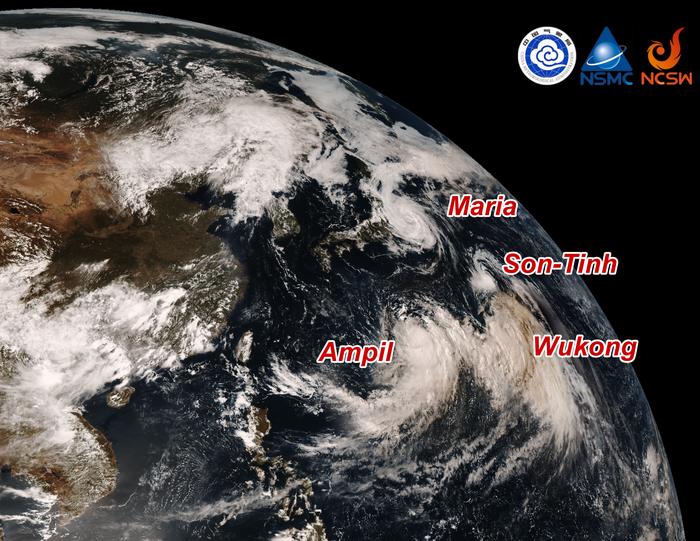
Multiple tropical cyclone

Credit: National Satellite Meteorological Centre of China

Exploring the Impact of Different Weather Patterns on the Formation of Multiple Tropical Cyclones


This August, Japan and South Korea, particularly Japan, have experienced a dramatic surge in typhoon activity. From August 8 to August 13, within just six days, Typhoons Maria, Son-Tinh, Ampil, and Wukong consecutively formed over the waters east of Japan. Among them, Tropical Storm Maria caused record-breaking rainfall in parts of northern Japan, while just a few days later, Typhoon Ampil arrived during Japan’s Obon holiday week, causing significant damage in Japan. Starting from August 19, Typhoons Jongdari and Shanshan formed in quick succession, reaching the coastal areas of South Korea and Japan, respectively. This sequence of storms is a striking example of a phenomenon called multiple tropical cyclone (MTC) formation, where several typhoons either occur at the same time or follow one another in quick succession. The region typically sees about five of these clustering events each year, and their combined impact can significantly increase disaster risks and cause extensive damage.

So, why do typhoons seem to group together?

A recent study led by Professor Ruifen Zhan and her team at Fudan University sheds light on this puzzling question. Their research, published in Advances in Atmospheric Sciences, explores the key weather patterns that contribute to this clustering of tropical cyclones.

Prof. Zhan and her team have identified several important weather patterns that make it more likely for typhoons to cluster:

  • Monsoon Trough: “This pattern forms when the subtropical high pressure system interacts with the monsoon trough,” Prof. Zhan explains. “Typhoons often develop along the monsoon trough and its surrounding areas.”
  • Confluence Zone: This occurs where different wind currents meet. “Here, the southwesterly and southeasterly winds come together,” says Prof. Zhan. “Typhoons can form at this meeting point, influenced by surrounding high-pressure systems.”
  • Easterly Waves: These are large, slow-moving waves of wind that travel from east to west. Typhoons often form along these easterly waves.
  • Monsoon Gyre: This pattern involves a large, spinning system of winds called a monsoon vortex. “Typhoons can form within this spinning system,” Prof. Zhan adds.


The study also looks into how these patterns create the right conditions for typhoons to develop. For instance, the Monsoon Trough pattern is driven by certain wind and moisture conditions, while the other patterns rely on different atmospheric factors.

“In our previous research, we aimed to understand the atmospheric circulation patterns conducive to the formation of MTCs,” says Prof. Zhan. “This study provides a theoretical basis for improving the predictability and early warning systems for these complex events.”


Journal

Advances in Atmospheric Sciences

DOI

10.1007/s00376-024-3237-4

Article Title

Environmental Conditions Conducive to the Formation of Multiple Tropical Cyclones over the Western North Pacific

Article Publication Date

28-Aug-2024

Share27Tweet17
Previous Post

How cheerful is that water bottle?

Next Post

MSK Research Highlights, September 3, 2024

Related Posts

Randomized Clinical Trial Reveals Plant-Based Diet Slashes Climate Impact by Over 50% — Athmospheric
Athmospheric

Randomized Clinical Trial Reveals Plant-Based Diet Slashes Climate Impact by Over 50%

April 30, 2026
Only a Handful of Species Steer Plant Communities’ Reaction to Rising Temperatures — Athmospheric
Athmospheric

Only a Handful of Species Steer Plant Communities’ Reaction to Rising Temperatures

April 30, 2026
New Clinical Trial Reveals Vegan Diet Significantly Reduces Food-Related Emissions and Boosts Health — Athmospheric
Athmospheric

New Clinical Trial Reveals Vegan Diet Significantly Reduces Food-Related Emissions and Boosts Health

April 30, 2026
Breakthrough Discovery: The Organelle Fueling Methane Production in Livestock — Athmospheric
Athmospheric

Breakthrough Discovery: The Organelle Fueling Methane Production in Livestock

April 30, 2026
Evolutionary History Influences Fruit Size, with Climate Affecting Its Impact — Athmospheric
Athmospheric

Evolutionary History Influences Fruit Size, with Climate Affecting Its Impact

April 30, 2026
FAU Study Uncovers Cellular Secrets Behind Camels’ Heat Resilience — Athmospheric
Athmospheric

FAU Study Uncovers Cellular Secrets Behind Camels’ Heat Resilience

April 30, 2026
Next Post
MSK Researcher

MSK Research Highlights, September 3, 2024

  • Mothers who receive childcare support from maternal grandparents show more parental warmth, finds NTU Singapore study

    Mothers who receive childcare support from maternal grandparents show more parental warmth, finds NTU Singapore study

    27639 shares
    Share 11052 Tweet 6908
  • University of Seville Breaks 120-Year-Old Mystery, Revises a Key Einstein Concept

    1042 shares
    Share 417 Tweet 261
  • Bee body mass, pathogens and local climate influence heat tolerance

    677 shares
    Share 271 Tweet 169
  • Researchers record first-ever images and data of a shark experiencing a boat strike

    540 shares
    Share 216 Tweet 135
  • Groundbreaking Clinical Trial Reveals Lubiprostone Enhances Kidney Function

    527 shares
    Share 211 Tweet 132
Science

Embark on a thrilling journey of discovery with Scienmag.com—your ultimate source for cutting-edge breakthroughs. Immerse yourself in a world where curiosity knows no limits and tomorrow’s possibilities become today’s reality!

RECENT NEWS

  • New study reveals limited social support for traumatized children within their own circles
  • New Legislation Reduces Cannabis Arrests, Yet Racial Disparities Remain
  • Strategies to Prevent Supply Chain Disruptions Amid the Rapid Growth of Drone and Robot Manufacturing
  • Dr. Hannah Cabré Named Assistant Professor and Director of Aging, Gynecology, and Endocrinology Lab at Pennington Biomedical

Categories

  • Agriculture
  • Anthropology
  • Archaeology
  • Athmospheric
  • Biology
  • Biotechnology
  • Blog
  • Bussines
  • Cancer
  • Chemistry
  • Climate
  • Earth Science
  • Editorial Policy
  • Marine
  • Mathematics
  • Medicine
  • Pediatry
  • Policy
  • Psychology & Psychiatry
  • Science Education
  • Social Science
  • Space
  • Technology and Engineering

Subscribe to Blog via Email

Enter your email address to subscribe to this blog and receive notifications of new posts by email.

Join 5,145 other subscribers

© 2025 Scienmag - Science Magazine

Welcome Back!

Login to your account below

Forgotten Password?

Retrieve your password

Please enter your username or email address to reset your password.

Log In
No Result
View All Result
  • HOME
  • SCIENCE NEWS
  • CONTACT US

© 2025 Scienmag - Science Magazine

Discover more from Science

Subscribe now to keep reading and get access to the full archive.

Continue reading
