


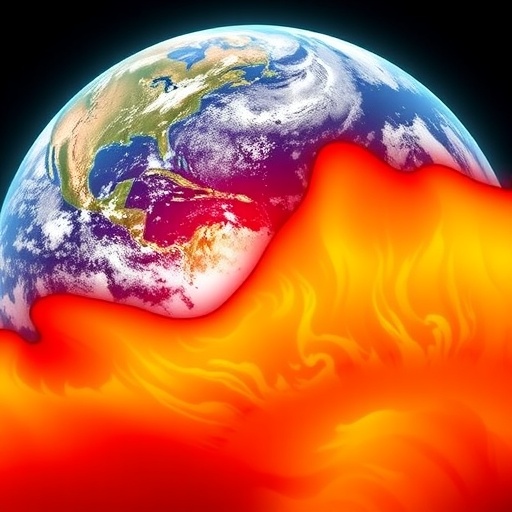
On June 11, 2026, the global scientific community collectively sounded a clarion call as the fourth edition of the Indicators of Global Climate Change (IGCC) report revealed unequivocal evidence of the accelerating pace of Earth’s warming. Released through the reputable journal Earth System Science Data, this comprehensive observational study underscores an era where the entire climate system is heating at unprecedented rates due to persistent anthropogenic influences. Human activities have already elevated global temperatures to 1.37°C above pre-industrial levels in 2025, and projections indicate that the critical threshold of 1.5°C warming will be breached within the next four years, possibly around 2030.
This alarming trend is underpinned by the Earth’s growing energy imbalance—a key metric quantifying the incremental heat retained by the planet’s climate system. Ideally, Earth’s energy budget should be nearly in equilibrium, with incoming solar energy balanced by outgoing heat radiation. However, since the 1970s this balance has steadily tipped, with the energy imbalance doubling over recent decades, signaling a formidable and accelerating heat accumulation in the atmosphere, oceans, cryosphere, and terrestrial environments. This escalating energy surplus is a direct consequence of rising greenhouse gas concentrations, principally from fossil fuel combustion, which enhance the trapping of thermal radiation.
In 2024, global greenhouse gas emissions, quantified as carbon dioxide equivalents (CO2e), hit a record peak of 56.8 gigatonnes, driven primarily by unabated fossil fuel burning. This emission surge perpetuates an increased atmospheric load of carbon dioxide, methane, and nitrous oxide—all potent greenhouse gases whose molecular properties intricately dictate absorption of infrared radiation, thereby catalyzing global warming. Notably, atmospheric measurements in 2025 highlighted concentrations reaching 425.6 ppm for CO2, 1936.3 ppb for CH4, and 339.4 ppb for N2O, marking substantial increments over the prior six years. The elevated concentrations signify a feedback loop whereby intensified emissions entrench the warming trajectory further.
The decade spanning 2016 through 2025 registered a notable temperature anomaly, averaging 0.32°C warmer than the preceding decade of 2006–2015. Exceptional warmth during 2023 and 2024 amplified this warming trend. This period has witnessed the unmasking of greenhouse gas-induced warming effects previously dampened by atmospheric aerosols, particularly sulfur dioxide. Reduction in sulfur aerosol emissions, while beneficial for air quality, unfortunately diminishes their cooling influence, thereby revealing a greater proportion of GHG-driven warming. Consequently, current warming rates hover near 0.27°C per decade, emphasizing a relentless upward temperature trend.
Sea level rise, intrinsically coupled to thermal expansion of ocean waters and accelerated ice melt from glaciers and ice sheets, is exhibiting an alarming acceleration in line with the Earth’s energy imbalance. By 2025, the observed global mean sea level had risen to 23 centimeters above the baseline established in 1901, advancing at roughly 1.8 millimeters per year with an increasing rate trajectory. This seemingly modest elevation exacerbates coastal flooding events globally, endangering vulnerable ecosystems and human settlements, particularly in low-lying coastal regions, and portending profound socio-economic consequences if unmitigated.
Marine heatwaves, a relatively novel metric incorporated in this IGCC edition, highlight the intensification and frequency of anomalously warm oceanic conditions. Globally, aquatic ecosystems experienced 65 days of marine heatwaves in 2025 alone, a stark increase from historical baselines. Such prolonged oceanic thermal extremes disrupt biological productivity, hinder fisheries, and compromise marine biodiversity. Beyond ecological impacts, marine heatwaves perturb ocean-atmosphere carbon exchanges and modify ocean chemistry, including acidification and oxygen depletion, thereby cascading effects on global climate variability and extreme weather patterns on land.
Land surface temperature extremes have also reached unprecedented peaks in the recent decade. Average maximum land temperatures for any given day have increased by approximately 0.49°C since the prior decade, accentuating risks to agriculture, water resources, and human health. Precipitation patterns are exhibiting enhanced variability, with increased rainfall over regions such as Asia, the Maritime Continent, Siberia, and southern Africa during 2025, attributed in part to La Niña conditions. Conversely, drought alleviation in central South America marks notable hydrological shifts, while the Arctic and extensive Siberia continue to experience persistently wet conditions.
The IGCC report places critical emphasis on the remaining global carbon budget, delineating the finite amount of carbon dioxide emissions permissible if the world is to limit warming to the internationally agreed 1.5°C target. Starting from 2026, this budget stands at an estimated 130 gigatonnes of CO2. At current emission rates, this buffer could be entirely exhausted within approximately three years, highlighting the urgency for accelerated and transformative decarbonization strategies. The report serves as an unambiguous indicator that incremental mitigation efforts are insufficient; rather, bold systemic changes must rapidly curtail emissions pathways.
The scientific endeavor behind this latest IGCC edition involved over seventy distinguished researchers affiliated with more than fifty-six institutions across seventeen countries. The collective expertise ranges across climatology, atmospheric sciences, oceanography, and environmental monitoring, ensuring robust interdisciplinary analysis. Notably, this collaborative initiative supports the Copernicus Earth Observation program under the European Union’s Space Programme, leveraging advanced satellite and in-situ observational datasets to monitor and analyze climate indicators with unparalleled precision.
Continuity in climate data acquisition remains a pivotal concern. Numerous critical global datasets informing the IGCC are currently jeopardized by funding uncertainties, which threaten the long-term viability of climate monitoring efforts. Experts advocate for coordinated international action and sustained investment to safeguard these observational infrastructures. The absence of consistent high-quality data would impair future assessments and undermine science-driven policy making at a time when evidence-based climate action is paramount.
The implications of these findings transcend academic discourse, manifesting as tangible threats to human societies and natural ecosystems worldwide. Continued warming is projected to exacerbate extreme weather events, disrupt agricultural systems, intensify water scarcity, and accelerate biodiversity loss. The IGCC report’s stark projections illustrate that the upcoming decade represents a critical juncture—presenting both unprecedented challenges and a narrow window for decisive interventions to mitigate long-term global climate risks.
In summary, the 2026 IGCC report delivers compelling, high-resolution insights into the evolving nature of Earth’s climate system under human influence. It documents an accelerating thermal signal permeating oceans, atmosphere, and cryosphere, driven by record-high emissions of greenhouse gases. The emerging patterns of energy imbalance, sea level rise, marine heatwave frequency, and temperature extremes collectively underscore a climate system teetering further out of equilibrium. With the remaining carbon budget rapidly dwindling, the report calls for immediate global mobilization toward ambitious decarbonization and adaptive strategies to avert the most catastrophic climate futures.
News Publication Date: 11 June 2026
Web References: DOI accessible through Earth System Science Data (specific DOI link not provided)
References: Forster et al., 2026. Indicators of Global Climate Change (IGCC), Earth System Science Data
Cite Scienmag News
Russell Cooper. (June 10, 2026). Earth’s Heat Accumulation Accelerates, Global Warming Hits 1.37°C in 2025. Scienmag. https://scienmag.com/earths-heat-accumulation-accelerates-global-warming-hits-1-37c-in-2025/
Russell Cooper. "Earth’s Heat Accumulation Accelerates, Global Warming Hits 1.37°C in 2025." Scienmag, 10 June 2026, https://scienmag.com/earths-heat-accumulation-accelerates-global-warming-hits-1-37c-in-2025/. Accessed 3 September 2026.
Russell Cooper. "Earth’s Heat Accumulation Accelerates, Global Warming Hits 1.37°C in 2025." Scienmag. June 10, 2026. https://scienmag.com/earths-heat-accumulation-accelerates-global-warming-hits-1-37c-in-2025/


