


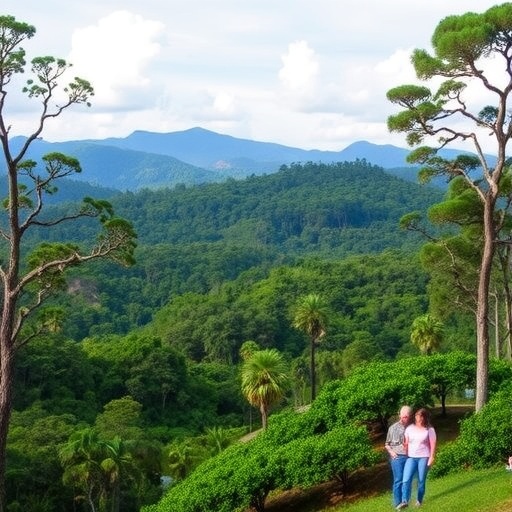
In the verdant landscapes of the Colombian Andes, an area renowned for its prolific coffee production and exceptional biodiversity, a paradigm shift is emerging in conservation science. Recent investigations reveal that the overarching presence of forest cover around coffee farms plays a far more pivotal role in sustaining avian diversity than previously appreciated. This understanding transcends the conventional focus on farm-level shade management, emphasizing the indispensable nature of landscape-scale forest conservation for robust bird communities.
Drawing insights from an integrative study spearheaded by ecologists affiliated with SELVA and the Smithsonian’s National Zoo and Conservation Biology Institute, researchers employed advanced computational simulation and ecological modeling techniques to dissect the interplay between local vegetation structure and broader landscape composition. The results illuminate how these factors synergistically influence bird habitat use within one of the globe’s critical coffee-growing regions.
Central to their findings is the compelling influence of forest cover within a 2-kilometer radius around coffee farms. This spatial scale emerged as a critical determinant of bird occupancy across diverse ecological guilds—groups of species utilizing resources in functionally similar ways. Irrespective of their foraging strategies or habitat specializations, avifauna demonstrated a pronounced preference for environments embedded within extensive forest matrices.
Species inherently dependent on forest ecosystems exhibited heightened sensitivity, necessitating a minimum threshold of 32% forest cover in surrounding landscapes to attain median occupancy levels. This contrasts sharply with generalist species, which displayed a remarkable degree of ecological plasticity. Such species maintained median occupancy levels not only within remnant forest patches but also amidst shade-grown coffee plantations boasting at least ten different tree species and a canopy cover of 45%.
Intriguingly, the research unveiled a nuanced interaction between landscape-scale forest availability and farm-scale vegetation complexity. As deforestation intensifies, the ecological burden shifts toward on-farm habitat quality; coffee plantations in deforested regions must compensate by cultivating denser, more diverse shade canopies to uphold avian diversity. This discovery underscores that local agroforestry management cannot substitute for landscape-level conservation but rather must operate in concert with it.
Differential responses among bird guilds to farm vegetation types were also observed. Dense, structurally complex shade plantations positively influenced the presence of generalists, frugivores, insectivores, and nectarivores, each critical for ecological functions such as seed dispersal and pollination. Conversely, sun coffee systems—characterized by intensive monoculture with scarce or no shade trees—favored granivores and omnivores. Early successional forest patches similarly supported these latter guilds, illustrating the varied habitat preferences that complicate conservation strategies.
Beyond spatial dynamics, temporal variability emerged as a key component of habitat use. The study detected seasonal shifts, notably an increased utilization of forest habitats by multiple guilds during December and January, coinciding with peak breeding periods. This temporal dependence accentuates the necessity of preserving heterogeneous habitats throughout the year to accommodate differing life history needs.
The collective evidence positions forest conservation and shade-coffee management as dual, complementary pillars of avian biodiversity preservation. Forest cover provides the fundamental ecological framework within which farm-scale interventions can enhance habitat quality, rather than acting as isolated or interchangeable tactics. For the Eastern Colombian Andes, elevating forest cover holds promise for augmenting habitat suitability across nearly all bird guilds, thereby bolstering both biodiversity and the sustainability of coffee production landscapes.
This research carries profound implications for global agroforestry and conservation paradigms. As coffee cultivation expands against a backdrop of rampant deforestation and habitat fragmentation, strategies that integrate landscape-level forest preservation with intricately managed shade systems may emerge as vital blueprints for reconciling agricultural productivity with biodiversity conservation.
Moreover, the study’s use of computational simulation and ecological modeling exemplifies the increasing sophistication of conservation science, enabling nuanced understanding of complex ecological interactions at multiple scales. These methodological advances catalyze evidence-based decision making, guiding stakeholders and policymakers toward interventions that support ecosystem services fundamental to both human well-being and wildlife persistence.
In sum, the Colombian Andes offer an illuminating case study that elevates forest cover to a linchpin status in tropical coffee farming landscapes. The intricate dance between landscape matrix and on-farm vegetation orchestrates patterns of avian occupancy that bear directly upon ecosystem health and productivity. Conservation efforts anchored in this dual focus promise to forge resilient agroecosystems where biodiversity thrives alongside sustainable coffee livelihoods.
Cite Scienmag News
Alan Morgan. (June 10, 2026). Conservationists Highlight Importance of Preserving Intact Forests Within Coffee Landscapes. Scienmag. https://scienmag.com/conservationists-highlight-importance-of-preserving-intact-forests-within-coffee-landscapes/
Alan Morgan. "Conservationists Highlight Importance of Preserving Intact Forests Within Coffee Landscapes." Scienmag, 10 June 2026, https://scienmag.com/conservationists-highlight-importance-of-preserving-intact-forests-within-coffee-landscapes/. Accessed 4 September 2026.
Alan Morgan. "Conservationists Highlight Importance of Preserving Intact Forests Within Coffee Landscapes." Scienmag. June 10, 2026. https://scienmag.com/conservationists-highlight-importance-of-preserving-intact-forests-within-coffee-landscapes/


