


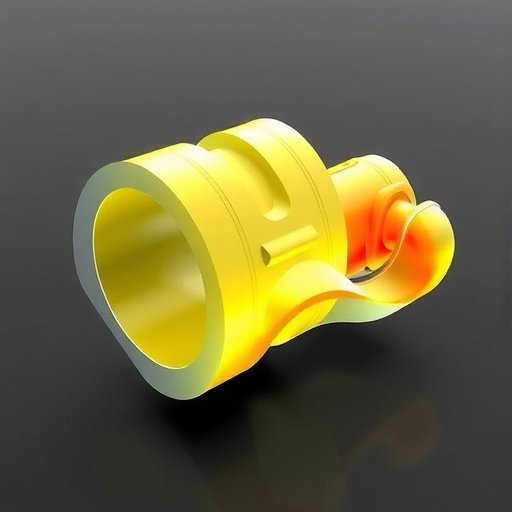
Industrial flow components may soon be designed with far greater aerodynamic efficiency, following the introduction of a computational strategy that brings three-dimensional topology optimization closer to practical engineering workflows. In a study published in Communications Engineering, Tian, Li, Ren and colleagues present a “pseudo three-dimensional” method intended to reduce aerodynamic resistance in industrial flow components. The approach addresses a long-standing challenge in fluid engineering: how to create shapes that guide air or other fluids efficiently while remaining realistic to manufacture, analyze and deploy.
Aerodynamic resistance is a major source of energy loss in systems that transport fluids. Pipes, ducts, channels, valves, diffusers, cooling passages and other industrial components can generate pressure drops when their internal geometries force a moving fluid to separate, recirculate or collide with surfaces. Even modest losses can become significant across large facilities operating continuously. Reducing resistance can therefore lower pumping or ventilation energy requirements, improve system performance and potentially reduce the environmental footprint of industrial infrastructure.
Topology optimization is one of the most powerful tools developed to address this problem. Instead of adjusting only a few predefined dimensions, the technique allows a computer to determine where material should remain and where it can be removed within a specified design region. When applied to fluid systems, the method seeks geometries that meet a target performance—such as lower pressure loss or improved flow uniformity—while obeying constraints related to space, strength and production. The resulting forms can be highly unconventional, often resembling organic structures rather than traditional engineered parts.
The difficulty is that fully three-dimensional optimization can demand enormous computational resources. Fluid motion must be calculated throughout a volume, while the design evolves through repeated cycles of simulation and modification. Each cycle may involve solving complex equations that describe conservation of mass, momentum and energy. For industrial design teams, the time and computing power required can make the method difficult to integrate into routine development, particularly when many operating conditions or component variations must be examined.
The pseudo three-dimensional strategy described by the researchers is designed to address that barrier. Based on the study’s title and stated purpose, the method seeks to capture key three-dimensional flow and shape effects without requiring the full computational burden of a conventional three-dimensional topology-optimization process. It does so by providing an intermediate design framework: more representative of real industrial geometries than a purely two-dimensional model, yet potentially more manageable than a complete volumetric optimization.
This distinction could be important because industrial flow components rarely behave as simple flat channels. Curvature, changing cross-sections, wall interactions and the transition between inlet and outlet regions can all influence resistance. A method that accounts for these features while simplifying the numerical problem may allow engineers to explore more design alternatives in less time. It could also make advanced optimization accessible to organizations that lack the computing infrastructure typically associated with high-fidelity three-dimensional simulation.
At the technical core of the work is the relationship between geometry and fluid dynamics. As a fluid moves through a component, its velocity field changes from one location to another. Poorly shaped transitions can produce vortices and separated flow, converting useful mechanical energy into turbulence and heat. An optimization algorithm can instead search for smoother pathways that control acceleration, deceleration and redirection. By repeatedly evaluating candidate geometries against an aerodynamic objective, the computational process can identify regions where material or structural boundaries contribute little to efficient flow and areas where they remain essential.
The potential impact extends beyond a single component or industry. Lower-resistance designs could be relevant to ventilation equipment, industrial cooling systems, process machinery, energy-generation facilities and transportation-related fluid networks. In each case, the value of the method would depend on how well its optimized geometries can be translated into manufacturable parts. That issue is especially important for topology optimization, whose mathematically efficient forms may contain thin features, sharp transitions or intricate internal passages. Practical implementation therefore requires careful consideration of fabrication methods, tolerances, maintenance and durability.
The study arrives at a moment when engineering is increasingly shaped by computational design, digital manufacturing and pressure to reduce energy consumption. Its pseudo three-dimensional framework represents a possible bridge between highly simplified design models and computationally expensive full-scale simulations. Rather than treating optimization as a purely theoretical exercise, the approach is aimed at industrial flow components, where efficiency gains must coexist with engineering constraints. If validated across a broad range of operating conditions and manufacturing processes, such methods could help transform the hidden geometry inside everyday machines—and make the movement of fluids through industry smoother, quieter and less energy-intensive.
Cite Scienmag News
Denise Maddox. (August 12, 2026). New pseudo-3D topology optimization method cuts aerodynamic drag in industrial flow components. Scienmag. https://scienmag.com/new-pseudo-3d-topology-optimization-method-cuts-aerodynamic-drag-in-industrial-flow-components/
Denise Maddox. "New pseudo-3D topology optimization method cuts aerodynamic drag in industrial flow components." Scienmag, 12 August 2026, https://scienmag.com/new-pseudo-3d-topology-optimization-method-cuts-aerodynamic-drag-in-industrial-flow-components/. Accessed 4 September 2026.
Denise Maddox. "New pseudo-3D topology optimization method cuts aerodynamic drag in industrial flow components." Scienmag. August 12, 2026. https://scienmag.com/new-pseudo-3d-topology-optimization-method-cuts-aerodynamic-drag-in-industrial-flow-components/


