


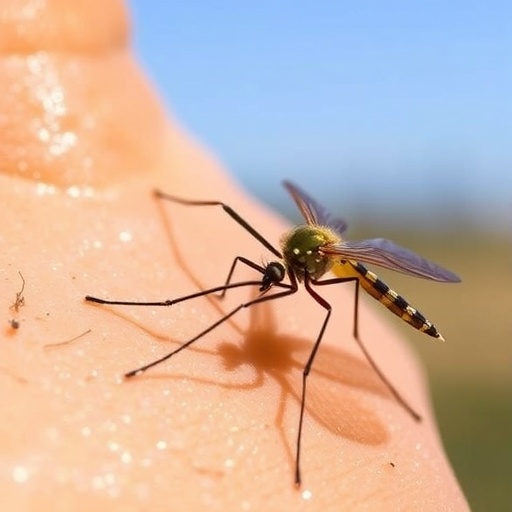
In a groundbreaking study recently published in The Lancet Regional Health – Americas, researchers have raised urgent alarms about the burgeoning threat of dengue fever in California, a state historically free from the local transmission of this tropical disease. Dengue fever, often dubbed “breakbone fever” for the severe, disabling joint and muscle pain it causes, is poised to become a significant public health concern in regions of California due to shifting climatic conditions. This unsettling development underscores the profound impact of global warming on infectious disease dynamics, particularly vector-borne illnesses, as the Aedes aegypti mosquito, the primary carrier of dengue virus, finds new footholds in temperate zones.
Dengue fever is caused by the dengue virus, which exists in four antigenically distinct serotypes. Infection with one serotype typically confers lifelong immunity against that specific strain but not against the others, and subsequent infections with different serotypes can trigger severe, sometimes fatal conditions due to antibody-dependent enhancement. The virus is transmitted exclusively by Aedes aegypti mosquitoes, highly adapted to urban environments and with a strong preference for human blood meals. Until recently, these mosquitoes and the virus they carry were confined mostly to tropical and subtropical climates.
The landscape in California is shifting rapidly. The first documented presence of Aedes aegypti in the state was recorded in 2013, and within a decade, it had spread to over half of California’s counties. The year 2023 marked a critical turning point when public health officials confirmed local, non-travel-associated dengue infections for the first time. One patient from Pasadena was hospitalized with dengue, and a neighborhood screening revealed another asymptomatic case, confirming endemic circulation of the virus in a region once thought inhospitable to its lifecycle.
The critical factor influencing dengue’s potential establishment lies in California’s warming climate. The virus requires an optimal temperature near 29 degrees Celsius (about 84 degrees Fahrenheit) for efficient replication inside the mosquito host. Mosquitoes ingest the virus during a blood meal, and the virus must undergo an extrinsic incubation period within the mosquito before it can be transmitted to another human host. Cooler temperatures historically created a bottleneck effect by prolonging this viral incubation period, reducing transmission efficiency. However, accelerated warming trends are eroding these thermal limitations, expanding windows of transmission and increasing the number of locations where conditions are suitable for sustained dengue virus circulation.
Researchers from several institutions, including UC Berkeley, UC Santa Barbara, and Stanford University, employed semi-mechanistic models integrating entomological data, climate projections, human mobility patterns, and land-use changes to predict current and future dengue risk zones within California. Their analysis revealed that approximately 18.2 million residents, nearly half of the state’s population, currently inhabit areas with the necessary environmental and epidemiological prerequisites for dengue transmission. Moreover, the models forecast a geographic and temporal expansion of transmission seasons as global warming and urban expansion continue.
Importantly, these models also accounted for human mobility, a critical vector-independent factor in the virus’s spread. Many local dengue cases in California have been traced back to returning travelers from endemic regions, introducing the virus into mosquito populations newly capable of sustaining local transmission cycles. This repeated reintroduction in conjunction with expanding mosquito habitats elevates the risk of endemic establishment, potentially rendering dengue a permanent public health challenge for the state.
However, the study highlights uncertainty contingent on demographic and socioeconomic variables that affect human movement and exposure risks. For instance, the assumption that populations with ethnic ties to endemic countries may travel more frequently to those regions introduces complex biases into risk projections. Similarly, the role of socioeconomic status in facilitating travel to dengue hotspots worldwide adds layers of unpredictable complexity to forecasting future outbreaks.
Beyond dengue alone, the researchers caution that other Aedes-borne diseases such as chikungunya and Zika virus infections could follow similar trajectories of expanding transmission risk under California’s warming climate. Both diseases share the same primary vector, and their ecology is similarly contingent on temperature and urban environmental factors, raising concerns for multimodal arboviral threats in the near future.
At present, Californians are urged to adopt evidence-based preventative measures to mitigate the risk of infection. These include eliminating standing water sources around homes to disrupt mosquito breeding, using effective insect repellents such as those containing DEET, and wearing protective clothing during peak mosquito activity periods. Public health advisories also recommend that individuals who have traveled to dengue-endemic regions continue to use protective measures against mosquito bites for at least three weeks after returning to avoid potential local transmission.
This unfolding story is a potent reminder of how environmental changes are reshaping disease landscapes and the critical role of surveillance, modeling, and public awareness in preparing for emerging infectious diseases. It stresses the interconnectedness of global mobility, urbanization, and climate change in propagating vector-borne illnesses beyond their traditional ranges. As California stands at the frontline of this epidemiological shift, integrated efforts spanning climate science, entomology, epidemiology, and public policy will be pivotal to anticipating, controlling, and ultimately mitigating the impacts of dengue fever in this new era.
Cite Scienmag News
Kristina Jarvis. (June 10, 2026). Rising Temperatures in California Could Fuel Increase in Dengue Fever Cases. Scienmag. https://scienmag.com/rising-temperatures-in-california-could-fuel-increase-in-dengue-fever-cases/
Kristina Jarvis. "Rising Temperatures in California Could Fuel Increase in Dengue Fever Cases." Scienmag, 10 June 2026, https://scienmag.com/rising-temperatures-in-california-could-fuel-increase-in-dengue-fever-cases/. Accessed 3 September 2026.
Kristina Jarvis. "Rising Temperatures in California Could Fuel Increase in Dengue Fever Cases." Scienmag. June 10, 2026. https://scienmag.com/rising-temperatures-in-california-could-fuel-increase-in-dengue-fever-cases/


