


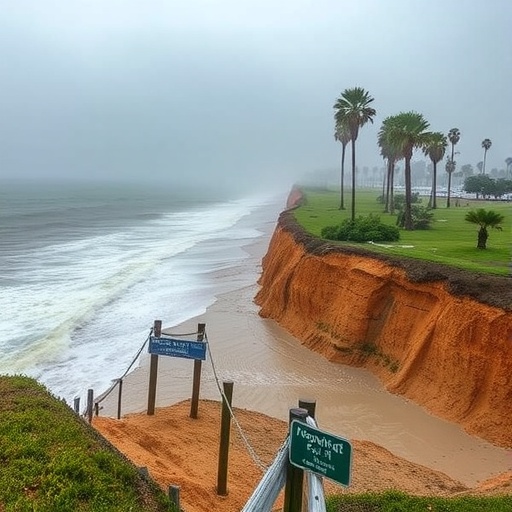
In the coming decades, Southern California, a region traditionally shielded from tropical cyclones due to its unique climatic setting, is projected to face a marked increase in extreme rainfall events stemming from tropical storms. This escalation is intricately linked to rising ocean temperatures and shifting atmospheric dynamics driven by climate change. A groundbreaking study published in Nature Climate Change offers an in-depth analysis of the emerging risks, particularly focusing on landslides triggered by tropical cyclone-induced heavy precipitation. The research reveals that while these intense rainfall events have been rare historically, their frequency and severity are expected to rise significantly, posing a major hazard for the region’s population and infrastructure.
Historically, tropical cyclones have been an infrequent phenomenon in Southern California, largely because of the cool sea surface temperatures (SSTs) prevalent in the northeastern Pacific. This natural oceanic barrier has historically suppressed storm formation and long-distance survival of such cyclones reaching the west coast. However, decades of steadily increasing SSTs, exacerbated by global warming and natural climatic oscillations like El Niño, are altering this status quo. As these waters warm, they create a more hospitable environment for tropical cyclones, which derive their energy from warm, moist air over ocean surfaces, enabling more intense and sustained storms.
In bright contrast to the hurricane-prone Atlantic and Gulf Coasts, where communities have longstanding infrastructure and emergency protocols to mitigate tropical cyclone damage, Southern Californian residents are less prepared due to the rarity of these climatic events. The recent 2023 remnants of Hurricane Hilary starkly demonstrated the vulnerability of the region. Hilary’s decaying yet potent tropical moisture unleashed record-breaking rainfall, causing catastrophic flash floods, immobilizing traffic systems, and triggering extensive landslides that buried homes under mud. The financial toll exceeded $900 million, underscoring the substantial risks that these so-called “grey swan” storms represent—events that are neither entirely unforeseen nor frequent but possess potentially severe consequences.
Scientists term these unusual, high-impact phenomena “grey swans” to denote their intermediate predictability. Unlike “black swans,” which are unpredictable and devastating events defying existing probability frameworks, grey swans emerge from physical climate mechanisms but fall outside historical norms. These storms can be hypothesized and analyzed using climate science tools but may not be evident from past weather records alone. This nuanced understanding directs attention toward anticipating and preparing for intensifying hazards that might not be prominent in historical data yet are underpinned by evolving climate dynamics.
This research initiative was sparked by personal ties to Southern California’s vulnerability, as lead author Yuan Wang experienced firsthand the aftereffects of Hilary in his former community. Driven by a concern for the region’s future in a warming world, Wang and colleagues gathered a multidisciplinary team to dissect the linkages between ocean warming, storm behavior, precipitation intensity, and human exposure in the region. Their goal was to forecast the evolving risks of tropical cyclone-induced landslides and to quantify the potential impact on different socioeconomic groups, recognizing that vulnerability is often unequally distributed.
At the crux of this study is understanding how an incremental rise in Eastern Pacific sea surface temperatures—projected to climb by about 2.7 degrees Celsius by the late 21st century—can dramatically amplify the probability of extreme rainfall events. Using sophisticated climate models paired with statistical downscaling techniques, the team simulated thousands of hypothetical storms, evaluating their likelihood of delivering significant precipitation to Southern California’s terrain. The results consistently showed that the chance of experiencing a 100-year rainfall event similar to Hurricane Hilary doubles under future warming scenarios, substantially increasing flood and landslide hazards.
Southern California’s mountainous landscape further compounds the risk of landslides. Moist air forced upward by mountain slopes cools and condenses, often resulting in intense, localized downpours. Climate change exacerbates this by increasing atmospheric moisture content and destabilizing soils, which are alternately parched by drought or overwhelmed by sudden rains. The dry soil’s diminished water absorption capacity makes rapid runoff and slope failure more common, as rainfall intensity breaches the threshold that land surfaces can handle, triggering mudslides and debris flows.
The spatial analysis component of the study incorporated detailed slope stability and population data, revealing an alarming trend of increasing exposure to landslide-prone zones. Los Angeles County, densely populated and characterized by extensive hillside communities, stands out as particularly vulnerable, with projections indicating that over 75% of its area may become susceptible to landslides by mid-century if emissions follow a high-end pathway. Other populous counties, including Orange, San Diego, and San Bernardino, similarly face growing risks, particularly in their mountainous and foothill regions where topography and human settlement converge to create hotspots of hazard.
Disparities in vulnerability also emerged clearly from socioeconomic analyses. The research highlighted that low-income populations have historically been concentrated in landslide-prone areas more so than wealthier groups. As climatic hazards worsen, this divide is expected to widen dramatically. Exposure for households earning less than $50,000 annually living in high-risk zones could nearly triple by 2050, while wealthier households will face relatively smaller increases. This stark inequality underscores the urgent need for integrating social equity considerations into disaster preparedness and urban planning.
From a policy and planning perspective, these findings advocate for proactive measures, including enhanced forecasting systems tailored to the region’s unique climatic and geological challenges, and thoughtful land use strategies such as rezoning to minimize development in highly vulnerable areas. Public awareness campaigns are equally critical to educate communities about the evolving nature of landslide risks and the practical steps individuals and local governments can take to mitigate damage and protect lives.
The study’s multiscale modeling approach, which bridges global climate projections with regional storm characteristics and local terrain susceptibility, represents a methodological advance that can be applied to other regions facing emerging climate-induced risks. Furthermore, the integration of socioeconomic data adds an indispensable dimension for crafting responsive and equity-focused resilience strategies.
Ultimately, this research serves as a clarion call to recognize Southern California not as a land immune to tropical cyclones, but as a region increasingly exposed to climate-driven hydrometeorological extremes. As global temperatures climb, the likelihood of tropical cyclone rainfall events causing destructive landslides in this historically low-risk area cannot be ignored. The work of Wang, Diffenbaugh, Zhu, Emanuel, and their colleagues lays the foundation for alerting policymakers, planners, and communities—illuminating the pathways through which climate change alters hazard landscapes and challenges established assumptions about regional vulnerability.
News Publication Date: 10-Jun-2026
Web References: DOI link, Hurricane Hilary Report (NOAA), Grey Swan Storms Concept (Nature Commentary)
References: Zhu et al. (2026), Nature Climate Change
Cite Scienmag News
Russell Cooper. (June 10, 2026). Increasing Hurricane Rainfall Elevates Landslide Risks in Southern California. Scienmag. https://scienmag.com/increasing-hurricane-rainfall-elevates-landslide-risks-in-southern-california/
Russell Cooper. "Increasing Hurricane Rainfall Elevates Landslide Risks in Southern California." Scienmag, 10 June 2026, https://scienmag.com/increasing-hurricane-rainfall-elevates-landslide-risks-in-southern-california/. Accessed 3 September 2026.
Russell Cooper. "Increasing Hurricane Rainfall Elevates Landslide Risks in Southern California." Scienmag. June 10, 2026. https://scienmag.com/increasing-hurricane-rainfall-elevates-landslide-risks-in-southern-california/


