


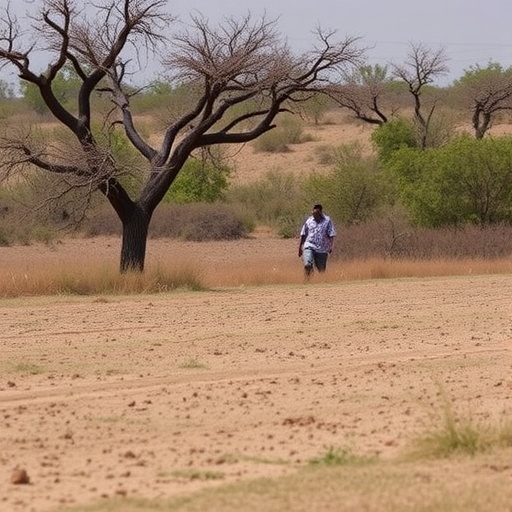
Drought is altering the geography and intensity of infectious disease, creating conditions in which some pathogens decline while others become more dangerous, according to a new review by researchers at the University of Colorado Boulder and the Cary Institute of Ecosystem Studies. The analysis, published in Trends in Ecology & Evolution, examines how water scarcity reshapes interactions among hosts, parasites, vectors and their environments. Although many infectious organisms depend on water, the authors warn that drought does not produce a simple, universal reduction in disease. Instead, drying landscapes can reorganize ecosystems in ways that concentrate animals, eliminate competitors and predators, increase exposure to contaminated dust, and favor pathogens capable of surviving outside aquatic habitats.
The findings arrive as drought becomes more widespread and less predictable under climate change. A United Nations assessment reported that more than 77% of Earth’s land experienced increasingly dry conditions over recent decades, while parts of the western United States have endured the most severe megadrought in roughly 1,200 years. Higher temperatures intensify evaporation, reduce snowpack and accelerate the loss of surface water, making droughts more frequent, prolonged and geographically extensive. For infectious disease researchers, the critical issue is not simply how much water is present, but how rapidly it disappears and how organisms respond to the remaining patches of habitat. Sudden environmental changes can disrupt normal host behavior and alter the balance between pathogens, predators and disease-carrying vectors.
One of the clearest mechanisms involves the forced concentration of animals around shrinking ponds, streams and reservoirs. When water is abundant, hosts may be dispersed across many habitats, reducing the frequency with which infected and uninfected individuals encounter one another. During drought, those same animals may be funneled into a few remaining water sources. The resulting crowding increases contact rates and can intensify the transmission of parasites shed in water, including infectious stages that persist in sediment or on vegetation. High densities also increase contamination, because more hosts contribute pathogens to a smaller volume of water. In this setting, a drought can simultaneously destroy some habitat while transforming the habitat that remains into a transmission hotspot.
Pieter Johnson encountered this pattern while studying a waterborne parasite that infects amphibians in California. The parasite causes developing frogs to grow abnormal additional limbs, a condition that can impair movement and make the animals more vulnerable to predators. During the severe drought of 2014, ponds contracted and amphibians became concentrated in the water bodies that had not yet dried. Johnson’s team observed more severe infections and higher infection rates among the frogs. The result demonstrated why disease responses to drought may be nonlinear: modest water loss can reduce transmission by eliminating habitat, but further drying can force hosts together and cause infection to rise sharply. Disease risk may therefore increase after passing a critical ecological threshold.
Drought can also change disease transmission by removing organisms that normally suppress vectors. In parts of North America, declining water levels have been associated with increases in mosquito-borne diseases such as West Nile virus and St. Louis encephalitis. Mosquito larvae develop in water, but shallow, stagnant pools created as larger bodies of water recede can be highly suitable for some mosquito species. At the same time, drought may reduce aquatic predators, including dragonfly larvae, that feed on mosquito larvae. Fewer predators can allow vector populations to expand, increasing the number of mosquitoes capable of acquiring and transmitting viruses. The consequences depend on local conditions, including mosquito species, water chemistry, temperature, predator communities and the timing of rainfall after a dry period.
Historical observations support the connection between drought and changing viral transmission. Previous studies in Florida found that periodic droughts increased the spread of St. Louis encephalitis virus, which is transmitted to humans by infected mosquitoes. The virus circulates primarily among birds, while mosquitoes act as vectors that bridge the pathogen to people and other hosts. Environmental stress can modify bird movement, mosquito abundance and the availability of breeding sites, potentially bringing vectors and reservoir hosts into closer contact. West Nile virus follows a related ecological pathway, with transmission influenced by interactions among mosquitoes, birds and humans. These systems show why drought-related disease risk cannot be inferred from water levels alone: the response emerges from a network of species whose behavior and abundance change together.
Other infections may become more prominent because drought creates new routes of exposure. Valley fever, caused by the soil-dwelling fungus Coccidioides, is acquired when people or animals inhale spores carried in contaminated dust. Dry soils and wind can increase the amount of airborne particulate matter, while land disturbance, wildfires and intense storms following prolonged drought may further redistribute fungal material. Although Valley fever is not a viral disease, it illustrates the broader principle identified in the review: water scarcity can shift pathogens from aquatic transmission systems into terrestrial and airborne pathways. In a drying environment, infections associated with dust, soil and mobile wildlife may gain importance even as strictly aquatic pathogens lose opportunities to spread.
The researchers emphasize that drought will not benefit every pathogen. Chytrid fungus, a major contributor to global amphibian declines, generally spreads less efficiently under dry conditions. Its transmission depends heavily on moist environments and contact with contaminated water or wet surfaces. As those conditions disappear, the pathogen may lose opportunities to infect susceptible hosts. Such declines, however, may be temporary or geographically uneven. A pathogen could disappear from a dried pond while intensifying in a neighboring refuge where hosts have gathered. Across a region, reduced transmission in one location may therefore be offset by concentrated transmission elsewhere. Drought can produce a patchwork of disease outcomes rather than a single trend.
To anticipate which infectious agents are most likely to expand, Johnson and collaborator Tara Stewart Merrill synthesized nearly 100 previous studies and identified traits that may determine pathogen success. Generalist pathogens capable of infecting multiple host species may be more resilient than specialists that depend on a single host. Organisms able to persist outside water, tolerate heat or desiccation, and move between aquatic and terrestrial environments may also gain an advantage. These characteristics are especially relevant to viruses with broad host ranges, including influenza viruses, whose circulation can be influenced by the movement and congregation of numerous bird and mammal species. By contrast, pathogens restricted to one host or one narrow habitat may be more vulnerable when drought removes the conditions required for transmission.
The review presents drought as an emerging infectious-disease challenge that will require ecological forecasting rather than simple assumptions about climate and illness. Monitoring reservoir hosts, mosquito populations, water quality, pathogen abundance and human exposure could help identify outbreaks before they become widespread. Public-health systems may need to combine climate data with satellite observations, wildlife surveillance and genomic analysis to detect changes in pathogen circulation. As droughts become more variable, disease risk may shift rapidly between locations and seasons, making historical patterns less reliable. The central warning from the researchers is that a drying world will not necessarily be a disease-free world. Instead, water scarcity may reshape the pathogen community, suppressing some infections while creating intense new opportunities for others.
News Publication Date: August 12
Web References: https://www.colorado.edu/ebio/pieter-johnson; https://pmc.ncbi.nlm.nih.gov/articles/PMC2738489/; https://www.un.org/sustainabledevelopment/blog/2024/12/press-release-three-quarters-of-earths-land-became-permanently-drier-in-last-three-decades-un/; https://www.nytimes.com/2025/06/04/climate/climate-change-drought.html
References: Trends in Ecology & Evolution. DOI: 10.1016/j.tree.2026.07.002
Cite Scienmag News
Kristina Jarvis. (August 12, 2026). Drought Is Reshaping How Infectious Diseases Spread Worldwide. Scienmag. https://scienmag.com/drought-is-reshaping-how-infectious-diseases-spread-worldwide/
Kristina Jarvis. "Drought Is Reshaping How Infectious Diseases Spread Worldwide." Scienmag, 12 August 2026, https://scienmag.com/drought-is-reshaping-how-infectious-diseases-spread-worldwide/. Accessed 4 September 2026.
Kristina Jarvis. "Drought Is Reshaping How Infectious Diseases Spread Worldwide." Scienmag. August 12, 2026. https://scienmag.com/drought-is-reshaping-how-infectious-diseases-spread-worldwide/


