


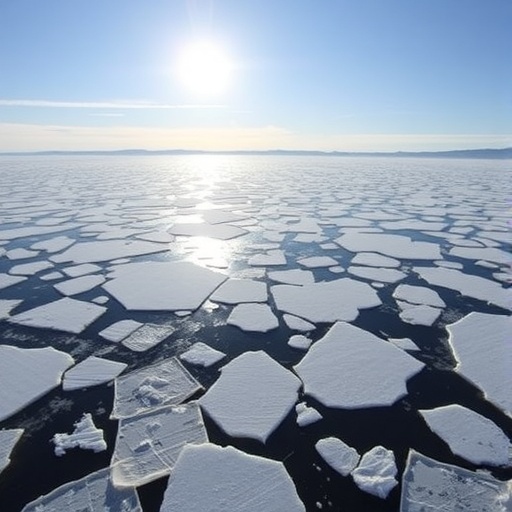
A new study has revealed that Arctic cyclones can become far more destructive when they arrive in rapid succession, transforming a series of storms into a prolonged assault on the region’s already fragile sea ice. An international research team led by the Alfred Wegener Institute, Helmholtz Centre for Polar and Marine Research, has systematically examined this phenomenon—known as “cyclone clustering”—across the Arctic using satellite observations and atmospheric data collected between 1979 and 2024. Their findings, published in Nature Communications, show that clustered cyclones reduce Arctic sea ice cover by approximately twice as much as isolated low-pressure systems. The damage also persists for roughly two and a half times longer, raising new concerns about the future stability of the Arctic climate system and the vulnerability of coastal communities.
Cyclone clustering occurs when several low-pressure systems pass through the same region within a short period. Each cyclone can bring strong winds, heavy precipitation, turbulent seas and unusual temperature conditions, but the storms’ impacts do not simply disappear when one system moves away. When another cyclone follows quickly, it strikes an ice cover that may already be fractured, displaced or weakened. This sequence creates a cumulative effect, allowing the storms to maintain disruption over a much longer period than a single event. Similar chains of storms have caused severe damage in Europe through high winds, flooding and coastal surges, but their consequences in the Arctic have remained comparatively poorly understood.
To investigate the phenomenon, the researchers adapted an algorithm designed to track weather systems so it could identify cyclones moving consecutively through Arctic regions. They combined this atmospheric information with satellite measurements of sea ice before and after storm clusters passed. This approach allowed the team to distinguish the effects of clustered cyclones from those of isolated storms and to examine how the response varied by season and location. The study represents the first systematic analysis of how serial cyclone activity affects Arctic sea ice over several decades, providing a new framework for understanding the interaction between short-lived weather events and long-term climate change.
The physical damage begins when cyclone winds and waves break apart the ice cover. Large, continuous fields of sea ice can be transformed into separated floes that drift, rotate and collide. During the Arctic winter, newly opened water gaps would normally freeze within a few days because of the extremely cold atmosphere. However, when cyclones arrive one after another, persistent winds and turbulent ocean conditions keep the ice fragments in motion and prevent the gaps from closing efficiently. The result is a longer-lasting reduction in ice concentration and a more fragmented ice cover, which is less capable of resisting future storms.
The consequences change as the Arctic moves into its warmer months. Summer cyclone clusters are generally less intense than their winter counterparts, but they can still trigger major local changes. Strong winds may push ice floes northward and compress them against existing ice, reducing the geographical area over which the ice is distributed. This compaction can alter ocean circulation and expose larger areas of dark, ice-free water. Because open water absorbs far more solar energy than reflective sea ice, the process can intensify regional warming and accelerate melting through the powerful ice-albedo feedback.
Cyclones also transport heat into the Arctic through both the atmosphere and the ocean. Storm systems can carry unusually warm air over the ice, increasing surface melting and weakening the snow and ice layers from above. At the same time, storm-driven ocean mixing can bring relatively warm seawater from deeper layers toward the surface. This upward movement of heat may thin the ice from below, particularly in regions where subsurface ocean temperatures are already elevated. Together, atmospheric warming, oceanic heat transport, mechanical breakup and ice compression can produce a compound effect that is much greater than any one process acting alone.
The researchers found that the number of storms within a cluster varies according to season and region, with an average of about 2.5 cyclones. The impact is also highly uneven across the Arctic. In some areas, clustering amplified the effect on sea ice by as much as 1.5 times, while in others the amplification reached seven times that associated with individual storms. Across the Arctic as a whole, clustered cyclones reduced sea ice approximately twice as much as conventional isolated low-pressure systems. The resulting decline persisted about two and a half times longer, demonstrating that storm timing can be as important as storm intensity.
The study also identifies a troubling trend: the sea-ice loss associated with cyclone clustering has increased significantly in recent decades. The researchers link this growing sensitivity to the physical transformation of the Arctic ice cover under global warming. Multiyear ice has become thinner, more mobile and less mechanically resilient, making it easier for strong winds and waves to break apart. In summer, the effect may be further intensified by a warmer Arctic Ocean, which supplies additional heat to the underside of the ice. This creates the possibility of a self-reinforcing feedback loop in which weaker ice is more easily damaged by cyclone clusters, and the resulting ice loss leaves the region even more vulnerable to later storms.
The implications extend far beyond the ice itself. Sea ice acts as a natural buffer that reduces the energy of waves before they reach Arctic coastlines. As the ice retreats and breaks into smaller pieces, waves can travel farther and strike the shore with greater force. Coastal erosion is already being accelerated in many Arctic communities, while thawing permafrost destabilizes the ground and makes infrastructure more vulnerable. Increasing cyclone activity could therefore magnify risks to settlements, transportation routes and industrial facilities. By identifying cyclone clustering as a distinct driver of sea-ice change, the research gives climate scientists a more precise way to evaluate future Arctic conditions. The team is now using climate projections to determine whether the intensifying influence of clustered cyclones observed in recent decades will continue as the Arctic warms.
News Publication Date: 5-Aug-2026
Web References: https://doi.org/10.1038/s41467-026-76245-5
References: Nature Communications; Alfred Wegener Institute, Helmholtz Centre for Polar and Marine Research
Cite Scienmag News
Russell Cooper. (August 12, 2026). Arctic cyclone clusters shrink sea ice, increasing threats to coastal communities. Scienmag. https://scienmag.com/arctic-cyclone-clusters-shrink-sea-ice-increasing-threats-to-coastal-communities/
Russell Cooper. "Arctic cyclone clusters shrink sea ice, increasing threats to coastal communities." Scienmag, 12 August 2026, https://scienmag.com/arctic-cyclone-clusters-shrink-sea-ice-increasing-threats-to-coastal-communities/. Accessed 3 September 2026.
Russell Cooper. "Arctic cyclone clusters shrink sea ice, increasing threats to coastal communities." Scienmag. August 12, 2026. https://scienmag.com/arctic-cyclone-clusters-shrink-sea-ice-increasing-threats-to-coastal-communities/


