


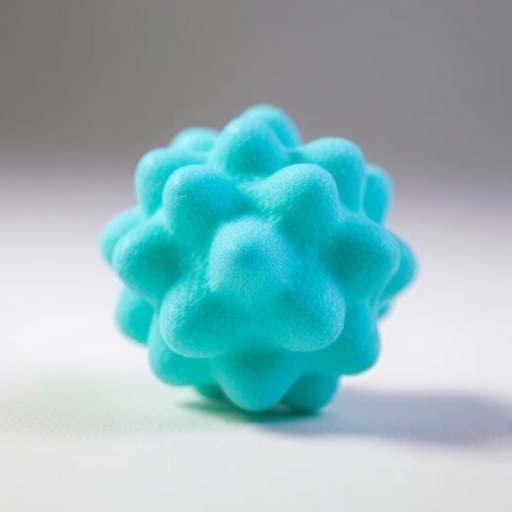
In a groundbreaking leap for drug delivery and material science, researchers at MIT have engineered a cutting-edge technology capable of producing highly structured microparticles at an industrial scale with remarkable precision. This innovation harnesses specially designed electronic nozzles—termed triaxial electrospray emitters—that generate droplets with three distinct fluid layers. The ability to fabricate such complex layered microparticles opens new frontiers in time-release pharmaceuticals, self-healing materials, and biosensors, potentially revolutionizing numerous applications across biotechnology and materials engineering.
At the heart of this advancement lies the triaxial electrospray emitter array, a device that uses electrical forces to meticulously dispense three immiscible liquids through concentric microscopic nozzles. When electrically charged, these liquids emerge as a laminar flow, forming droplets with well-defined core-shell-shell structures. These multilayered droplets can then solidify into microparticles whose individual layers function distinctly, enabling, for example, staged drug delivery where an outer layer degrades first followed by sequential release of internal therapeutic agents at targeted sites within the body.
The engineering challenge to realize such devices has traditionally been steep due to the need for ultrasmall components with precise microscale fluid channels and perfectly aligned nozzles. Conventional fabrication typically depends on silicon-based semiconductor cleanroom processes, expensive and time-consuming methods that limit device complexity and throughput. In a bold departure from this paradigm, the MIT team employed high-resolution 3D printing, specifically vat photopolymerization, to produce entire arrays of 16 triaxial nozzles within a chip scarcely larger than a penny.
Vat photopolymerization utilizes controlled light exposure to solidify liquid polymer resins layer-by-layer, achieving each layer at a mere 25 micrometers thickness—thinner than a human hair. This precision enables the creation of complex internal geometries, including a network of coiled microchannels that uniformly feed liquid to each nozzle. These helical channels optimize spatial constraints while ensuring flow uniformity, preventing disruptive “cross-talk” among nozzles that could otherwise degrade droplet consistency. The continuous iterations of design facilitated by 3D printing allowed rapid refinement toward optimal fluid dynamics inside the emitter.
Once fabricated, these arrays produce a uniform, steady spray of droplets each embodying three well-separated fluidic layers. Fine-tuning parameters such as liquid viscosities, flow rates, and applied voltages empowers scientists to control droplet diameter and individual layer thickness with exquisite specificity. For example, experiments revealed that the viscosity of the intermediate liquid layer is critical in maintaining structural integrity during droplet formation, preserving the distinctness of each shell. This precision tailoring endows the technology with the capacity to engineer drug carriers that release their contents in programmed stages, matching the pharmacokinetic profiles demanded by complex treatment regimens.
The implications extend beyond medicine. The fine control over multilayer droplets enables generation of microparticles embedded with intricate chemical patterns for advanced sensing platforms. Artificial cells constructed via this method could mimic biological functions relevant for tissue engineering and regenerative therapies. Furthermore, the ability to 3D print arrays rapidly and cost-effectively democratizes access to this technology, fostering innovation by reducing barriers that previously confined such microfluidic devices to specialized cleanroom facilities.
Luis Fernando Velásquez-García, a principal research scientist at MIT’s Microsystems Technology Laboratories and senior author of the study, emphasizes this democratization: “The particles these devices generate, whether for self-healing composites or targeted pharmaceuticals, can have profound impact. Bringing such devices out of exclusive fabrication suites through additive manufacturing broadens who can develop and use them.” This potential for widespread adoption underscores the team’s vision of transforming multiparticulate production into a mainstream industrial process.
The research publication, led by Bryan Ivan Quintanar-Abarca from the Technological Institute of Monterrey in Mexico and appearing in the journal Virtual and Physical Prototyping, delves into the meticulous design and testing process. One striking aspect is achieving uniform droplet production across all 16 emitters, a feat enabled by the internal coiled fluidic architecture. Achieving such uniformity was not straightforward; fluid dynamics simulations combined with empirical testing guided parameter adjustments, illustrating a synergy between physical prototyping and computational modeling in device optimization.
Looking forward, the research group intends to continue pushing the precision boundaries of their 3D-printed devices. Prospective developments include scaling arrays to even greater nozzle densities while integrating functional materials such as conductive or dielectric substances within the structures. These could lead to electrospray systems with enhanced functionalities, enabling, for example, electrically switchable droplet production or real-time control of layer composition. Such advancements pave the way for next-generation microfabricated tools with unprecedented capabilities.
This pioneering work in additive manufacturing microfluidics exemplifies how emerging technologies redefine research landscapes. By coupling sophisticated microfabrication with practical, scalable solutions, the MIT team has not only unlocked new scientific potential but also laid the groundwork for transformative applications that extend from personalized medicine to smart materials and beyond.
The successful fabrication and demonstration of 3D-printed triaxial electrospray emitter arrays thus stand as a testament to interdisciplinary collaboration bridging microsystems engineering, materials science, fluid dynamics, and biomedical engineering. The anticipated ripple effects across industry and academic research highlight additive manufacturing’s role in accelerating innovation where complexity meets practical scalability.
As the research community embraces this versatile platform, it heralds a future where complex multilayer microparticles and nanoparticles can be produced swiftly, cost-effectively, and tailored to exacting specifications. Such capabilities will inevitably spark new breakthroughs in diagnostics, therapeutics, manufacturing, and environmental sensing, underscoring the far-reaching impact of these miniature yet powerful devices.
Web References:
DOI: 10.1080/17452759.2026.2676503
Keywords
Additive manufacturing, triaxial electrospray emitter, multilayer microparticles, drug delivery, microfluidics, 3D printing, vat photopolymerization, microfabrication, biosensors, regenerative medicine, materials engineering, microsystems technology
Cite Scienmag News
Denise Maddox. (June 10, 2026). 3D Printing Revolutionizes Production of Drug-Delivery Microparticles. Scienmag. https://scienmag.com/3d-printing-revolutionizes-production-of-drug-delivery-microparticles/
Denise Maddox. "3D Printing Revolutionizes Production of Drug-Delivery Microparticles." Scienmag, 10 June 2026, https://scienmag.com/3d-printing-revolutionizes-production-of-drug-delivery-microparticles/. Accessed 3 September 2026.
Denise Maddox. "3D Printing Revolutionizes Production of Drug-Delivery Microparticles." Scienmag. June 10, 2026. https://scienmag.com/3d-printing-revolutionizes-production-of-drug-delivery-microparticles/


