


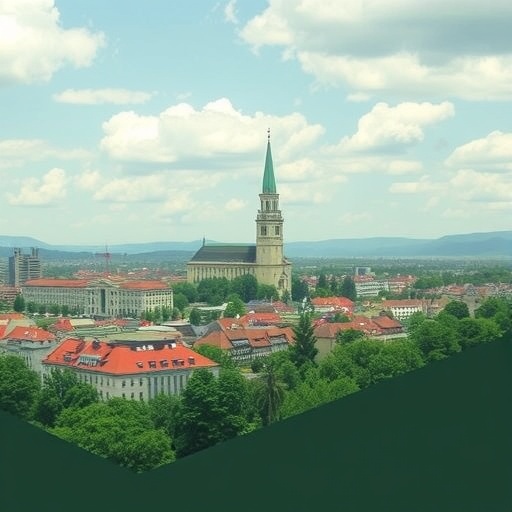
Cities around the world are turning to nature to solve problems created by urbanization, from extreme heat and flash flooding to air pollution and biodiversity loss. But a study published in npj Urban Sustainability warns that the most important question may not be whether cities adopt nature-based solutions, but who benefits from them—and who gets to decide what “green” urban development looks like. In an analysis of collaborative nature-based solutions in authoritarian Belgrade, sociologist Ana Pajvančić-Cizelj examines how environmental projects can be reshaped by political systems, European policy frameworks and powerful institutions. The research places a popular climate strategy under a sharper lens: green infrastructure can improve urban resilience, yet the processes used to design it may also reinforce existing inequalities.
Nature-based solutions, commonly known as NBS, use ecosystems or ecological processes to address social and environmental challenges. Examples include restoring rivers and wetlands to reduce flood risk, planting trees to lower urban temperatures, creating rain gardens to absorb stormwater and replacing sealed surfaces with permeable materials. Unlike conventional infrastructure, such as concrete drainage channels or air-conditioning systems, NBS can provide several functions simultaneously. Vegetation stores carbon, filters pollutants, offers habitat and reduces heat through shading and evapotranspiration—the release of water from plants and soil into the atmosphere. Their benefits, however, depend on location, maintenance, access and governance. A park built in a vulnerable neighborhood may reduce heat exposure, while a similar project in a wealthier district may increase property values and accelerate displacement.
The Belgrade case is significant because it brings together two trends that are often discussed separately: the spread of European environmental policy and the political realities of authoritarian urban governance. Europeanization refers broadly to the process through which European Union standards, funding mechanisms, administrative practices and policy ideas influence countries and cities, including those outside the EU. Nature-based solutions have become increasingly prominent in European climate and urban policy because they align with goals related to climate adaptation, biodiversity, public health and sustainable development. When these ideas enter local planning systems, they do not simply travel unchanged. They are translated into local institutions, funding applications and political narratives, where their meaning can be altered by the priorities of municipal authorities, developers and organized communities.
Pajvančić-Cizelj’s analysis focuses on collaborative NBS, an approach that treats residents, civil society groups, experts and public authorities as partners in designing and managing environmental interventions. Collaboration is often presented as a democratic alternative to top-down planning. In theory, residents contribute local knowledge about flooding, heat, neglected public spaces or access barriers, while planners and engineers provide technical expertise. This exchange can produce projects that are better adapted to everyday conditions than standardized designs. It can also build trust and increase public support. Yet participation is not automatically democratic. Meetings may be held without giving residents real decision-making power, while community input can be selectively accepted, delayed or used to validate plans already made elsewhere.
This tension is captured by the concept of co-optation. In political and social research, co-optation describes the process by which independent groups, critical ideas or participatory practices are absorbed into an existing institutional system and redirected toward its goals. Applied to NBS, the term does not mean that ecological measures are fake or technically ineffective. A rain garden may still capture stormwater, and trees may still cool streets. Rather, co-optation concerns the political conditions surrounding those interventions. A project promoted as community-led may provide authorities with an image of openness without transferring control over land, budgets or implementation. Participation can become a communication tool, a funding requirement or a way to manage dissent instead of a mechanism for shared power.
That possibility becomes especially important in authoritarian or semi-authoritarian urban environments, where formal institutions may exist but political competition, media independence and civic oversight are constrained. In such settings, governments can adopt the language of sustainability, resilience and citizen engagement while limiting the ability of residents to challenge major development decisions. Collaborative NBS may therefore perform a double function. They can deliver genuine ecological improvements and create valuable public spaces, but they can also help authorities demonstrate modernity, European alignment and administrative competence. The environmental project becomes part of a broader political story in which the city presents itself as progressive and internationally connected, even when participation remains tightly managed.
The study’s central contribution is to shift attention from the technical performance of NBS to the politics of their production. Researchers often evaluate green infrastructure through measurable indicators such as stormwater retention, surface temperature, carbon storage, species diversity or the number of residents served. These metrics are essential, but they do not reveal how land was acquired, whose knowledge influenced the design or whether benefits are distributed fairly. A project may achieve a strong ecological result while excluding informal users, displacing lower-income residents or prioritizing highly visible central districts over less politically influential neighborhoods. The research therefore treats NBS as socio-technical systems: arrangements in which ecological processes, engineering choices, public institutions, financial rules and social power operate together.
In Belgrade, this perspective also illuminates the ambiguous role of international policy models. European environmental frameworks can introduce new funding opportunities, technical standards and expectations for public participation. They can help local organizations gain visibility and give residents new language for demanding healthier and more accessible urban environments. At the same time, alignment with European agendas may encourage authorities to adopt selected elements of sustainability without embracing the deeper institutional reforms associated with transparency and accountability. The result is a selective form of Europeanization: ecological vocabulary and project formats travel quickly, while democratic safeguards may remain weak or unevenly applied. The city can appear greener and more participatory on paper than it is in practice.
The implications extend far beyond Belgrade. As climate adaptation accelerates, cities are competing for funds and public approval by promising greener, cooler and more resilient neighborhoods. The research suggests that policymakers should evaluate not only what NBS do for ecosystems, but also what they do to urban power relations. Effective safeguards would include transparent selection of project sites, publicly accessible budgets, independent monitoring, long-term maintenance commitments and clear evidence that residents can alter project decisions. Participation should be judged by influence rather than attendance: who sets the agenda, whose objections are recorded, who controls implementation and who can hold authorities accountable? Without those protections, nature-based solutions risk becoming attractive symbols of sustainable governance—visible, fundable and politically useful, but only partially shared.
The broader message is not that cities should reject nature-based solutions or collaboration. It is that ecological innovation cannot be separated from questions of ownership, representation and justice. Trees, wetlands and permeable landscapes can reduce climate risks, but they cannot by themselves create democratic urbanism. In Belgrade, the study shows how a language associated with environmental progress and European integration may be adapted within an authoritarian political context, producing projects whose ecological benefits coexist with limited public power. For the global urban sustainability movement, that finding is a warning and an opportunity: the next generation of green infrastructure must be designed not only to absorb water, capture carbon or cool streets, but also to distribute decision-making power as widely as the benefits it promises.
Cite Scienmag News
Courtney Benton. (August 18, 2026). Who Benefits from Nature-Based Solutions? Europeanization and Co-optation in Authoritarian Belgrade. Scienmag. https://scienmag.com/who-benefits-from-nature-based-solutions-europeanization-and-co-optation-in-authoritarian-belgrade/
Courtney Benton. "Who Benefits from Nature-Based Solutions? Europeanization and Co-optation in Authoritarian Belgrade." Scienmag, 18 August 2026, https://scienmag.com/who-benefits-from-nature-based-solutions-europeanization-and-co-optation-in-authoritarian-belgrade/. Accessed 3 September 2026.
Courtney Benton. "Who Benefits from Nature-Based Solutions? Europeanization and Co-optation in Authoritarian Belgrade." Scienmag. August 18, 2026. https://scienmag.com/who-benefits-from-nature-based-solutions-europeanization-and-co-optation-in-authoritarian-belgrade/


