


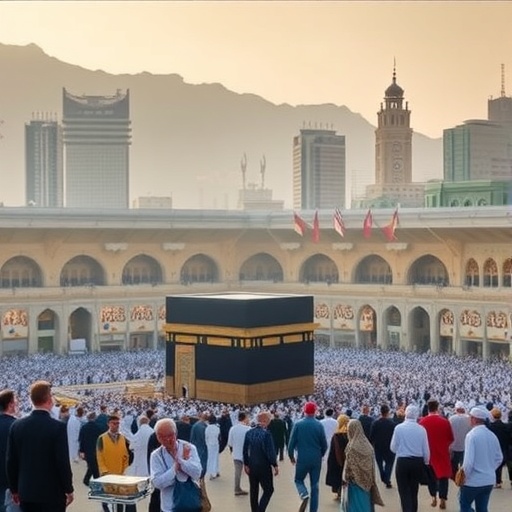
A groundbreaking study published ahead of the 2026 European Geosciences Union General Assembly has unveiled alarming new data on the escalating risks posed by climate change to millions of pilgrims undertaking the Hajj pilgrimage in Makkah, Saudi Arabia. This research, spearheaded by Atta Ullah from Weather and Climate Services in Islamabad, Pakistan, alongside Climate Analytics in Berlin, Germany, critically assesses how rising temperatures and increasing humidity levels are pushing human physiological thresholds to unprecedented extremes during this sacred event. Their findings reveal that even the youngest and healthiest pilgrims face life-threatening conditions due to heat stress during key periods of the 2024 Hajj, signaling an urgent need for enhanced adaptation and comprehensive climate mitigation to preserve both human life and the tradition itself.
The significance of this study lies in its integration of station-based sub-daily temperature and humidity data collected over the 2024 Hajj season, combined with forward-looking climate model projections to analyze both immediate and future heat-related risks. According to the data, during several hours in June 2024, heat stress was not merely uncomfortable but outright fatal for extended outdoor exposure, eclipsing survivability thresholds conventionally assumed safe even for well-conditioned individuals. This danger was most acute on June 17, 2024—known as the Day of Arafat—when the combination of extreme heat and humidity rendered prolonged outdoor exposure hazardous for approximately four continuous hours. During this window, natural thermoregulatory mechanisms such as sweating failed to maintain safe core body temperatures, underscoring the life-threatening implications for pilgrims engaged in strenuous rituals under direct sunlight.
Hajj represents one of the five fundamental pillars of Islam and mandates that Muslims who are physically and financially able undertake this once-in-a-lifetime spiritual journey. Pilgrims engage in a consolidated sequence of rituals over five days, collectively requiring extensive physical exertion in outdoor environments. These rituals include Tawaf (circling the Kaaba), Sa’i (walking between Safa and Marwa), standing in contemplative prayer on the plain of Mount Arafat, spending nights outdoors in Mina and Muzdalifah, and performing Rami al-Jamarat, the symbolic stoning of the devil. Each of these rites exposes pilgrims to harsh desert conditions, which are becoming increasingly intolerable due to gradually rising global temperatures and shifting climatic patterns, raising critical questions about the feasibility of safely conducting the pilgrimage in its traditional form.
Among the rituals, the Day of Arafat emerges as the apex of heat exposure risk. Pilgrims spend the entire day standing and praying on an expansive, open plain under minimal shade. This vulnerability is compounded by the extreme physical demands of the ritual and lack of cooling infrastructures, making pilgrims particularly susceptible to heat exhaustion, heatstroke, and other heat-related illnesses. The study highlights that, without urgent measures to adapt both infrastructure and pilgrimage timing, this integral ritual risks becoming a hazardous ordeal or may require fundamental alterations that could erode traditional practices key to the pilgrimage’s spiritual significance.
Current adaptations underway reflect attempts to mitigate heat risks while striving to preserve the pilgrimage’s authenticity. Notable interventions include relocating the Sa’i ritual indoors within climate-controlled environments and the construction of increasingly permanent shelters in Mina to provide respite from relentless sun exposure. While these strategies have indeed improved safety conditions, they simultaneously transform the spatial and experiential context of the pilgrimage, rendering an intricate balance between preserving heritage and safeguarding pilgrim health. The tension between tradition and necessary modernization forms a central challenge for religious authorities and event organizers as climate pressures intensify in the coming decades.
One of the more complex facets outlined in the study is the temporal shift in climate risk profiles associated with the Islamic lunar calendar governing the Hajj. For the next two or three decades, the pilgrimage will primarily coincide with relatively cooler seasons owing to the lunar cycle’s progression through the Gregorian calendar. However, projections indicate that by around 2050, the Hajj will once again fall within the hottest months of the year, potentially exacerbating heat-related dangers dramatically. This cyclical exacerbation underlines a long-term, systemic vulnerability to global warming’s coupled effects of increased ambient temperatures and humidity, threatening to undermine pilgrims’ safety and the feasibility of traditional pilgrimage observances.
Technically, the study employs sophisticated climate modeling techniques that synthesize observational sub-daily meteorological data from key stations surrounding Makkah with ensemble runs from climate prediction models under various emissions scenarios. This methodological rigor allows for granular insights into physiological heat stress dynamics—measured through indices such as Wet Bulb Globe Temperature and heat index values—that directly correlate with human heat tolerance and the risk of heat-related morbidity and mortality. The research underscores that without significant global reductions in greenhouse gas emissions and regional adaptation strategies, the survivability thresholds enshrined in human physiology will increasingly be breached during future Hajj seasons.
The implications of these findings ripple far beyond religious practice, touching on public health, climate justice, and the management of mass gatherings. Hajj, as one of the largest annual human assemblies globally, serves as a potent lens through which the broader societal costs of unchecked climate change become painfully visible. Beyond immediate risks like heat stress and dehydration, escalating temperatures also threaten the logistics, emergency response capacity, and medical infrastructure required to support millions in extreme conditions. The study asserts that fortifying infrastructure and redesigning pilgrim flow management systems, alongside elevating international cooperation on climate mitigation, is paramount for safeguarding both human life and the spiritual integrity of the Hajj.
Moreover, the research challenges the conventional framing of climate change solely as an environmental or economic issue. It posits that climate-induced risks are penetrating deeply into cultural and religious domains, with potentially profound consequences for faith communities worldwide. The necessity of reevaluating religious rites to reconcile them with altered climatic realities signals a new frontier in climate adaptation discourse that balances reverence for sacred traditions with pragmatic health and safety imperatives. In this context, the Hajj pilgrimage epitomizes the critical nexus where climate science, policy, and spiritual practice intersect with urgent ethical considerations.
As a response, the authors fervently advocate for a dual approach emphasizing both aggressive climate mitigation measures and innovative adaptation strategies. Mitigation efforts aimed at limiting global temperature rise are indispensable to reducing future risks once adaptation capacity plateaus. Concurrently, localized interventions such as expanding shaded infrastructure, improving hydration stations, medical preparedness, and disseminating heat risk awareness among pilgrims are crucial immediate steps. This combined strategy is essential not only for protecting millions of pilgrims today but for maintaining the continuity and authenticity of the Hajj experience for future generations, in the face of an evolving and increasingly hostile climate reality.
In summary, climate change presents an existential threat to the Hajj pilgrimage by subjecting participants to perilous heat stress levels that strain human physiological resilience. This research offers a scientifically robust, data-driven prognosis of these escalating risks, elucidating the urgent need for coordinated global action. As the pilgrimage’s traditional calendar advances into hotter periods over the coming decades, the study’s sobering conclusions compel reexamination of deeply rooted practices through the lens of climate resilience. Ultimately, protecting the millions of pilgrims who undertake this sacred journey every year requires transformational thinking at the intersection of science, policy, faith, and human dignity.
News Publication Date: June 2024
Web References: Presented at EGU General Assembly 2026, Session ITS4.19/CL0.10, May 7, 2026, Room 2.17.
Press contact: Asmae Ourkiya, EGU Media and Engagement Manager, media@egu.eu
Cite Scienmag News
Sloane Callahan. (May 7, 2026). When Faith Faces the Limits of Survival: New Study Reveals Hajj Pilgrimage Exceeds Human Endurance Thresholds. Scienmag. https://scienmag.com/when-faith-faces-the-limits-of-survival-new-study-reveals-hajj-pilgrimage-exceeds-human-endurance-thresholds/
Sloane Callahan. "When Faith Faces the Limits of Survival: New Study Reveals Hajj Pilgrimage Exceeds Human Endurance Thresholds." Scienmag, 7 May 2026, https://scienmag.com/when-faith-faces-the-limits-of-survival-new-study-reveals-hajj-pilgrimage-exceeds-human-endurance-thresholds/. Accessed 3 September 2026.
Sloane Callahan. "When Faith Faces the Limits of Survival: New Study Reveals Hajj Pilgrimage Exceeds Human Endurance Thresholds." Scienmag. May 7, 2026. https://scienmag.com/when-faith-faces-the-limits-of-survival-new-study-reveals-hajj-pilgrimage-exceeds-human-endurance-thresholds/


