


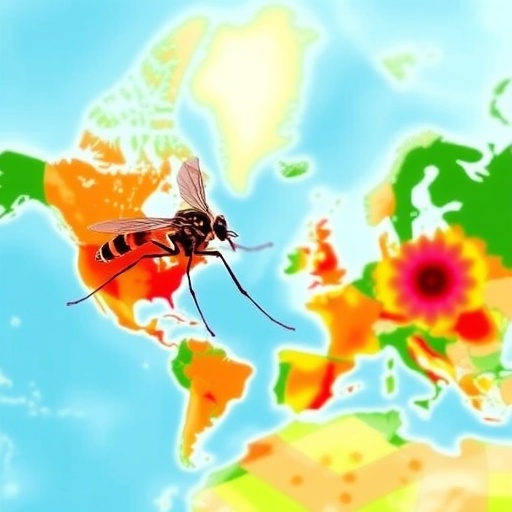
Chikungunya, a viral disease whose name derives from the Kimakonde language meaning “to become contorted,” is notorious for the debilitating joint pain it induces. Classified by the World Health Organization as one of the neglected tropical diseases, chikungunya virus (CHIKV) is transmitted primarily through the bites of Aedes mosquitoes, which thrive in tropical and subtropical environments. The disease manifests with symptoms including sudden onset of high fever, severe muscle and back pain, headache, profound fatigue, nausea, and distinctive skin rash. Historically confined to tropical locales, the distribution and risk of chikungunya are now poised for significant transformation in the face of global climate change.
Current epidemiological data underscore the disease’s impact, with the European Centre for Disease Prevention and Control reporting approximately 33,000 symptomatic cases worldwide so far in 2026. These cases, predominantly in South America, have resulted in nine fatalities. Notably, at present, chikungunya virus is not endemic to Europe or North America. Here, infections are typically isolated to travelers returning from regions where the disease circulates. However, emerging research prognosticates a substantial northward expansion in the virus’s geographic range by the end of the century, driven primarily by shifting climate patterns that alter mosquito habitats.
A ground-breaking study led by researchers at Zhejiang Chinese Medical University in Hangzhou, China, published in Frontiers in Cellular and Infection Microbiology, utilizes advanced species distribution models to simulate the future risk zones for chikungunya. By integrating an extensive database of geo-referenced records of both the chikungunya virus and its principal mosquito vector species, alongside diverse climatic variables, the team projected changes in vector and virus distribution under 16 IPCC climate scenarios. Their findings paint a clear and concerning picture: chikungunya risk zones will expand beyond the tropics to temperate zones, particularly northeastern North America, central Europe, and East Asia.
Historically, chikungunya transmission has been primarily associated with the yellow fever mosquito, Aedes aegypti, which flourishes in the warm, humid conditions of tropical human settlements. This vector’s limited tolerance for cooler temperatures has constrained the virus’s spread. However, outbreaks in 2005–2006, notably on Réunion Island and parts of India, highlighted a crucial shift in transmission dynamics. A mutation in the virus’s envelope protein gene (E1-A226V) substantially increased its infectivity and compatibility with the Asian tiger mosquito, Aedes albopictus—a species with greater cold tolerance and an expanding global footprint.
The presence of Aedes albopictus is a game-changer for chikungunya epidemiology. This mosquito species can survive in cooler, temperate climates that historically precluded sustained transmission of the virus. The modeling undertaken by the Zhejiang team demonstrated that over 70% of the projected future chikungunya distribution could be explained by the potential expansion of Aedes albopictus habitats. Under warming scenarios, the Asian tiger mosquito is anticipated to colonize regions that were previously inhospitable due to cold winters, thereby creating novel environments for chikungunya outbreaks.
Their approach employed ensemble species distribution models, which combine multiple algorithms to improve the robustness of predictions about species’ ecological niches. These models incorporated 16 critical environmental parameters—ranging from wind speed and elevation to precipitation and temperature extremes—to realistically simulate how mosquitoes and virus niches might evolve under different socio-economic development pathways forecasted by the IPCC. These pathways, such as the ‘green shift’ or ‘fossil-fueled development,’ represent varying global trajectories in emission patterns, economic growth, and land use.
The implications of these findings are profound. With vector habitat suitability increasing in regions previously spared from local transmission, public health landscapes in Europe, North America, and East Asia face new challenges. The arrival of Aedes albopictus as an established vector in temperate zones extends the transmission season and elevates the risk of autochthonous chikungunya outbreaks. This scenario underscores the urgency of proactive measures tailored to emerging high-risk areas, with the authors advising preparation well before 2040.
Experts advocate for comprehensive mosquito surveillance networks, especially in regions on the cusp of becoming suitable habitats. Early detection and continuous monitoring of Aedes mosquito populations will be critical to mitigating outbreak risk. Moreover, equipping healthcare practitioners with diagnostic tools and training to identify chikungunya in populations unfamiliar with the disease can accelerate response times. Strengthening vector control strategies—such as eliminating standing water, deploying insecticides, and community education—is essential to curtailing transmission.
Rapid-response infrastructure needs to be developed to address potential outbreaks efficiently. This includes establishing protocols for outbreak investigation, case management, and communication to the public to prevent panic while ensuring informed cooperation. Importantly, the study highlights that limiting additional global warming through policy and behavioral shifts remains a cornerstone strategy. Mitigating climate change can restrict the gain in vector habitat suitability and thereby reduce the likelihood of chikungunya’s geographical expansion and intensification.
This research delivers a powerful message: the rise in global temperatures, altered precipitation patterns, and changing ecological landscapes collectively contribute to the enhanced risk of chikungunya in previously unaffected regions. It is a clarion call for multidisciplinary cooperation between climatologists, entomologists, epidemiologists, and public health officials to mitigate future impacts. By integrating climate projections with biological data, it is possible to anticipate and preemptively counter infectious disease threats in an era of accelerating global change.
In summary, chikungunya’s future trajectory maps an ominous potential spread into temperate zones as climate change reshapes vector ecology. The Asian tiger mosquito’s role emerges as pivotal, and the challenges ahead lie in surveillance, preparedness, and climate action. With research illuminating the pathways of disease risk transformation, the public health community stands better equipped to respond. However, time is of the essence to implement measures before the virus exploits new ecological niches and transitions from a tropical scourge to a global health concern.
News Publication Date: 27-May-2026
Web References: DOI 10.3389/fcimb.2026.1808175
References: Available in the journal Frontiers in Cellular and Infection Microbiology
Cite Scienmag News
Kristina Jarvis. (May 27, 2026). Climate Change May Turn North America and Europe into Chikungunya Virus Hotspots. Scienmag. https://scienmag.com/climate-change-may-turn-north-america-and-europe-into-chikungunya-virus-hotspots/
Kristina Jarvis. "Climate Change May Turn North America and Europe into Chikungunya Virus Hotspots." Scienmag, 27 May 2026, https://scienmag.com/climate-change-may-turn-north-america-and-europe-into-chikungunya-virus-hotspots/. Accessed 3 September 2026.
Kristina Jarvis. "Climate Change May Turn North America and Europe into Chikungunya Virus Hotspots." Scienmag. May 27, 2026. https://scienmag.com/climate-change-may-turn-north-america-and-europe-into-chikungunya-virus-hotspots/


