


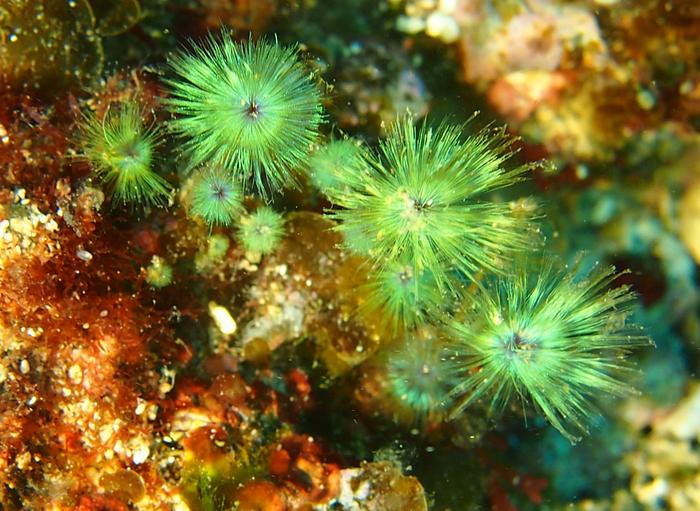
Compartments of consistently sized, tightly packed microspheres are what makes some brown algae shimmer like opal. The Kobe University discovery not only sheds light on the mechanism behind the alga’s structural coloration, it is also the first to spot the effect in an order of brown algae other than the two where it was known to occur.

Credit: KAWAI Hiroshi
Compartments of consistently sized, tightly packed microspheres are what makes some brown algae shimmer like opal. The Kobe University discovery not only sheds light on the mechanism behind the alga’s structural coloration, it is also the first to spot the effect in an order of brown algae other than the two where it was known to occur.
Most brown algae are indeed yellowish-brown, but scuba divers noticed that a species resembling Sporochnus in the order Sporochnales shimmers like peacock feathers in yellow, bright green or blue when direct light is shone on them. Kobe University phycologist KAWAI Hiroshi says: “Being a diver myself, I have observed and collected Sporochnus species many times in many places, but I have never seen an individual that appeared to glow green, so I was interested in analyzing it.” An opal-like play-of-color, or “iridescence,” is known to occur in two other orders of brown algae, but never in Sporochnales, and in particular, not in the seaweed species that has become a conversation topic among divers. “I wanted to clarify the mechanism behind this green glow, and also wondered why this phenomenon does not commonly occur in other Sporochnus species,” says Kawai.
One reason why no-one else has described the phenomenon might be the fragility of the organism. Kawai explains: “Generally speaking, Sporochnus species are very fragile, and are often damaged within a short period of time after being collected and removed from the sea, making it very difficult to observe the details of the intact organism. Therefore, we dived to a 25-m depth in Kushimoto, the southernmost point of Japan’s main island, to observe and photograph the algae. We then collected some specimens, placed them in a large amount of seawater to prevent damage, and rushed them to the laboratory to conduct detailed observations on the healthy algae, also using a specialized fixation method to preserve their delicate features.”
The effort paid off. In the European Journal of Phycology, the group now published not only stunning photos of the iridescent algae, but also their analysis using electron-microscopic images to explain where the effect comes from. Similar to other brown algae exhibiting structural coloration, the organisms have cellular compartments that are packed with microspheres of very consistent size. These so-called “iridescent bodies” reflect green light much more than other colors, which is the source of the color effect. The researchers explain in the paper, “It is known that regular arrangement of fine structures such as crystals and multilayered membranes cause structural colouration in both organic and inorganic structures.” The effect might thus be a result of the interaction of light reflected from different “layers” of the fine structures, extinguishing some colors and letting through others.
To support this hypothesis, the Kobe University team compared two Sporochnus species, the one with and another without shimmering colors. In both species, they found that cells at the ends of their photosynthetic filaments contained spherical bodies that brightly reflect light, and that are therefore called “iridescent bodies.” These iridescent bodies were in both cases tightly filled with small nanospheres, but in the species that does not exhibit actual iridescence, the nanospheres fused and resulted in the compartment filled with globules of very different sizes. On the other hand, in the iridescent brown alga, the nanospheres remained of uniform size between 130 and 160 nanometers, which is consistent with how structural coloration amplifies only select colors based on the size and spacing of the fine structures.
“Now that we have some understanding of the mechanism of the structural coloration, we would like to clarify the ecological relevance of this property and the evolutionary relationship between the structure and mechanism in different brown algae exhibiting the phenomenon,” explains Kawai. While in those other brown algae iridescence has been linked to photosynthesis, the alga Kawai studied grows in deeper waters, making it unlikely that the purpose is the same. Kawai says: “The iridescent bodies also contain highly reactive substances that, when released by the rupture of iridescent bodies, destroy the entire cell in a short time. Since these algae grow in waters where algae-eating fish are abundant, the reactive substances are thought to play a role in repelling grazers. We thus believe that the structural coloration may play a role in communication among organisms, such as camouflage or a warning to grazers.”
This research was conducted in collaboration with a researcher from Hokkaido University.
Kobe University is a national university with roots dating back to the Kobe Commercial School founded in 1902. It is now one of Japan’s leading comprehensive research universities with nearly 16,000 students and nearly 1,700 faculty in 10 faculties and schools and 15 graduate schools. Combining the social and natural sciences to cultivate leaders with an interdisciplinary perspective, Kobe University creates knowledge and fosters innovation to address society’s challenges.
Journal
European Journal of Phycology
Method of Research
Observational study
Subject of Research
Not applicable
Article Title
Structural colour in the brown algal genus Sporochnus (Sporochnales, Phaeophyceae)
Article Publication Date
7-May-2024
Cite Scienmag News
Violet Maxwell. (May 20, 2024). What makes some brown algae shimmer and others not? Scienmag. https://scienmag.com/what-makes-some-brown-algae-shimmer-and-others-not/
Violet Maxwell. "What makes some brown algae shimmer and others not?" Scienmag, 20 May 2024, https://scienmag.com/what-makes-some-brown-algae-shimmer-and-others-not/. Accessed 3 September 2026.
Violet Maxwell. "What makes some brown algae shimmer and others not?" Scienmag. May 20, 2024. https://scienmag.com/what-makes-some-brown-algae-shimmer-and-others-not/

