


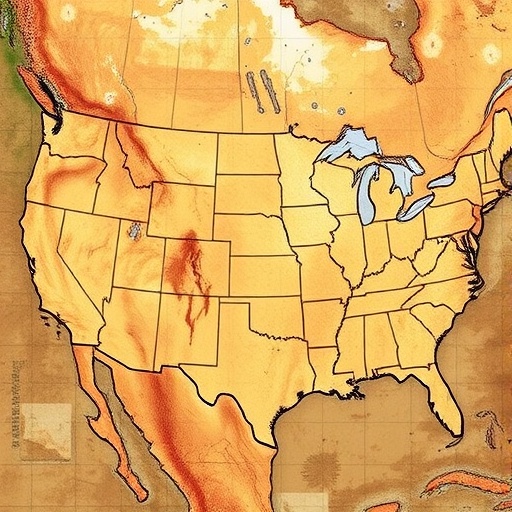
Over the past four decades, the Western United States has experienced a paradoxical climate phenomenon that has puzzled scientists and policymakers alike: the region has undergone significant drying despite broader trends of increasing global atmospheric moisture. A groundbreaking study authored by Ding, Shaw, Wang, and colleagues, soon to be published in Nature Communications, offers compelling evidence that this regional drying trend is primarily driven by enhanced atmospheric subsidence—an effect that intensifies downward air movement and inhibits precipitation, effectively overshadowing the global moistening observed since 1980.
This paradox underscores the complex interplay between regional and global climate dynamics, emphasizing that increases in atmospheric moisture on a planetary scale do not necessarily translate to increased rainfall—or less drought—in specific areas. In the case of the Western U.S., enhanced atmospheric subsidence acts as a climatic regulator, exerting a drying influence so potent that it counteracts the potential hydrologic benefits of a moister global atmosphere. Subsidence, characterized by the sinking of air masses, leads to warming and stabilization of the lower atmosphere. These conditions suppress cloud formation and precipitation, thereby causing regional aridification.
The research team meticulously analyzed atmospheric data spanning four decades, from 1980 to 2020. They combined satellite observations, radiosonde measurements, and climate model simulations to establish robust correlations between subsidence patterns and drying trends. Their results reveal a strengthening of the high-pressure atmospheric systems over the Western United States, which effectively enhance subsidence rates. This strengthening is linked to global climate changes, including warming-induced shifts in oceanic and atmospheric circulation patterns that foster persistent anticyclonic conditions.
One crucial insight from the study is the identification of an atmospheric mechanism that complicates the conventional understanding of climate change impacts. Generally, warmer temperatures increase the water-holding capacity of the atmosphere, leading to expectations of wetter conditions in many regions—a phenomenon often described by the Clausius-Clapeyron relationship. However, in the Western U.S., the elevated subsidence offsets this effect by stabilizing the atmosphere and limiting convective cloud development, critical processes for precipitation events.
This enhanced subsidence phenomenon is not isolated but is closely tied to changes in large-scale circulation features such as the Pacific High and stratospheric warming events, which modulate the intensity and location of high-pressure ridges. The Pacific High, a semi-permanent high-pressure system over the northeastern Pacific Ocean, has exhibited increasing intensity and persistence. Its intensified subsidence zone extends inland, promoting arid conditions over a broad swath of the Western United States. This extension has contributed significantly to the onset and persistence of drought episodes in recent decades.
Moreover, the drying trend has severe ecological, agricultural, and socioeconomic ramifications. The Western U.S., home to critical watersheds, diverse ecosystems, and substantial agricultural production, is increasingly vulnerable to the impacts of this prolonged drying trend. Reservoir levels, snowpack depth, and soil moisture content have all markedly declined, leading to heightened wildfire risks, declining crop yields, and challenges in water resource management. Understanding the atmospheric mechanisms behind these changes is thus pivotal for future adaptation and mitigation strategies.
Another important aspect the study highlights is the role of global moistening trends that, paradoxically, coexist alongside regional drying. While the total atmospheric moisture burden increases as oceans evaporate more due to warming, the redistribution of moisture becomes uneven. Enhanced subsidence dynamically redistributes this moisture away from the Western U.S., funneling it towards other regions and thus causing spatial imbalances. This finding challenges simplistic narratives about climate change effects and calls for integrating dynamic atmospheric processes into regional climate predictions.
The methodology used by Ding and colleagues involved advanced climate modeling that incorporated both observed climate variability and detailed physics of atmospheric motions. This approach allowed them to simulate not only the trends but also the underlying causal relationships between enhanced subsidence and drying. Their model outputs aligned well with observational data, thereby strengthening confidence in their conclusions and paving the way for improved future climate projections at regional scales.
An intriguing implication of this research lies in its potential to inform water resource policy and disaster preparedness in the Western United States. Recognizing that enhanced atmospheric subsidence is likely to persist or even intensify with ongoing climate change suggests the necessity for proactive measures. Increased investments in water conservation, drought-resistant agriculture, and updated water management frameworks that account for atmospheric dynamics could help buffer the adverse effects of prolonged drying.
In addition, the study sheds light on the need for interdisciplinary collaboration to tackle complicated climate phenomena. Combining atmospheric science, hydrology, ecology, and socioeconomics will be essential to design holistic responses to drying trends that threaten communities and natural systems. This comprehensive perspective ensures that mitigation strategies are grounded not only in climate science but also in practical considerations of human and ecological resilience.
Furthermore, the findings provoke a reevaluation of climate models that have traditionally struggled to accurately project regional precipitation changes. By incorporating detailed mechanisms of subsidence and atmospheric circulation changes, climate models can gain predictive capabilities necessary for effective climate adaptation. This will also improve understanding of extreme weather events, such as droughts, which are already having devastating impacts globally.
The significance of this study extends beyond the Western United States, offering insights applicable to other regions experiencing similar paradoxical drying amidst global atmospheric moistening. Regions in the Mediterranean, parts of Australia, and Central Asia, for example, might exhibit analogous subsidence-driven drying patterns, indicating a global resonance of this climatic phenomenon. This broad relevance underscores the universal importance of understanding atmospheric subsidence in the context of climate change impacts.
Looking ahead, the scientific community anticipates further exploration of feedback mechanisms that might amplify or mitigate enhanced subsidence. For instance, land surface changes, such as deforestation and urbanization, could influence local atmospheric dynamics, while ocean temperatures and circulation patterns may modulate subsidence intensity. Continuous monitoring and modeling improvements will be key to unfolding the complex climate system interactions governing regional drying.
In summary, the study by Ding, Shaw, Wang, and team has provided the most comprehensive analysis to date of how enhanced atmospheric subsidence underpins regional drying in the Western United States. Their findings illuminate a critical climate mechanism that overrides global moistening trends, emphasizing the nuanced and region-specific nature of climate change impacts. As droughts become more frequent and severe, such research is indispensable for informed, science-based decision-making that safeguards environmental and societal well-being.
This pioneering work not only advances scientific understanding but also offers a crucial foundation for policy frameworks tailored to the realities of evolving climate dynamics. In doing so, it highlights the imperative to address climate challenges with sophisticated and regionally attuned strategies that take into account the multidimensional forces shaping our planet’s future.
Cite Scienmag News
Russell Cooper. (April 16, 2026). Western U.S. Drying Linked to Rising Atmospheric Subsidence. Scienmag. https://scienmag.com/western-u-s-drying-linked-to-rising-atmospheric-subsidence/
Russell Cooper. "Western U.S. Drying Linked to Rising Atmospheric Subsidence." Scienmag, 16 April 2026, https://scienmag.com/western-u-s-drying-linked-to-rising-atmospheric-subsidence/. Accessed 4 September 2026.
Russell Cooper. "Western U.S. Drying Linked to Rising Atmospheric Subsidence." Scienmag. April 16, 2026. https://scienmag.com/western-u-s-drying-linked-to-rising-atmospheric-subsidence/


