


As the United States experiences escalating extreme heat events, one might instinctively expect a corresponding surge in climate-induced migration. However, groundbreaking research from Florida Atlantic University dismantles this simplistic assumption, revealing a far more intricate relationship between rising temperatures and residential mobility. Contrary to popular narratives, the study finds that elevated heat levels alone have not yet spurred significant population exodus within the country. Instead, the evolving demographic landscape is predominantly governed by a confluence of economic prospects, housing market dynamics, and local quality of life parameters, rather than climate variability per se.
The comprehensive analysis, published in the journal Sustainability, leverages an extensive array of data sources including IRS migration records, U.S. Census demographic information from 2020 to 2022, alongside climate datasets from NOAA and the CDC. This multidisciplinary approach enables a nuanced assessment of how temperature anomalies influence migration trends at the county level across contiguous U.S. states. Researchers uncovered that while rising heat may subtly diminish an area’s appeal to potential new residents, it does not actively catalyze mass outward migration. Rather, it exerts a dampening effect on in-migration, tempering population growth in warmer regions without directly compelling existing inhabitants to move.
One of the most striking observations from the study is the resilience of economically vibrant counties in attracting residents despite experiencing notable temperature increases. Regions marked by robust job markets, affordable housing, and attractive amenities continue to enjoy positive net migration, underscoring the primacy of socioeconomic factors over climate stress in residential decisions. This finding holds true even in the rapidly expanding Sun Belt states such as Florida, Texas, and Arizona, which simultaneously register some of the highest temperature rise rates. The juxtaposition of climate trends with demographic shifts illustrates the multifaceted nature of migration determinants.
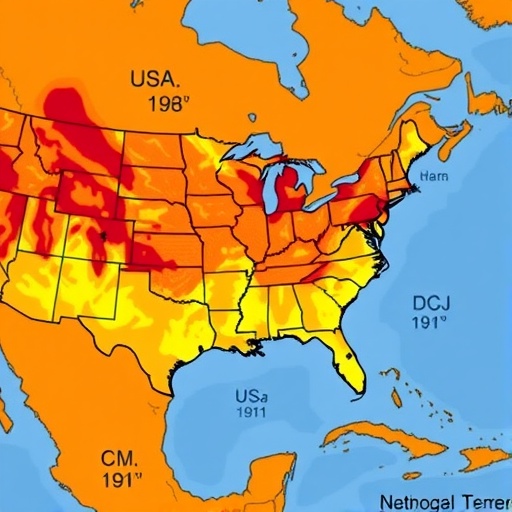
From a spatial perspective, temperature changes across U.S. counties are far from uniform. The Southwest, Southeast, and parts of the Northeast have encountered pronounced warming, whereas segments of the Great Plains have experienced relatively modest temperature shifts or even slight cooling trends. On average, nationwide county temperatures have climbed approximately 1.9 degrees Fahrenheit between 2017 and 2021 relative to the 20th-century baseline. However, certain localities—primarily in Colorado and Ohio—register warming exceeding 3.7 degrees Fahrenheit, highlighting patchy climate impacts that compound the complexity of migration responses at the community level.
To interrogate the possibility of non-linear migration reactions to heat, the study employs spline regression techniques, seeking ‘tipping points’ beyond which temperature anomalies might evoke more profound population movements. Results suggest relative stability in migration flows up until around 2.6 to 2.7 degrees Fahrenheit of warming, where early signs of behavioral shifts emerge. Despite this signal, strong migration responses remain modest, implying that even substantial heat increases to date have only gently modulated human mobility patterns.
A particularly compelling dimension unearthed is the phenomenon of “climate immobility” or “trapped populations.” Gradual temperature stress does not uniformly propel relocation but often constrains movement, especially among economically vulnerable groups lacking the financial resources or social capital to migrate. This intricacy introduces an urgent discourse on climate justice, as lower-income communities may face escalating exposure to environmental hazards without the means to escape, thereby intensifying their vulnerability profiles.
Moreover, the study highlights diverging migration tendencies tied to socio-economic strata. In counties characterized by elevated poverty levels, higher temperatures correlate with increased out-migration rates, implicating economic disadvantage as a catalyst for climate-related relocation. Conversely, areas with sizeable educated populations witness higher rates of selective movement, with patterns indicating a preference for in-migration into vibrant economies coupled with out-migration of certain demographic groups. This heterogeneity in response underscores the essential interplay between social structures and environmental change.
Housing market dynamics emerge as a pivotal factor shaping migration outcomes amid rising temperatures. Interestingly, high housing costs in desirable locales do not necessarily deter incoming residents, illustrating a valuation of amenities and economic opportunity over affordability constraints in some contexts. By contrast, regions plagued by elevated vacancy rates often experience suppressed mobility, which may reflect broader economic stagnation or insufficient infrastructure, thus complicating straightforward linkages between climate and population shifts.
From a policy standpoint, these insights call for a recalibrated approach that transcends immediate expectations of mass climate migration. Rather than anticipating dramatic displacement in the near term, attention should be directed towards fostering resilience within communities. Investments in heat-resilient housing, infrastructural upgrades, and mitigation of energy cost burdens emerge as critical levers to sustain populations in heat-affected regions. Furthermore, tailored support for renters and low-income households—who disproportionately bear climate risks—must complement broader adaptation strategies to ensure equitable outcomes.
Dr. Yanmei Li, the study’s senior author and associate professor in the Department of Urban and Regional Planning at FAU, emphasizes the subtlety of current climate-induced mobility effects. According to Dr. Li, the key impact lies less in forcing people to leave and more in rendering areas less attractive for newcomers, thereby slowing regional growth. This distinction between being pushed out by unbearable heat versus choosing alternatives based on a complex calculus of economic and environmental variables reframes the dialogue around climate and population dynamics.
Co-author Dr. Diana Mitsova further cautions that while present migration responses to heat increments remain subdued, future interactions between temperature rise, extreme weather events, and structural limitations such as housing availability or insurance markets could precipitate more pronounced shifts. Such potential “tipping points” necessitate proactive monitoring and responsive policymaking to preempt disproportionate dislocation and socioeconomic upheaval.
Collectively, this research challenges reductive assumptions about climate’s primacy in shaping human migration within the U.S., foregrounding the intricate interdependence of environmental, economic, and social forces. It invites an integrated appraisal of sustainable adaptation measures that not only address climatic variables but also dismantle systemic barriers to mobility and resilience. As climate change accelerates, nuanced understanding of these dynamics becomes indispensable for crafting policies that safeguard both community stability and individual agency in an increasingly warm world.
In sum, the intricate relationships revealed by this study underscore the importance of viewing climate-induced migration through a multidimensional lens. Temperature anomalies exert influence predominantly by moderating population inflows rather than provoking outright departures. Economic vitality, housing dynamics, and local living conditions remain the foremost drivers of migration decisions. Recognizing this layered reality is vital for anticipating and managing the demographic and social transformations that will accompany ongoing and future climate shifts.
News Publication Date: 17-Feb-2026
Web References:
- DOI: 10.3390/su18042040
- Florida Atlantic University: www.fau.edu
Cite Scienmag News
Russell Cooper. (April 16, 2026). Too Hot to Handle? New Study Reveals How Rising Temperatures Are Driving U.S. Population Shifts. Scienmag. https://scienmag.com/too-hot-to-handle-new-study-reveals-how-rising-temperatures-are-driving-u-s-population-shifts/
Russell Cooper. "Too Hot to Handle? New Study Reveals How Rising Temperatures Are Driving U.S. Population Shifts." Scienmag, 16 April 2026, https://scienmag.com/too-hot-to-handle-new-study-reveals-how-rising-temperatures-are-driving-u-s-population-shifts/. Accessed 3 September 2026.
Russell Cooper. "Too Hot to Handle? New Study Reveals How Rising Temperatures Are Driving U.S. Population Shifts." Scienmag. April 16, 2026. https://scienmag.com/too-hot-to-handle-new-study-reveals-how-rising-temperatures-are-driving-u-s-population-shifts/


