


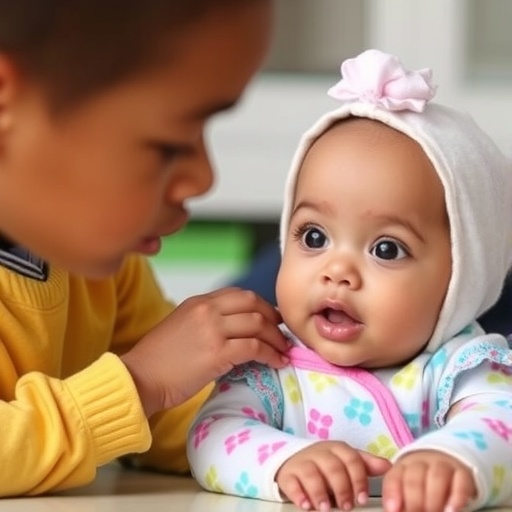
A groundbreaking study recently published in The Lancet Public Health has underscored the transformative effects of the Rx Kids program, the United States’ first community-wide prenatal and infant cash prescription initiative. Spearheaded in Flint, Michigan, this pioneering program has produced significant improvements in birth outcomes, notably reducing incidences of low birthweight, preterm births, and neonatal intensive care unit (NICU) admissions. The findings reveal that direct economic intervention during pregnancy and early infancy can profoundly influence maternal and infant health at a population level, challenging longstanding assumptions about the role of socioeconomic factors in birth outcomes.
The research team, representing renowned institutions Michigan State University and the University of Michigan, conducted a meticulous analysis of approximately 4,500 births in Flint, spanning from January 2021 to June 2025. By employing a quasi-experimental design that compared birth outcomes before and after the program’s launch against similar non-participating communities in Michigan, the researchers illuminated the profound impacts of monetary support on neonatal health metrics. The data showed a reversal in negative trends previously observed in Flint, with the Rx Kids program initiating marked reductions in adverse birth outcomes beginning in 2024.
Quantitatively, the program achieved an 18% reduction in preterm births and a 27% decline in low birthweight cases. These improvements had a cascading effect, leading to an approximate 29% decrease in NICU admissions. This reduction translates into not only healthier neonates but also substantial healthcare cost savings, positioning Rx Kids as a win-win intervention for both families and public health systems. These outcomes provide compelling evidence supporting direct cash transfers during vulnerable periods as an impactful public health strategy.
The conceptual framework of Rx Kids addresses the economic volatility that families often experience during pregnancy and infancy. This critical period frequently entails a sudden reduction in household income alongside surging expenses. Understanding that early-life conditions profoundly shape lifelong health trajectories, the program offers $1,500 during pregnancy and a monthly stipend of $500 throughout infancy. This infusion of resources fosters financial stability and reduces stressors known to compromise maternal and fetal well-being.
Prior research associated with Rx Kids has documented near-universal participation within targeted communities and attributed several positive social determinants to the program. Families reported enhanced housing stability, diminished food insecurity, improved maternal mental health, and greater trust in healthcare institutions. Additionally, there was a documented decrease in prenatal smoking, a well-established risk factor for adverse neonatal outcomes. Collectively, these improvements establish a robust causal pathway linking economic support to biological and psychosocial mechanisms influencing birth outcomes.
Dr. Mona Hanna, the program’s architect and associate dean at Michigan State University’s College of Human Medicine, articulates the profound implications of these findings. She highlights that poverty operates as a potent pathogen detrimental to maternal and infant health but also emphasizes the malleability of these social drivers through targeted investment. The Rx Kids initiative demonstrates that direct cash assistance during pregnancy and infancy not only alleviates financial hardship but also tangibly reduces medical complications and facilitates a healthier start for children across entire populations.
Health economist and University of Michigan faculty member Sumit Agarwal further contextualizes the study’s significance within broader epidemiological discourse. He points out that while individual-specific interventions have held promise, the scalability and population-level efficacy observed in Rx Kids signify a paradigm shift in maternal-infant health strategies. These results advocate for public health policies that integrate direct economic support as a foundational component of prenatal and postnatal care.
The program’s expansion since its inception in early 2024 is notable. Rx Kids has scaled to encompass 42 communities throughout Michigan, providing vital financial aid to over 11,000 families to date. This broader implementation not only amplifies the direct health benefits but also generates ancillary economic advantages. Studies indicate increased family financial stability and prevention of child welfare system involvement. Furthermore, the influx of funds has stimulated local economies, with millions of dollars circulating through area businesses, thereby driving jobs and income growth within recipient communities.
Rx Kids operates through a robust public-private partnership model, led by Michigan State University and administered by GiveDirectly, a global leader in unconditional cash transfer programs. Supported by state funds and philanthropic contributors, this model ensures efficient, transparent delivery of financial resources directly to families. The program complements existing healthcare frameworks rather than replacing them, effectively bridging gaps by targeting the social determinants of health through tangible economic support.
Technical analysis of the underlying mechanisms suggests that cash transfers during pregnancy mitigate chronic stress responses and improve maternal nutrition, both critical to fetal development. Lowered psychosocial stress can downregulate inflammatory pathways implicated in preterm labor, while improved prenatal care utilization enhances early detection and management of pregnancy complications. Collectively, these biological and behavioral modulations converge to enhance birth outcomes and reduce the need for intensive neonatal care.
The implications of these findings extend far beyond Flint or Michigan. They offer a replicable model demonstrating how unconditional, direct cash interventions during critical developmental windows can counteract poverty’s physiological imprint on birth and early health outcomes. As maternal and infant health remain pressing public health challenges worldwide, Rx Kids furnishes an evidence-based, scalable approach to mitigate disparities and improve health equity.
Future research directions will likely investigate the long-term developmental trajectories of children benefitting from such cash assistance and the integration of this approach within broader social policy frameworks. The study’s quasi-experimental design provides a robust foundation for causal inference but also invites further randomized controlled trials to optimize program parameters. Nonetheless, these initial results herald a potential paradigm transformation in the nexus between socioeconomic policy and public health.
In conclusion, Rx Kids represents a seminal advancement in population health interventions, illuminating the potent impact of direct financial support during pregnancy and infancy on birth outcomes. This novel approach challenges traditional paradigms by addressing upstream determinants through unconditional cash transfers, yielding measurable health improvements and economic benefits. The program’s demonstrated efficacy and scalability offer a compelling blueprint for reimagining maternal and infant care in both policy and practice.
News Publication Date: 27-May-2026
Web References:
- The Lancet Public Health: https://www.thelancet.com/journals/lanpub/article/PIIS2468-2667(26)00055-/fulltext
- Rx Kids: https://rxkids.org/
- Michigan State University College of Human Medicine: https://humanmedicine.msu.edu/
References:
- Prior research summaries on housing stability, food hardship, maternal mental health, prenatal care utilization, and smoking reduction cited within the primary article.
Cite Scienmag News
Harold Sullivan. (May 28, 2026). Study Validates Rx Kids Program Enhances Health Outcomes for Flint Infants and Families. Scienmag. https://scienmag.com/study-validates-rx-kids-program-enhances-health-outcomes-for-flint-infants-and-families/
Harold Sullivan. "Study Validates Rx Kids Program Enhances Health Outcomes for Flint Infants and Families." Scienmag, 28 May 2026, https://scienmag.com/study-validates-rx-kids-program-enhances-health-outcomes-for-flint-infants-and-families/. Accessed 3 September 2026.
Harold Sullivan. "Study Validates Rx Kids Program Enhances Health Outcomes for Flint Infants and Families." Scienmag. May 28, 2026. https://scienmag.com/study-validates-rx-kids-program-enhances-health-outcomes-for-flint-infants-and-families/


