


Concrete is everywhere, and so is its carbon problem. Portland cement production accounts for roughly 7 to 8 percent of global anthropogenic carbon dioxide emissions, a burden rooted in the limestone calcination reaction and the enormous thermal energy required to fire clinker at high temperatures. Alkali-activated concrete, which replaces cement with industrial by-products such as fly ash and ground granulated blast furnace slag, has long promised a way out. Yet a hidden catch has dogged the technology: the alkaline activators that make these binders work, chiefly commercial sodium silicate and sodium hydroxide, are themselves energy-hungry chemicals that can contribute 40 to 70 percent of the total global warming potential and embodied energy of the finished concrete. A new systematic study published in Case Studies in Construction Materials now offers the most comprehensive quantitative answer yet to whether waste-derived activators can break that bottleneck.
Researchers Anuoluwapo Sola Kolade, Damilola Oyewumi Oyejobi and Bolanle Deborah Ikotun assembled a database of 40 concrete mixes drawn from 20 peer-reviewed experimental studies published between 2016 and 2026, following a PRISMA-inspired screening procedure that began with 65 records. Twenty of the mixes relied on commercial sodium silicate activation, while twenty used activators synthesized from waste materials, most commonly waste glass powder and rice husk ash. The team deliberately distinguished between sole waste-derived activator systems, which eliminate commercial alkalis entirely, and hybrid systems that supplement the waste-derived activator with additional sodium hydroxide. Every mix was rebuilt from its published proportions into a harmonized cradle-to-gate life cycle inventory, using standardized environmental coefficients from the Inventory of Carbon and Energy database and process-specific literature, so that the environmental comparison rested on consistent assumptions rather than the heterogeneous reporting of the original studies.
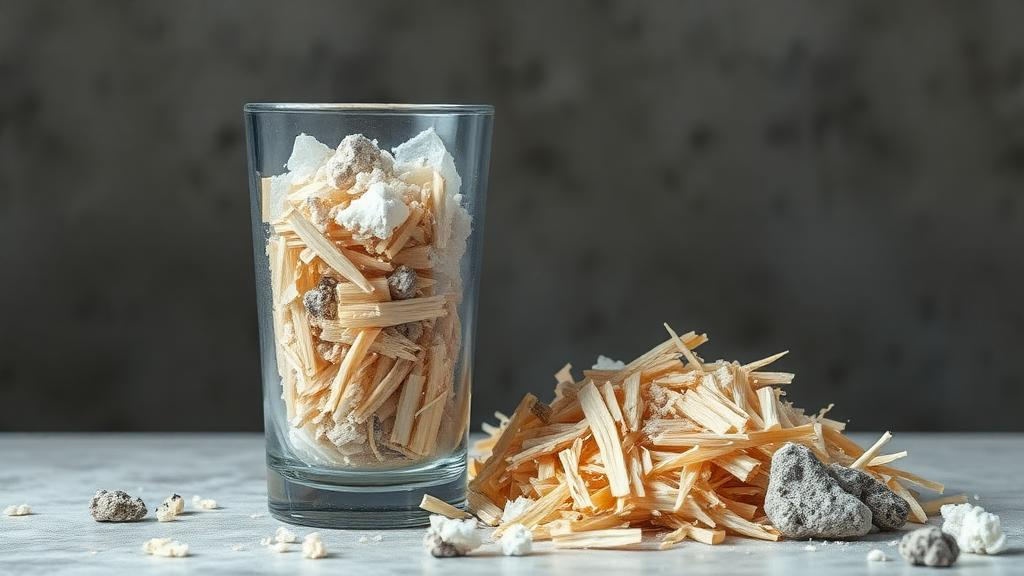
The feedstocks at the heart of the analysis are abundant. The world generates an estimated 100 to 130 million tonnes of waste glass annually, while roughly 190 million tonnes of rice husks are produced each year, corresponding to a potential rice husk ash yield of 26 to 34 million tonnes. Both materials can contain more than 70 percent amorphous silica, the reactive ingredient needed to build soluble silicate activators. Two synthesis routes were compared: hydrothermal dissolution of the silica-rich waste in alkaline solution at 80 to 100 degrees Celsius, and thermochemical fusion, in which the waste is heated with solid alkalis at 150 to 650 degrees Celsius to form reactive solid silicate powders suitable for one-part, mix-and-go concretes. The thermochemical route proved especially attractive, since a standardized 500-degree-Celsius furnace cycle for two or three hours consumed only 0.072 to 0.108 megajoules per kilogram of product, roughly six times less energy than the hydrothermal coefficients adopted from the literature.
The mechanical verdict was strikingly even. Commercial-activated mixes averaged 41.56 megapascals of 28-day compressive strength across the pooled database, while the waste-derived systems averaged 39.44 megapascals, a difference the researchers’ statistical tests found insignificant, with a small effect size. Within the structural-grade class of 40 to 60 megapascals, the sole waste-derived systems actually outperformed both alternatives, averaging 52.87 megapascals against 50.32 for the commercial controls and 44.34 for the hybrids. The best waste-glass thermochemical formulations reached 59.12 megapascals, and several rice husk ash systems exceeded 55 megapascals, all without any heat curing. The authors attribute this performance to the higher slag contents these formulations carried, which supply calcium-rich phases that form dense C-(A)-S-H-type reaction products even at ambient temperature.
On carbon, the waste-derived systems delivered a decisive win. Average cradle-to-gate global warming potential fell from 173.42 kilograms of carbon dioxide equivalent per cubic metre for commercial activation to 114.82 for the waste-derived mixes, a reduction of about 34 percent that was statistically significant with a large effect size. The 95 percent confidence interval placed the true reduction between 19 and 49 percent. Sole waste-derived systems did best of all, averaging 103.50 kilograms of carbon dioxide equivalent per cubic metre, because hybrid systems still carry the burden of chlor-alkali sodium hydroxide production, an electrochemical process whose energy demand can exceed 20 megajoules per kilogram. Notably, the embodied energy picture was less flattering: waste-derived mixes actually consumed slightly more energy on average than the commercial controls, a difference that fell just short of statistical significance, reminding engineers that carbon savings and energy savings do not automatically travel together.
Contribution analysis made the reason unmistakable. Activator production dominated the environmental profile of every category, accounting for 82 percent of global warming potential in commercial systems and still 75 to 76 percent in the waste-derived ones, and for 65 to 73 percent of embodied energy. Precursors, particularly slag, formed the consistent secondary hotspot, while aggregates, water, superplasticizer and curing each contributed less than 13 percent individually. In other words, the lever that matters most in low-carbon alkali-activated concrete is not the aggregate supply or the mixing water but the chemistry of the activator itself, which is precisely where waste valorization intervenes.
The robustness of these conclusions was tested through sensitivity analyses that perturbed the most uncertain assumptions. Raising the environmental coefficients assigned to waste glass and rice husk ash by 20 percent shifted the sole waste-derived average by only about 2 percent and changed no rankings. Substituting an alternative, lower-impact inventory for commercial sodium silicate reduced the commercial systems’ average carbon footprint substantially, yet the waste-derived systems still held the lowest position. Cutting the hydrothermal processing energy by 20 percent likewise left the ordering intact. Formal t-tests at the 95 percent confidence level, with Welch’s correction applied where variances were unequal, supported the headline comparisons throughout.
When strength was folded into the environmental accounting, the picture sharpened further. Strength-normalized carbon intensity averaged 3.23 kilograms of carbon dioxide equivalent per megapascal for waste-derived systems against 4.60 for the commercial controls, a significant difference with a moderate effect size. A composite sustainability index, which combines carbon and energy burdens per unit of strength, placed seven of the top ten most eco-efficient mixes in the waste-derived category, with the leading formulation achieving 50 megapascals at an index of just 2.23. Pareto analysis, which searches for mixes that no other formulation can beat on both strength and carbon simultaneously, identified three non-dominated systems, all of them sole waste-derived and all activated by thermochemically fused waste glass. One achieved 35 megapascals at a mere 51.52 kilograms of carbon dioxide equivalent per cubic metre, the lowest-carbon solution in the entire database, while another delivered 59.12 megapascals at 85.39.
Perhaps most consequential for real-world procurement, the researchers mapped their reconstructed carbon values onto the Low Carbon Concrete Group’s tiered embodied carbon classification, a framework increasingly used in infrastructure purchasing. Six of the eleven sole waste-derived formulations earned the top Market Beating rating, compared with only three of the twenty commercial mixes, and several waste-derived structural-grade concretes exceeded 50 megapascals while staying within that best band. The commercial systems, by contrast, spread across the ratings and included the only mixes classified in the worst band. The authors caution that these classifications were applied without regional adjustment for electricity mixes or supply chains, and that the cradle-to-gate boundary excludes transport, construction and end-of-life stages, so the results should be read as production-stage benchmarks rather than complete life cycle verdicts.
The path from laboratory promise to industrial deployment still runs through familiar obstacles: feedstock variability, contamination in waste glass streams, the regional dependence of rice husk ash quality, the need for dedicated thermal processing infrastructure, and the absence of the standards and mix-design frameworks that Portland cement enjoys. The study’s authors argue that future work should integrate durability indicators such as chloride migration and carbonation resistance into eco-efficiency assessments, standardize environmental reporting, and explore low-energy synthesis routes including mechanochemical processing. But the central message stands on firm quantitative ground: concrete that matches the strength of commercial formulations while cutting embodied carbon by roughly a third can be built on activators made from the glass bottles and rice husks the world already throws away, and the bottleneck to greener construction may be solved not by reinventing the binder but by reinventing its chemistry.
Subject of Research: Waste-derived alkaline activators for fly ash-slag alkali-activated concrete and their strength and life cycle environmental benchmarking
Article Title: Strength and environmental benchmarking of waste-derived activators in fly ash-slag alkali-activated concrete: A systematic and quantitative assessment
Article References: Kolade, A. S., Oyejobi, D. O., & Ikotun, B. D. (2026). Strength and environmental benchmarking of waste-derived activators in fly ash-slag alkali-activated concrete: A systematic and quantitative assessment. Case Studies in Construction Materials, 25, Article e06602. https://doi.org/10.1016/j.cscm.2026.e06602
Image Credits: AI Generated
DOI: 10.1016/j.cscm.2026.e06602
Keywords: alkali-activated concrete, waste-derived activators, sodium silicate, waste glass powder, rice husk ash, fly ash, ground granulated blast furnace slag, life cycle assessment, global warming potential, embodied carbon, geopolymer, low-carbon procurement
Cite Scienmag News
Alan Morgan. (October 7, 2026). Waste Glass and Rice Husk Ash Activators Cut Concrete Carbon by a Third Without Losing Strength. Scienmag. https://scienmag.com/waste-glass-and-rice-husk-ash-activators-cut-concrete-carbon-by-a-third-without-losing-strength/
Alan Morgan. "Waste Glass and Rice Husk Ash Activators Cut Concrete Carbon by a Third Without Losing Strength." Scienmag, 7 October 2026, https://scienmag.com/waste-glass-and-rice-husk-ash-activators-cut-concrete-carbon-by-a-third-without-losing-strength/. Accessed 7 October 2026.
Alan Morgan. "Waste Glass and Rice Husk Ash Activators Cut Concrete Carbon by a Third Without Losing Strength." Scienmag. October 7, 2026. https://scienmag.com/waste-glass-and-rice-husk-ash-activators-cut-concrete-carbon-by-a-third-without-losing-strength/


