


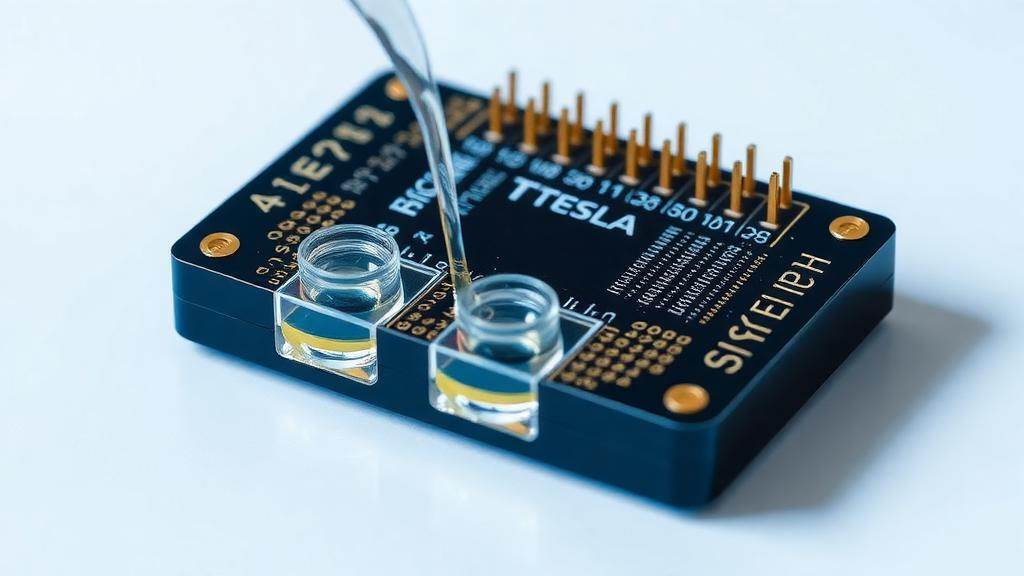
A team of researchers at the University of Minho in Portugal has unveiled a microfluidic multiplexer platform that can passively mix two fluids flowing at very different rates and then deliver the mixture with near-equal volumes into three parallel reaction chambers. The work, published in the journal Results in Engineering, addresses one of the most stubborn bottlenecks in the march toward point-of-care diagnostics: getting a lab-on-a-chip to do many things at once, reliably, without bulky external equipment. Led by Filipe Ferreira and Susana O. Catarino, the group designed, simulated and experimentally validated four versions of the device, each combining a passive micromixer with a three-way fluid distribution network, and found that a design inspired by a century-old idea from Nikola Tesla delivered the best overall performance.
The physics of microscale flow is what makes mixing on a chip so difficult. In channels whose widths are measured in micrometers, fluids with constant viscosity, known as Newtonian fluids, flow in a laminar regime, meaning viscous forces overwhelm inertial ones. The Reynolds number, the dimensionless ratio of inertial to viscous forces, typically falls well below one in such devices, far under the threshold of roughly 2000 where turbulence begins. Without turbulence, there is no chaotic churning to scramble two streams together; species move between streams mainly by diffusion. The Péclet number, which compares advective to diffusive transport, is likewise low in microchannels, so diffusion dominates. For large biomolecules, whose diffusion coefficients can be as small as ten to the minus fourteen square meters per second, this makes mixing painfully slow unless the channel geometry is cleverly engineered to stretch and fold the fluids into each other.
Engineers tackle this problem with two broad families of micromixers. Active micromixers inject energy from outside, using electric or magnetic fields, acoustic waves or thermal gradients to stir the fluids, but the extra transducers add cost and complexity, and the applied fields can damage delicate biological samples. Passive micromixers, by contrast, rely entirely on channel geometry and flow conditions to maximize contact between the streams, inducing mixing through splitting and recombination of flow, vortices and fluid collisions. Because they are cheap to fabricate and easy to integrate, passive designs have become the workhorses of lab-on-a-chip systems. What has been missing, the Portuguese team argues, is a passive device that simultaneously achieves efficient mixing under unequal inlet flow rates and guarantees that the mixed fluid arrives at multiple detection sites in equal amounts, a combination essential for running several biomarker tests on a single chip at the same time.
The new platform consists of a passive mixing region followed by a compensation chamber that stabilizes the flow and three millimetric reaction chambers sized to accommodate future integration of miniaturized optical detectors such as LEDs and photodiodes. The researchers built four two-dimensional designs by pairing two micromixer geometries with two reaction chamber diameters, 3500 and 5000 micrometers. The first geometry, dubbed Tesla-shaped, adapts a structure originally conceived by Nikola Tesla, in which the flow is partially split at a constriction, accelerating through the narrow passage while the remainder curls into a vortex and emerges in the opposite direction, dramatically increasing interaction between the species. The team set the constriction widths to 50 and 90 micrometers and repeated the mixing unit eight times along the channel. The second geometry, half-moon-shaped, borrowed from a topology-optimized design, places two semicircular structures symmetrically on opposite walls with a central obstacle that divides the flow; the two streams then form vortices and collide. Here the researchers doubled the original dimensions to a maximum channel width of 400 micrometers and replicated the unit four times along a five-segment serpentine.
Before fabricating anything, the team ran transient finite element simulations in COMSOL Multiphysics, solving the Navier-Stokes equations for laminar flow coupled with the transport of diluted species. Water was the working fluid, and the inlets were driven at three flow rate ratios: 1:1, 1:3 and 1:6, with the reference inlet fixed at 5 microliters per minute while the second ranged from 5 to 30 microliters per minute. A preliminary three-dimensional study confirmed that a cheaper two-dimensional model captured the physics faithfully, and a mesh independence study settled on a coarse refinement of roughly ten thousand to twenty thousand elements per geometry. The simulations showed that in the Tesla-shaped device mixing was nearly complete by the second mixing structure, while in the half-moon design it was almost finished by the end of the first serpentine segment. Quantitatively, both geometries reached simulated mixing indices of almost 100 percent within 20 seconds, indicating essentially homogeneous concentration across the channel width.
The experimental devices were made in polydimethylsiloxane, the transparent, biocompatible elastomer beloved of microfluidics researchers, using a low-cost replica molding process with SU-8 epoxy molds fabricated by ultraviolet soft lithography, notably without cleanroom facilities. The testing rig combined a two-syringe pump for precise flow control, bubble extractors at the inlets, an inverted optical microscope with a high-speed camera, and a spectrophotometer to analyze the collected fluids. Blue and yellow dyes served as the test fluids, and each device ran continuously for 20 minutes under the three flow ratios, with all experiments repeated three times. Mixing efficiency was quantified from microscopy images by measuring the standard deviation of pixel intensities across the channel: a well-mixed stream shows a uniform grayscale, while an unmixed one shows dark blue flanks and a bright yellow center.
The results confirmed the simulations with some instructive nuances. The Tesla-shaped micromixer consistently outperformed the half-moon version, showing a more uniform color distribution at the channel end and slightly higher mixing indices, with both geometries exceeding the 80 percent target. The half-moon device retained a slight color variation at the outlet, a shortfall the authors attribute partly to air bubbles accumulating near the vertices of its semicircular structures. Interestingly, mixing improved at higher flow rates, because stronger inertial effects promote chaotic advection and increase the interfacial contact between the streams, a reminder that even in the laminar world inertia can be harnessed rather than merely tolerated. Spectrophotometric analysis of the outlet fluids, tracking absorbance at 400 and 640 nanometers and the ratio between them, showed similar spectral profiles across all three outlets, further evidence of effective mixing and distribution.
On the distribution side, the size of the reaction chambers turned out to matter enormously. In the Tesla-shaped device with 3500 micrometer chambers, the coefficient of variation of collected volumes hovered around or below 25 percent, but enlarging the chambers to 5000 micrometers pushed that figure down to around or below 10 percent, meeting the uniformity target, and the differences were not statistically significant. The same trend appeared in the half-moon family, where the smaller-chamber version showed statistically significant volume disparities between the central and lateral outlets while the larger-chamber version did not. The team also noted a recurring cosmetic quirk: the central outlets tended to look slightly greener than the lateral ones, because the laminar flow profile mixes more thoroughly in the fast-moving center of the stream, an effect that could be mitigated by widening the channel feeding the central chamber.
The best all-around performer was the Tesla-shaped multiplexer with 5000 micrometer chambers, which balanced strong mixing with the most even fluid delivery, although its 3500 micrometer sibling achieved marginally better mixing uniformity at high flow ratios. The authors are candid about limitations: the study used Newtonian test fluids within a restricted flow range, the dyes can leave residues in the channels over time, and occasional bubble entrapment perturbed the half-moon geometry. Real biological samples, functionalized reaction chambers and surface-interaction studies will be needed before the platform can compete with validated multiplexed diagnostics. Still, the achievement is significant: a fully passive, low-cost chip that mixes fluids at flow rate ratios as steep as 1:6 and splits the result three ways with volumes uniform to within about 10 percent. With future work on geometry optimization and biofunctionalization, the researchers envision these multiplexers forming the fluidic backbone of lab-on-a-chip systems that screen multiple biomarkers simultaneously, bringing faster, cheaper and more portable diagnostics closer to the clinic.
Subject of Research: Passive microfluidic mixing and multiplexed fluid distribution for point-of-care diagnostics
Article Title: Multiplexer microfluidic platform for mixing and driving Newtonian fluids under high flow rate ratios
Article References: Ferreira, F., Sousa, P. J., Minas, G., Lima, R. A., Pinto, V. C., & Catarino, S. O. (2026). Multiplexer microfluidic platform for mixing and driving Newtonian fluids under high flow rate ratios. Results in Engineering, 32, Article 113345. https://doi.org/10.1016/j.rineng.2026.113345
Image Credits: AI Generated
DOI: 10.1016/j.rineng.2026.113345
Keywords: microfluidics, micromixer, point-of-care diagnostics, lab-on-a-chip, passive mixing, Tesla valve, PDMS, laminar flow, multiplexing, biosensing, chaotic advection, fluid dynamics
Cite Scienmag News
Denise Maddox. (October 7, 2026). Tesla-Inspired Microfluidic Chip Mixes Fluids and Feeds Three Test Chambers Evenly. Scienmag. https://scienmag.com/tesla-inspired-microfluidic-chip-mixes-fluids-and-feeds-three-test-chambers-evenly/
Denise Maddox. "Tesla-Inspired Microfluidic Chip Mixes Fluids and Feeds Three Test Chambers Evenly." Scienmag, 7 October 2026, https://scienmag.com/tesla-inspired-microfluidic-chip-mixes-fluids-and-feeds-three-test-chambers-evenly/. Accessed 7 October 2026.
Denise Maddox. "Tesla-Inspired Microfluidic Chip Mixes Fluids and Feeds Three Test Chambers Evenly." Scienmag. October 7, 2026. https://scienmag.com/tesla-inspired-microfluidic-chip-mixes-fluids-and-feeds-three-test-chambers-evenly/


