


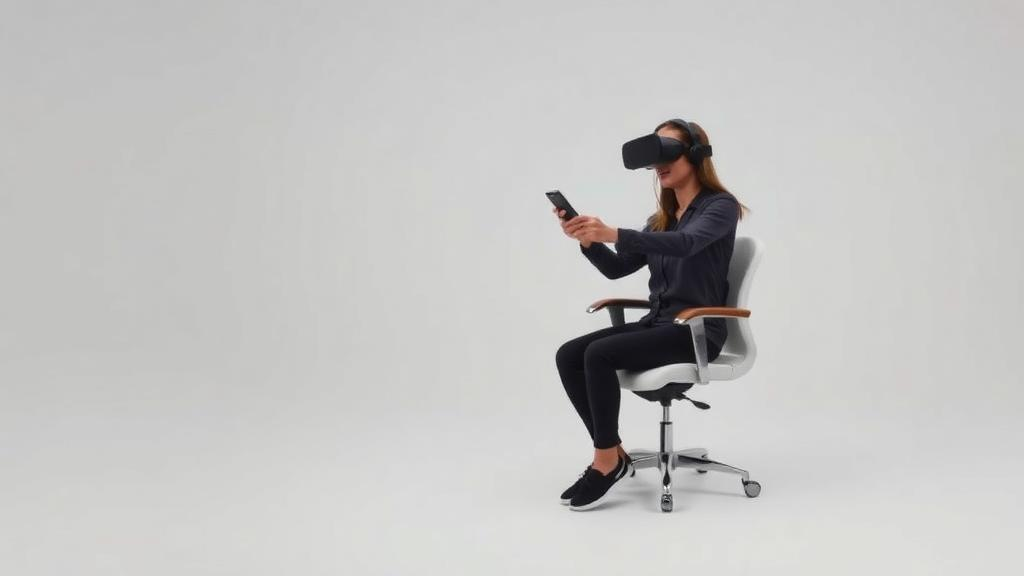
The image of virtual reality that most people carry in their minds is instantly recognizable: a person encased in bulky goggles, turning awkwardly in circles, reaching out to grab objects that exist only in silicon. It is an image that researchers at Kyushu University in Fukuoka, Japan, have set out to change. Their new system, presented at the SIGGRAPH Emerging Technologies conference, allows a user to enter an immersive stereoscopic virtual environment simply by sitting down in a specially designed chair. No headset touches the head, no straps press against the face, and no display dangles millimeters from the eyes. Instead, the virtual scene appears to float in the air beyond the physical boundaries of the chair itself, delivered by an optical technique known as aerial imaging.
The project, according to Shogo Fukushima, Associate Professor at Kyushu University’s Faculty of Information Science and Electrical Engineering, began with a very human complaint. One of his students, who spends more of his day inside virtual environments than outside them, found that the headset itself had become the main obstacle to long sessions. He would even try to sleep in VR, Fukushima recalls, but the headset made it impossible to get comfortable. That observation reframed the engineering problem. Rather than asking how to make head-mounted displays lighter or more ergonomic, the team asked a more radical question: what if nothing needed to be mounted on the head at all?
The question matters because the fundamental architecture of modern VR hardware works against comfort. Conventional headsets create a three-dimensional view by presenting slightly different images to each eye through displays and lenses positioned close to the face. To widen the field of view, raise the resolution, or increase processing power, engineers must add more hardware, and every added component translates directly into weight and pressure on the head and neck. Most consumer and professional VR devices are therefore designed with relatively short sessions in mind. That constraint limits how naturally VR can fit into everyday life, whether in workplaces, clinics, classrooms, or living rooms. Fukushima’s lab inverted the design philosophy: instead of shrinking the hardware onto the user, they moved it off the user entirely.
The technical heart of the system is a micromirror array, a device composed of many tiny mirrors that can direct different images toward each of the viewer’s eyes. By steering light precisely, the array reproduces the stereoscopic effect that headsets achieve with lenses and near-eye displays, but from a distance and without any contact with the user. The approach builds on aerial imaging optics, a technique that makes images appear to float in space rather than on a physical screen. Light rays from the display are redirected so that they appear to diverge from a point in mid-air, forming a real image that hovers beyond the apparatus. Viewers perceive depth and volume in empty space, with no screen surface visible anywhere in the optical path.
Aerial imaging optics as a principle has been explored before, but the Kyushu team pushed it further by assembling it into a working VR system that a person can sit in and look around. The optical module is mounted on a chair, and a built-in gyroscope tracks the chair’s rotation in real time. As users turn their bodies, the stereoscopic view rotates with them, allowing them to scan the virtual world naturally. Crucially, this happens without wearing a headset and without any calibration procedure; the sensing is tied to the chair rather than to the person, which removes a whole layer of setup friction that normally separates a curious newcomer from an immersive experience. The compact footprint of the setup also means that a convincing, theater-like virtual scene can be delivered within a relatively small physical space.
The implications for comfort are only the beginning. Fukushima notes that the system also has the potential to reduce VR sickness in the future. Cybersickness, the nausea and disorientation that many users experience in VR, is widely attributed to a mismatch between visual sensations and physical ones, such as when the eyes report motion that the inner ear does not confirm. Because the display no longer has to be constrained to something wearable, larger optical components and moving mechanisms can be incorporated more freely, Fukushima explains. That flexibility could enable new approaches to closing the gap between what the user sees and what the user’s body feels, attacking one of VR’s most persistent adoption barriers at the level of system design rather than software compensation.
Another quiet advantage of the mountless architecture lies in where the computation lives. In a conventional headset, image processing, tracking, and rendering hardware must all be packed into the device strapped to the face, competing for space, power, and thermal headroom with the optics. By moving image processing outside the wearable device, the Kyushu design frees the system from those constraints. Heavier, more power-hungry, and more capable electronics can sit in the chair or nearby, while the user experiences only light and empty air. For applications that demand hours of continuous use, from industrial training to clinical monitoring, that separation between the human and the machinery could prove decisive.
The research team is already looking beyond the laboratory. They are seeking industry partners to bring the technology into everyday life, and the range of envisioned applications is broad: in-car workspaces where a passenger could enter a virtual office during a long ride, interactive museum exhibits where visitors could step into a scene without hygiene concerns or fitting delays, remote-controlled construction machinery operated through immersive views, and disaster-response robots piloted by operators who need sustained, comfortable immersion. In each of these cases, the headset is not merely an inconvenience but a practical liability, whether because of weight, shared use, safety regulations, or the simple fact that a person cannot wear goggles indefinitely while performing real work.
Looking further ahead, Fukushima hopes to create something akin to Doraemon’s famous Anywhere Door, a portal through which two people could share the same immersive virtual scene. The reference is fitting for a system whose charm lies in its apparent magic: a user sits down, and a world opens in front of them with nothing worn and nothing touched. It is also a reminder of the lab’s underlying philosophy. As Fukushima puts it, the lab has always wanted to question what we take for granted in our routines, and technical skills are not the most important thing when it comes to imagining a different future. The team would welcome more people who want to challenge the way things are usually done.
Whether mountless VR becomes the next default or simply a powerful complement to head-mounted systems, the Kyushu prototype demonstrates that the goggled silhouette is not a law of nature. By rethinking the mounted assumption that has defined virtual reality since its inception, and by borrowing optical tricks that let images float freely in air, the researchers have shown that immersion can begin the moment a user takes a seat. For the students and professionals who live much of their lives in virtual spaces, and for the many more who have been deterred by the weight on their heads, that could be the most important development VR has seen in years.
Subject of Research: A headset-free virtual reality system using aerial imaging optics and a rotating chair
Article Title: How to head into VR without wearing a headset
Article References: How to head into VR without wearing a headset. (n.d.). Original publication
Image Credits: AI Generated
DOI: Not provided
Keywords: virtual reality, aerial imaging optics, micromirror array, head-mounted display, Kyushu University, VR sickness, stereoscopic display, SIGGRAPH, human-computer interaction, remote operation, gyroscope tracking, immersive technology
Cite Scienmag News
Courtney Benton. (October 7, 2026). Sitting Into Virtual Reality: Chair-Based Aerial Imaging Ditches the Headset. Scienmag. https://scienmag.com/sitting-into-virtual-reality-chair-based-aerial-imaging-ditches-the-headset/
Courtney Benton. "Sitting Into Virtual Reality: Chair-Based Aerial Imaging Ditches the Headset." Scienmag, 7 October 2026, https://scienmag.com/sitting-into-virtual-reality-chair-based-aerial-imaging-ditches-the-headset/. Accessed 7 October 2026.
Courtney Benton. "Sitting Into Virtual Reality: Chair-Based Aerial Imaging Ditches the Headset." Scienmag. October 7, 2026. https://scienmag.com/sitting-into-virtual-reality-chair-based-aerial-imaging-ditches-the-headset/


