


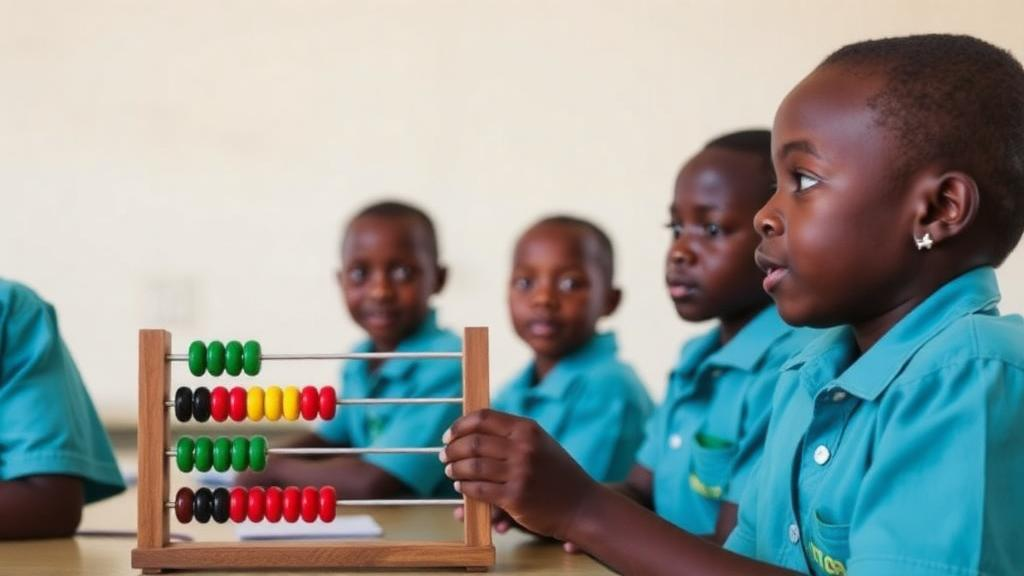
In classrooms across the Rundu Circuit in Namibia’s Kavango East Region, a single abacus is often the only concrete mathematics tool a school owns. Teachers carry it from lesson to lesson, holding it at the front of the room while as many as seventy children strain to see the beads. When everyone wants to touch it at once, lessons collapse into competition for access, and the promise of hands-on learning quietly dissolves. A new qualitative study of ten Grade 4 mathematics teachers reveals in detail why the teaching aids that could unlock one of arithmetic’s hardest concepts, place value, so rarely make it into daily practice, and what small factors allow a handful of teachers to use them anyway.
Place value, the principle that a digit’s meaning depends on its position within a multi-digit number, is the structural backbone of the base-ten system. Without it, children cannot reliably round numbers, write a digit’s value in a four-digit numeral such as 3724, or decompose 1253 into 1000 + 200 + 50 + 3 in expanded notation. These are precisely the competencies the Namibian senior primary syllabus for Grades 4 to 7 demands, and precisely the ones learners find hardest. An analysis of Grade 4 learners’ mathematics books in Namibia previously documented persistent failures on number charts, rounding, digit value and expanded notation, suggesting that the topic’s difficulty is not incidental but systemic, rooted in how it is taught.
The theoretical case for manipulatives, physical objects such as abacuses, base-ten blocks and place value charts that let children handle number structures directly, is well established. Young children often lack the mental maturity to grasp abstract concepts presented only in words or symbols, and concrete materials with visual representations provide the experiential bridge. Research from Quebec has shown that manipulatives designed to make place value denominations transparent reinforce understanding, especially for learners at risk of mathematics learning disabilities. A systematic review from Turkey found that game-based, hands-on approaches produce large effects on both understanding and motivation. Yet the evidence also carries warnings: Multi-base Arithmetic Blocks can increase extraneous cognitive load when their representations are misaligned with learners’ understanding, and manipulative use can degenerate into an end in itself rather than a route to mathematical meaning.
What has been missing, the researchers argue, is attention to the decision point itself: how teachers in under-resourced Global South classrooms actually choose and integrate these tools. Most existing studies come from Ireland, the Philippines, Turkey, Eswatini and the United States, contexts where curriculum expectations, resource conditions and school structures differ sharply from Namibia’s. To fill that gap, the team from the University of Namibia conducted an exploratory qualitative case study, purposively selecting ten Grade 4 mathematics teachers from a pool of 51 in the Rundu Circuit, each with at least two years of Grade 4 experience. Data came from semi-structured interviews of roughly forty minutes each, followed by document analysis of the teachers’ lesson plans, with thematic analysis applied across both sources and triangulated to confirm or challenge each emerging theme.
The enablers the study identified were strikingly human. Teacher preparedness and familiarity topped the list: teachers who felt confident connecting a concrete tool to the underlying concept used manipulatives, while those who did not simply avoided them. One participant admitted that when unsure how to use a particular tool, she did not use it at all; another confessed to avoiding manipulatives out of fear that learners would get confused. Knowledge of learners mattered too, with teachers calibrating tool choice to prior knowledge and the spread of fast and slow learners in a class. Perhaps most unexpectedly, linguistic flexibility emerged as a decisive asset: because Grade 3 learners are taught in vernacular languages and switch to English in Grade 4, teachers who could code-switch explained manipulative-based place value content far more clearly, positioning the tools as language-independent representations that work across linguistic boundaries.
Material availability played its part, but in a soberingly minimal way. The abacus was the only manipulative physically present in most sampled schools, and its mere existence enabled whatever hands-on teaching occurred. One teacher stated plainly that she used an abacus only because it was the only tool available at school. Yet the lesson plan analysis complicated the interview findings: across the documents, the most commonly listed resources were place value charts and textbooks rather than concrete manipulatives, indicating that even where a tool existed, planning documents did not consistently build it into instruction. Availability, the authors conclude, functions as either an enabler or a constraint depending on how it interacts with teacher knowledge and pedagogical purpose.
The barriers, by contrast, were structural and overwhelming. Nine of the ten teachers identified overcrowded classrooms as the dominant obstacle, with class sizes reaching about seventy learners. At that scale, teachers cannot give individualised attention, monitor each child’s manipulation of materials, or even ensure that children at the back can see the demonstration. One teacher described having to stop lessons repeatedly to enforce discipline amid noise and disengagement, then starting over; another noted that learners constantly fight for the chance to come to the front and use one of the school’s two abacuses. The classroom ecology itself, not the teacher’s willingness, defeats the resource-intensive pedagogy.
Professional development deficits compounded the problem. Six of the ten teachers had never attended any workshop on manipulatives or any mathematics workshop at all during their careers, and the four who had received training reported that it consisted of a single pre-service session on the abacus, the only manipulative their university introduced for place value teaching. Left alone, teachers turned to self-directed learning: one fourth-year teacher described going to YouTube to watch videos whenever lesson planning exposed a gap in her knowledge, while a thirteen-year veteran reported that the only workshop of her career concerned curriculum reform, not manipulatives. The researchers read this as a systemic failure operating simultaneously at pre-service and in-service levels, with teachers improvising expertise through informal platforms.
Time pressure and resource scarcity closed the trap. Under the platooning system, lessons last only thirty minutes, which pushes teachers back toward lecture methods and traditional teaching despite Namibia’s learner-centred curriculum ambitions. Teachers reported that selecting appropriate materials requires thinking, comparing and searching, all time-consuming activities, and that teaching place value with manipulatives could stretch the topic to two weeks because learners progress slowly, a pace the timetable cannot absorb. Improvisation offered only partial relief: one teacher built her own abacus, but it was fragile and sometimes broke before reaching the classroom. The authors caution that even the ubiquitous abacus deserves scrutiny, since poorly integrated representations can produce a redundancy effect that raises extraneous cognitive load and harms learning, as documented with Multi-base Arithmetic Blocks.
The study’s central conclusion is that manipulative integration is not primarily a resource problem but an interaction among pedagogical preparedness, learner characteristics, classroom ecology and material availability. Improving it, the authors argue, requires simultaneous systemic interventions: targeted professional development that builds pedagogical confidence, review of class size norms, equitable resource allocation, curriculum support, and reconsideration of scheduling structures such as platooning that make hands-on teaching structurally impossible. Teacher education institutions should strengthen pre-service preparation in the pedagogical use of manipulatives across primary mathematics topics, not just a single tool. The findings also carry weight beyond Namibia, adding rare empirical evidence from the Global South to a literature dominated by high-resource contexts and illuminating how contextual conditions mediate the enactment of learner-centred pedagogy wherever classrooms are crowded, budgets thin and time short. Future research, the authors suggest, should follow up with intervention studies measuring whether targeted training changes teacher confidence and competence, incorporate learners’ perspectives, and add classroom observation to corroborate teachers’ self-reported accounts.
Subject of Research: Enablers and barriers to teachers' selection and integration of manipulatives in Grade 4 place value teaching in Namibia
Article Title: Enablers and barriers to manipulative selection and integration in primary school place value teaching
Article References: Hailulu, R. K., & Kanandjebo, L. N. (2026). Enablers and barriers to manipulative selection and integration in primary school place value teaching. Discover Education, 5(1), Article 1130. https://doi.org/10.1007/s44217-026-02164-8
Image Credits: AI Generated
DOI: 10.1007/s44217-026-02164-8
Keywords: manipulatives, place value, mathematics education, primary school, Namibia, Grade 4, teacher professional development, overcrowded classrooms, abacus, Global South, qualitative case study, cognitive load
Cite Scienmag News
Courtney Benton. (October 6, 2026). One Abacus, Seventy Learners: What Blocks Hands-On Math in Namibian Classrooms. Scienmag. https://scienmag.com/one-abacus-seventy-learners-what-blocks-hands-on-math-in-namibian-classrooms/
Courtney Benton. "One Abacus, Seventy Learners: What Blocks Hands-On Math in Namibian Classrooms." Scienmag, 6 October 2026, https://scienmag.com/one-abacus-seventy-learners-what-blocks-hands-on-math-in-namibian-classrooms/. Accessed 6 October 2026.
Courtney Benton. "One Abacus, Seventy Learners: What Blocks Hands-On Math in Namibian Classrooms." Scienmag. October 6, 2026. https://scienmag.com/one-abacus-seventy-learners-what-blocks-hands-on-math-in-namibian-classrooms/


