


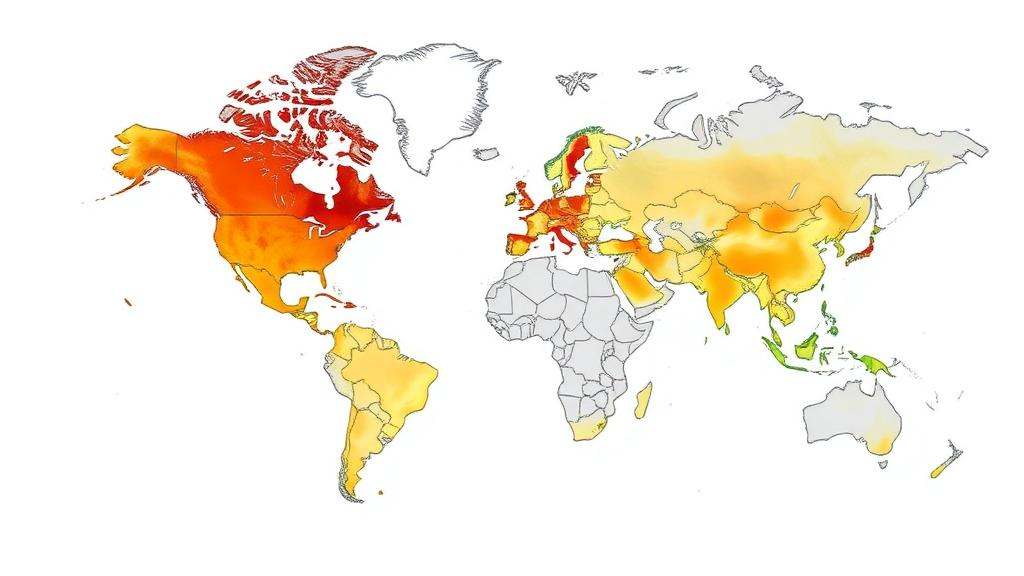
Scientists studying the climate of the last 11,700 years have produced a remarkable body of work over the past two decades, but until now nobody had systematically mapped where that research comes from, who leads it, and how its themes have shifted. A new open-access study published in Discover Geoscience by Najia Bouabid, Hayet Mnasri, Feyda Srarfi and Mohamed Ali Tagorti of the University of Gabès in Tunisia does exactly that. Rather than offering yet another synthesis of Holocene climate dynamics, the team turned the lens on the scientific literature itself, performing a bibliometric analysis of 1,141 research papers indexed in the Scopus database between 2002 and 2023. The result is a quantitative portrait of a field that has grown steadily, remains strikingly concentrated in a handful of wealthy nations, and is becoming ever more interdisciplinary as paleoclimatologists race to understand natural climate variability in a warming world.
The methodology behind the study is straightforward but rigorous. The authors searched Scopus, the multidisciplinary citation database launched by Elsevier in 2004, using keywords such as climate change, paleoclimate, Holocene, climate variability and Quaternary, combined with Boolean operators and explicit inclusion and exclusion criteria. After removing duplicates and screening titles and abstracts for relevance, they retained 1,141 articles published across the 22-year window. The dataset was then analyzed and visualized with VOSviewer, the bibliometric mapping software developed at Leiden University’s Centre for Science and Technology Studies, alongside Microsoft Excel. This allowed the team to track annual publication trends, identify the most productive countries, institutions and authors, map keyword co-occurrences, and construct citation networks linking the field’s core journals. The authors are careful to note that their findings depend entirely on the coverage, accuracy and classification practices of Scopus itself, a caveat that shapes how the results should be read.
The temporal trends reveal a field in sustained expansion, though not without turbulence. In 2002, the earliest year of the analysis, only 26 documents appeared in the search results. Output climbed irregularly thereafter, with a sharp jump between 2012 and 2013, when the count leapt from 42 to 73 papers, and another surge between 2016 and 2018, culminating in a peak of 84 publications in 2018. The trajectory was not monotonic: 2014 saw a steep fall back to 42 documents, and 2022 dropped to 58 after hovering between 65 and 73 in the preceding years, before recovering slightly to 68 in 2023. These oscillations, the authors suggest, may reflect irregularities in publication patterns or in how the database collects and indexes records. The overall message, however, is unambiguous: scientific interest in Holocene climate variability has grown substantially over the long term, mirroring broader concern about understanding natural climate baseline conditions against which modern anthropogenic warming can be compared.
The geography of the field is strikingly lopsided. The United States leads with more than 300 publications, followed by Germany with roughly 250 and the United Kingdom with around 225. China ranks fourth with approximately 175 papers, and France contributes about 150. Canada, Australia, Spain, Switzerland and Sweden round out the top ten, each producing between 75 and 125 documents. At the institutional level, the Chinese Academy of Sciences stands out as the single most prolific affiliation, exceeding 100 papers, with France’s CNRS close behind. The University of Bern in Switzerland, Spain’s Consejo Superior de Investigaciones Científicas and Germany’s Alfred-Wegener-Institut Helmholtz-Zentrum occupy an intermediate tier, while Lanzhou University, the Deutsches GeoForschungsZentrum GFZ, China’s Ministry of Education and the University of Minnesota Twin Cities contribute more modest volumes. The map that emerges is one of dense research capability in North America, Western Europe and China, and comparatively thin coverage elsewhere.
Individual researchers show similarly uneven productivity. Melanie J. Leng tops the author ranking with around 18 papers in the dataset, well ahead of R. Lawrence Edwards at roughly 10. Achim Brauer, Hai Cheng and Feng Sheng Hu each published between six and eight papers, while most other highly ranked authors produced fewer than five. In the journal landscape, Quaternary Science Reviews dominates both in output and influence, typically publishing between 5 and 15 relevant papers per year and reaching approximately 15 in 2023. The Holocene follows a fluctuating path of 3 to 10 papers annually, Quaternary International varies between 2 and 8 with growth after 2010, and Palaeogeography, Palaeoclimatology, Palaeoecology records 2 to 7 per year. The Journal of Quaternary Science trails with 1 to 3. Citation network analysis confirms Quaternary Science Reviews as the most influential source, followed by Quaternary International, with related outlets such as Climate of the Past, the Journal of Paleolimnology and Marine Geology anchoring the multidisciplinary edges of the network.
Perhaps the most revealing finding concerns disciplinary breadth. Earth and Planetary Sciences accounted for about 37.7 percent of the publications, the largest single share, but the remainder is scattered across a remarkable range of fields: Environmental Sciences at 18.4 percent, Agricultural and Biological Sciences at 15.9 percent, and Arts and Humanities at nearly the same 15.8 percent, with Social Sciences contributing 8.1 percent. Medicine, chemistry and energy each registered only fractions of a percent. Keyword density mapping reinforces this picture of interdisciplinarity. The word Holocene dominates the center of the co-occurrence network, surrounded by clusters referencing paleoenvironment, precipitation, monsoon and glaciology, alongside oceanographic and isotopic terms such as Atlantic Ocean, oxygen isotope and sea surface temperature. Palynological and sedimentary vocabulary, including lacustrine deposit, pollen and fire history, appears prominently, and terms like genetics, mitochondrial DNA and genetic variability hint at links to biological evolution and species adaptation. Holocene climate research, in other words, is not the province of climatologists alone but a genuinely hybrid enterprise spanning geology, ecology, archaeology and even the humanities.
The study contextualizes this bibliometric portrait within the scientific substance of the field. Holocene climate variability has been reconstructed from a diverse suite of paleoclimate archives, each with distinct strengths. Ice cores from polar regions deliver annual-resolution records of oxygen isotopes with precise dating; speleothems from caves capture seasonal-scale signals in isotope ratios and trace elements; marine sediment cores, rich in foraminiferal assemblages and magnesium-to-calcium ratios, offer centennial-scale resolution with moderate dating accuracy. Pollen assemblages document past vegetation and hydroclimate, charcoal reflects fire activity, and stable isotopes such as δ18O and δ13C are widely used to infer temperature, precipitation sources and moisture balance. The driving mechanisms span multiple timescales: slow orbital forcing from Milankovitch cycles shaped the early to mid-Holocene climatic optimum, while solar variability, volcanic eruptions and internal ocean-atmosphere dynamics, including the Atlantic Meridional Overturning Circulation, the North Atlantic Oscillation and the El Niño-Southern Oscillation, generated abrupt and regionally heterogeneous responses such as the 8.2 ka cooling event. Transient model simulations from the Paleoclimate Modelling Intercomparison Project broadly reproduce orbitally driven trends, though discrepancies persist in the magnitude and timing of regional hydroclimatic shifts, particularly in the tropics and Southern Hemisphere.
The bibliometric data also expose structural weaknesses that the authors argue the field must confront. Regional disparities are pronounced: Europe, North America and China dominate the literature, while Africa and South America remain markedly underrepresented, a gap that echoes the spatial bias already known in proxy data coverage itself. Temporal resolution varies enormously across archives, from annually layered tree rings and ice cores to coarser marine sediments, complicating direct comparison of short-lived climatic events. Chronological uncertainties arising from radiocarbon calibration and reservoir effects further limit the precision of regional syntheses, and proxy sensitivity can differ depending on local environmental conditions. The authors also flag the limitations of their own approach, noting that English-language dominance in the indexed literature, keyword selection and Scopus’s disciplinary classifications all introduce potential biases into the analysis. They call for stronger integration of climate models with high-resolution proxy data, improved dating techniques, and expanded interdisciplinary and global collaboration to fill the geographic and methodological gaps.
Why does this matter beyond the census-taking? Because the Holocene is the stage on which human civilization developed, and its climate history provides the natural baseline against which modern, human-driven warming must be judged. Since the Industrial Revolution, emissions of carbon dioxide and methane have intensified the greenhouse effect to a degree that now overwhelms the natural forcings, orbital, solar and volcanic, that governed Holocene variability for millennia. Understanding how climate behaved under purely natural conditions, and how societies responded to events like the African Humid Period’s abrupt termination or the sapropel S1 interval in the eastern Mediterranean, informs climate resilience strategies, resource management and policy development. The authors expect research on the topic to keep growing in the coming years, and their analysis suggests where that growth is most needed: in the under-sampled regions of the global South, in the integration of models with proxy records, and in the high-resolution chronologies that would let paleoclimatologists pin down exactly when and how fast past climates changed. A field that can map its own blind spots, this study shows, is far better equipped to close them.
Subject of Research: Bibliometric analysis of Holocene climate variability research publications from 2002 to 2023
Article Title: Bibliometric analysis of Holocene climate variability research papers from 2002 to 2023 identifying trends leading contributors and thematic developments
Article References: Bouabid, N., Mnasri, H., Srarfi, F., & Tagorti, M. A. (2026). Bibliometric analysis of Holocene climate variability research papers from 2002 to 2023 identifying trends leading contributors and thematic developments. Discover Geoscience, 4(1), Article 325. https://doi.org/10.1007/s44288-026-00682-4
Image Credits: AI Generated
DOI: 10.1007/s44288-026-00682-4
Keywords: Holocene, climate variability, bibliometrics, Scopus, paleoclimate, VOSviewer, proxy records, Quaternary Science Reviews, research trends, climate forcing, interdisciplinarity, research gaps
Cite Scienmag News
Violet Maxwell. (October 6, 2026). Two Decades of Holocene Climate Research Mapped: Who Publishes, Where, and Why It Matters. Scienmag. https://scienmag.com/two-decades-of-holocene-climate-research-mapped-who-publishes-where-and-why-it-matters/
Violet Maxwell. "Two Decades of Holocene Climate Research Mapped: Who Publishes, Where, and Why It Matters." Scienmag, 6 October 2026, https://scienmag.com/two-decades-of-holocene-climate-research-mapped-who-publishes-where-and-why-it-matters/. Accessed 6 October 2026.
Violet Maxwell. "Two Decades of Holocene Climate Research Mapped: Who Publishes, Where, and Why It Matters." Scienmag. October 6, 2026. https://scienmag.com/two-decades-of-holocene-climate-research-mapped-who-publishes-where-and-why-it-matters/


