


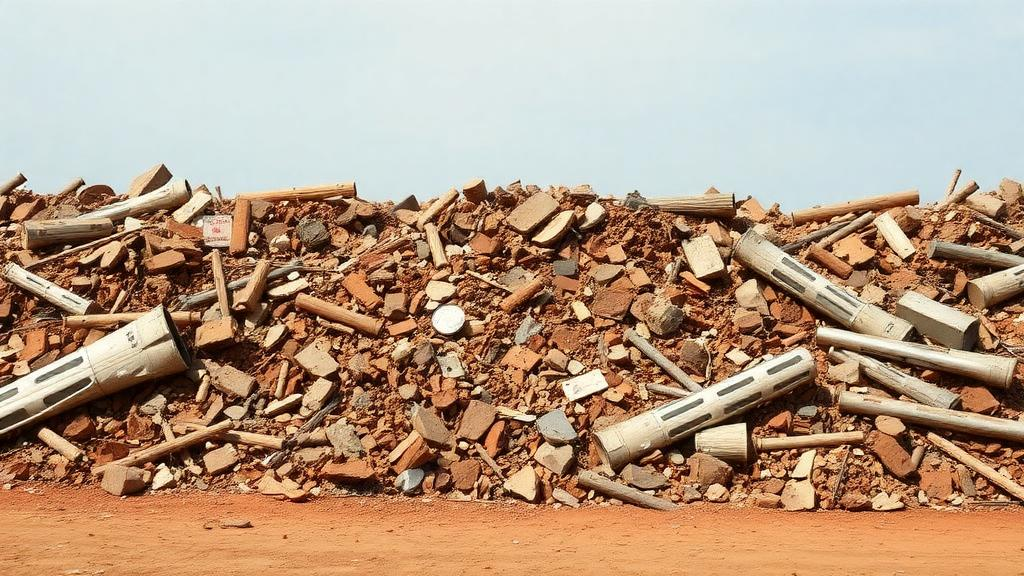
Every demolished wall, broken concrete slab, and discarded pile of masonry tells a story that most cities would rather ignore. In Kumasi, Ghana, one of West Africa’s fastest-growing urban centers, researchers have now traced that story beneath the surface, following the invisible journey of heavy metals as they escape from construction and demolition waste and migrate into the soil that sustains crops, gardens, and groundwater. The study, published in Environmental Monitoring and Assessment, offers one of the most detailed portraits yet of how the debris of urban expansion becomes a slow-moving chemical threat, and it arrives at a moment when cities across the developing world are grappling with mountains of building waste that are growing faster than the systems meant to manage them.
Construction and demolition waste, commonly abbreviated as CDW, is generated in staggering quantities wherever buildings rise and fall. It includes concrete, bricks, mortar, tiles, timber, metals, and a heterogeneous mixture of residual materials that end up stockpiled on vacant lots, dumped along roadsides, or spread informally across land at the edges of expanding neighborhoods. While much of this material appears inert, decades of research have shown that rainwater percolating through rubble can dissolve and carry away a suite of toxic elements. Lead, arsenic, cadmium, copper, zinc, and manganese are among the most frequently detected, and each behaves differently once it enters the soil environment. The new study led by Francis Agyapong of the Department of Materials Engineering at Kwame Nkrumah University of Science and Technology set out to quantify exactly which of these elements are escaping from waste piles in Kumasi, how concentrated they are, and how far they travel through the ground.
The research team collected samples of construction and demolition waste from an active construction site in Kumasi, along with samples of the soil lying directly beneath and around the waste deposits. Back in the laboratory, the samples were digested and analyzed to determine the concentrations of six target heavy metals: lead, arsenic, zinc, copper, manganese, and cadmium. These six were chosen deliberately. Lead and arsenic are notorious for their toxicity even at low exposures, cadmium accumulates in the kidneys and bones of humans and animals, and copper, zinc, and manganese, although essential micronutrients at trace levels, become damaging contaminants when concentrations climb beyond natural background ranges. By comparing metal levels in the waste itself with levels in the underlying soil, the researchers could infer which elements were actively leaching out of the debris and entering the soil column.
One of the study’s most consequential findings concerns the physical character of the waste itself. Analysis showed that the construction and demolition waste in Kumasi is dominated by sand-sized particles. This composition matters enormously for contaminant transport. Coarse, sandy material has large pore spaces between grains, allowing water to infiltrate quickly and percolate downward with minimal filtration. In contrast, fine-grained clays and silts tend to slow water movement and can adsorb metals onto particle surfaces, effectively immobilizing them. The sandy nature of the Kumasi waste therefore acts like a permeable conduit, helping leachate, the contaminated liquid that forms as water passes through waste, move easily through the deposit and into the underlying ground. In practical terms, the rubble piles scattered across the city are not merely unsightly; they function as diffuse, unlined chemical reactors that release their contents whenever it rains.
To move beyond simple concentration measurements, the team employed two complementary modeling approaches to map how contamination spreads through space. The first, inverse distance weighting, or IDW, is a geostatistical interpolation technique that estimates values at unsampled locations based on the measured values at surrounding sampling points, weighting nearby observations more heavily than distant ones. IDW is widely used in environmental monitoring because it is computationally straightforward and produces intuitive contamination surfaces. The second approach was more sophisticated: a radial basis function neural network, or RBF network, a machine learning architecture that uses radial basis functions as activation functions to approximate complex, nonlinear relationships in data. Radial basis function networks have a long history in engineering, having been applied to problems ranging from power system stabilization to function approximation, and they excel at fitting irregular multidimensional surfaces. By training the network on the measured metal concentrations, the researchers could predict both the vertical and horizontal spread of contaminants through the site, generating predictive maps of where pollution is heading rather than merely where it has already been detected.
The modeling results revealed a clear hierarchy of mobility among the six metals. Copper, zinc, and manganese emerged as the most mobile contaminants, spreading appreciably from their source and dispersing through the soil profile. Lead and arsenic, by contrast, tended to remain localized near the waste deposits, showing limited migration. This contrast reflects fundamental differences in geochemical behavior. Zinc and manganese form relatively soluble species under the mildly acidic conditions that often develop in decomposing waste, while copper, though it binds strongly to organic matter, can still be transported when complexing agents are present. Lead and arsenic, meanwhile, tend to adsorb strongly onto iron oxides and clay minerals or precipitate as insoluble compounds, anchoring them in place. The distinction is critical for risk assessment: mobile metals threaten groundwater and wider soil ecosystems, whereas immobile ones create persistent hotspots that can poison anything rooted directly in them and can be remobilized if soil chemistry changes.
The environmental consequences of this mobility are far-reaching. The study highlights soil degradation as a primary concern, since accumulating metals alter soil chemistry, disrupt nutrient cycling, and diminish fertility. Plants growing in contaminated ground take up metals through their roots, introducing toxins into the food chain and suppressing growth. Soil microbial communities, the invisible engines that decompose organic matter and sustain soil health, are also vulnerable, as elevated metal concentrations reduce microbial diversity and activity. In a city like Kumasi, where urban agriculture and informal gardening are common and where many residents rely on shallow wells, the migration of copper, zinc, and manganese through sandy soils raises the specter of contaminated drinking water and contaminated food produced on or near waste dumps. Because these impacts unfold gradually and invisibly, they often escape regulatory attention until damage is well advanced.
What makes the study particularly timely is the trajectory of urbanization in Ghana and across sub-Saharan Africa. Construction booms in rapidly growing cities generate enormous volumes of demolition debris, yet formal recycling infrastructure remains limited, and enforcement of disposal regulations is inconsistent. Much of the region’s CDW is managed informally, with little consideration of where waste is placed or what it contains. Previous international research, including life cycle assessments and leaching studies of recycled concrete aggregates in Europe, has documented similar contamination pathways, but localized data from African cities has been scarce. The Kumasi study helps fill that gap, demonstrating that the tools of modern environmental science, from laboratory digestion analysis to GIS-based interpolation and neural network modeling, can be deployed effectively in data-scarce settings to characterize risks that would otherwise go unmeasured.
The authors do not stop at diagnosis. Their recommendations form a three-pronged response to the problem. First, they call for regulatory reform, arguing that existing frameworks governing construction and demolition waste disposal are inadequate to the scale of the challenge and need stronger standards for where and how debris may be stockpiled. Second, they advocate sustainable construction practices, including better sorting of waste streams, reuse of clean materials, and reduction of hazardous components in building products, so that less toxic material enters the waste cycle in the first place. Third, they recommend chemical stabilization, a remediation technique in which binding agents such as lime, cement, or phosphate amendments are mixed into contaminated soil or waste to immobilize metals chemically, reducing their solubility and preventing further leaching. Applied together, these measures could transform CDW from an unmanaged hazard into a managed resource stream.
The broader lesson of the Kumasi research is that the environmental cost of a building does not end when the building comes down. Rubble piles are active chemical systems whose behavior depends on their composition, their particle size, the local climate, and the chemistry of the ground beneath them. As cities worldwide pursue circular economy goals and seek to recycle more construction waste into new roads, embankments, and aggregates, studies like this one serve as a caution: recycled does not automatically mean safe. Understanding what leaches from waste, how far it travels, and who is exposed downstream is a prerequisite for any genuinely sustainable construction future. For Kumasi, and for the countless cities following the same growth trajectory, the metals hidden in the rubble are now on the scientific record, and the clock on remediation is running.
Subject of Research: Leaching and spatial migration of heavy metals from construction and demolition waste in Kumasi, Ghana
Article Title: Assessment of leached heavy metals from construction and demolition waste
Article References: Agyapong, F., Koomson, B., Kwofie, S., Gidigasu, S. S. R., & Gyamfi, C. (2026). Assessment of leached heavy metals from construction and demolition waste. Environmental Monitoring and Assessment, 198(10), Article 1097. https://doi.org/10.1007/s10661-026-15868-z
Image Credits: AI Generated
DOI: 10.1007/s10661-026-15868-z
Keywords: heavy metals, construction and demolition waste, leaching, soil contamination, Ghana, Kumasi, groundwater, inverse distance weighting, radial basis function neural network, GIS mapping, waste management, chemical stabilization
Cite Scienmag News
Violet Maxwell. (October 6, 2026). Hidden metals in rubble: construction waste quietly poisons Ghana’s soils. Scienmag. https://scienmag.com/hidden-metals-in-rubble-construction-waste-quietly-poisons-ghanas-soils/
Violet Maxwell. "Hidden metals in rubble: construction waste quietly poisons Ghana’s soils." Scienmag, 6 October 2026, https://scienmag.com/hidden-metals-in-rubble-construction-waste-quietly-poisons-ghanas-soils/. Accessed 6 October 2026.
Violet Maxwell. "Hidden metals in rubble: construction waste quietly poisons Ghana’s soils." Scienmag. October 6, 2026. https://scienmag.com/hidden-metals-in-rubble-construction-waste-quietly-poisons-ghanas-soils/


