

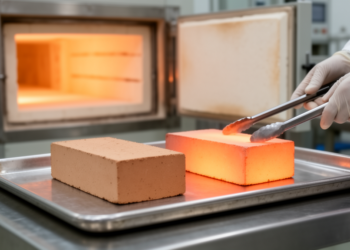
Chemically Activated Clay Bricks Keep Most of Their Strength After 800°C Fire Exposure
Researchers report that clay bricks doped with alumina and activated with sodium hydroxide retain nearly 76 percent of their strength ...
Researchers report that clay bricks doped with alumina and activated with sodium hydroxide retain nearly 76 percent of their strength ...

The study's framing of geopolymer optimization reflects a broader shift in construction materials research away from single-property maximization toward balanced, ...
Researchers in Turkey have developed rhyolitic tuff geopolymer tiles reinforced with carbon fibers and zinc oxide that achieve up to ...
A new study shows that concrete slurry waste pressurized with supercritical CO2 can replace up to 25 percent of slag ...
Researchers have created a porous geopolymer adsorbent from metakaolin and silica fume, using hydrogen peroxide foaming and oil templating, that ...
Researchers show that an alkali-activated blend of fly ash and blast furnace slag can stabilize dredged waste soil for embankments, ...
Researchers replaced fly ash in carbon-fiber-reinforced geopolymer with red mud and ore tailings, achieving up to 33.5 decibels of X-band ...
A systematic study of rubberized alkali-activated concrete shows that fine crumb rubber particles under one millimeter preserve strength while boosting ...
Researchers in Türkiye have fused Neurospora fungal cells with a geopolymer support to create a reusable hybrid sorbent that removes ...
Thai researchers have turned invasive water hyacinth into pelletized diatomite-based geopolymer adsorbents that remove up to 77 percent of methylene ...

Embark on a thrilling journey of discovery with Scienmag.com—your ultimate source for cutting-edge breakthroughs. Immerse yourself in a world where curiosity knows no limits and tomorrow’s possibilities become today’s reality!