


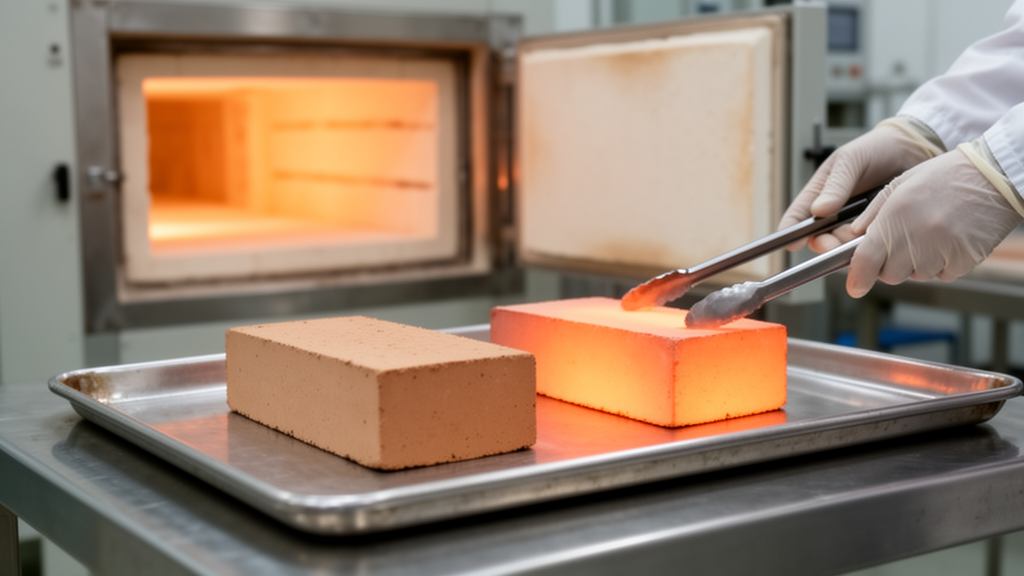
Clay bricks have carried human architecture for millennia, prized for their strength, durability, and natural fire resistance. Yet when fire sweeps through a building, ordinary fired bricks can lose more than half of their compressive strength, and their poor thermal insulation wastes enormous amounts of energy. A research team from Jordan, Bahrain, and Egypt now reports a way to make clay bricks that not only start out stronger than conventional ones but also hold onto most of that strength after being baked at 800 degrees Celsius — temperatures typical of a severe building fire.
The study, published in Frontiers in Built Environment, systematically combined two treatments that had previously only been explored separately: doping the clay with industrial metal oxides and chemically activating the mixture with an alkaline solution. The researchers, led by Hebah Mohammad Al-Jabali of Yarmouk University, prepared bricks from a base recipe of 82 percent clay, 13 percent fine sand, and 5 percent Class F fly ash, then added varying doses of iron oxide (Fe2O3), aluminum oxide (Al2O3), or carbon black N550. Some batches were left untreated, while others were mixed with an alkaline activator solution of 8 molar sodium hydroxide combined with sodium silicate.
The chemistry behind the improvement is geopolymerization. Hydroxide ions from the sodium hydroxide dissolve aluminosilicate species from the clay and fly ash, and those dissolved species then polymerize into a three-dimensional amorphous gel known as N-A-S-H — a sodium aluminosilicate hydrate. This gel coats unreacted particles, fills pores, and binds the whole matrix together. The metal oxides add a second layer of benefit: dissolved aluminum and iron ions substitute into the gel structure, and fine oxide particles act as nucleation sites and packing fillers that refine the pore network.
The standout performer was the mixture labeled Al-7A, containing 7 percent alumina by clay weight plus alkali activation. At room temperature it reached a compressive strength of 19.5 megapascals, a 57.3 percent increase over the untreated control’s 12.4 megapascals. More remarkably, after two hours of exposure to 800 degrees Celsius in a muffle furnace, the same mixture retained 14.8 megapascals — 75.9 percent of its original strength. Conventional fired clay bricks typically retain only 48 to 91 percent of their strength under comparable conditions, and the untreated control in this study fell to just 6.1 megapascals after the same thermal assault.
The iron oxide and carbon black variants also benefited from activation, though less dramatically. The Fe-4A mixture, with 4 percent iron oxide, achieved 16.8 megapascals at ambient temperature and 11.5 megapascals after 800-degree exposure, while the CB-0.5A mixture with 0.5 percent carbon black reached 16.0 and 10.5 megapascals respectively. Iron oxide acts as a flux, promoting liquid-phase sintering that densifies the ceramic body, but beyond about 5 percent the excess liquid phase becomes detrimental — a dose-dependence the team documented clearly. Carbon black works differently: it burns out during heating, leaving behind a controlled porous structure that improves thermal insulation at some cost to strength.
The temperature trajectory of brick behavior follows a well-understood mineralogical script. Around 200 degrees Celsius, physically bound water evaporates, and most specimens actually gained a few percent in strength as the matrix compacted. At 400 degrees, kaolinite undergoes dehydroxylation, converting to metakaolin and sacrificing some strength. Near 573 degrees, the alpha-to-beta quartz transition causes volume expansion and microcracking, driving further losses. Above 800 degrees, metakaolin begins transforming into spinel and mullite — crystalline phases that can restore strength at even higher temperatures. The alkali-activated bricks appear to accelerate this ceramic bonding, forming thermally stable crystalline phases within the gel matrix.
Durability metrics reinforced the mechanical story. The Al-7A mixture absorbed only 8.8 percent water by mass, 38 percent lower than the control’s 14.2 percent, and achieved a bulk density of 1,980 kilograms per cubic meter. Thermogravimetric analysis showed Al-7A lost just 4.8 percent of its mass up to 800 degrees, retaining 95.2 percent — the best thermal stability of any formulation. Scanning electron microscopy revealed the reason: the control bricks showed loose, cracked particles with large intergranular voids, while the activated mixtures displayed a continuous gel matrix enveloping the particles, with Al-7A exhibiting the densest, most homogeneous microstructure of all.
Accelerated aging tests added a practical dimension. The team subjected the best-performing mixtures to seven cycles of five-hour water soaking followed by 42-hour drying at 70 degrees Celsius, mimicking years of moisture cycling. The control lost 37.1 percent of its strength, but Al-7A retained 82.1 percent of its initial value, with Fe-4A at 75.0 percent and CB-0.5A at 70.6 percent. The dense geopolymer matrix limits water ingress during wetting, reducing the internal pressures that drive microcracking in conventional bricks.
The environmental implications are significant. Because alkali-activated bricks cure at modest temperatures rather than requiring energy-intensive kiln firing, the approach could cut the substantial carbon footprint of the roughly 1.39 trillion bricks produced worldwide each year. The researchers note that the technique uses locally available clay and industrial additives, and that the resulting material could serve not only in fire-prone buildings but also in heat-resistant structures such as heat-exchanger linings. Buildings currently lose roughly half of the one-third of global energy they consume through poorly insulating envelopes, so any material that improves both fire resilience and thermal performance addresses two problems at once.
The authors caution that some conclusions remain provisional: the suspected formation of mullite and spinel phases was inferred from behavior and microscopy rather than direct X-ray diffraction confirmation, and thermal conductivity was not directly measured on the carbon black formulations. Future work, they say, should include those measurements. Still, the demonstration that a simple combination of alumina powder and sodium hydroxide activation can nearly double the post-fire strength of clay brick marks a striking convergence of ancient material and modern chemistry — one that could reshape how the world’s most common building unit survives its hottest moments.
Subject of Research: Alkali-activated clay bricks with metal oxide additives for enhanced residual strength at elevated temperatures
Article Title: Enhancing the residual strength of clay bricks exposed to elevated temperatures using metal oxides, carbon black, and sodium hydroxide activation
Article References: Al-Jabali, H. M., Edris, W. F., Abdelkhalik, A., Al-Kader A. Al Sayed, A., & Khairy, S. (2026). Enhancing the residual strength of clay bricks exposed to elevated temperatures using metal oxides, carbon black, and sodium hydroxide activation. Frontiers in Built Environment, 12, Article 1966926. https://doi.org/10.3389/fbuil.2026.1966926
Image Credits: AI Generated
DOI: 10.3389/fbuil.2026.1966926
Keywords: materials science, clay bricks, alkali activation, geopolymer, fire resistance, construction materials, alumina, thermal stability, Enhancing, residual, strength, clay
Cite Scienmag News
Violet Maxwell. (October 17, 2026). Chemically Activated Clay Bricks Keep Most of Their Strength After 800°C Fire Exposure. Scienmag. https://scienmag.com/chemically-activated-clay-bricks-keep-most-of-their-strength-after-800c-fire-exposure/
Violet Maxwell. "Chemically Activated Clay Bricks Keep Most of Their Strength After 800°C Fire Exposure." Scienmag, 17 October 2026, https://scienmag.com/chemically-activated-clay-bricks-keep-most-of-their-strength-after-800c-fire-exposure/. Accessed 17 October 2026.
Violet Maxwell. "Chemically Activated Clay Bricks Keep Most of Their Strength After 800°C Fire Exposure." Scienmag. October 17, 2026. https://scienmag.com/chemically-activated-clay-bricks-keep-most-of-their-strength-after-800c-fire-exposure/


