


Beneath the surface of your skin flows a fluid that may know more about your health than your blood does. Dermal interstitial fluid, the extracellular liquid that bathes every cell in skin tissue, carries proteins, antibodies, nucleic acids, and extracellular vesicles that reflect both systemic physiology and local tissue activity. Unlike blood, which is dominated by circulating signals that may be diluted or obscured, interstitial fluid sits at the immediate biochemical interface where cells acquire nutrients, exchange metabolites, and communicate through molecular signals. Many of the biomolecules found there are directly involved in disease mechanisms rather than being downstream correlates, making this fluid an attractive target for minimally invasive diagnostics. The challenge has always been access: how do you reliably sample a fluid that is locked inside a dense extracellular matrix without needles, pain, or compositional distortion?
A new mini review published in Frontiers in Sensors by Sahil Malhotra of the UCD School of Mechanical and Materials Engineering and Arun H. S. Kumar of the UCD School of Veterinary Medicine in Dublin addresses this question head-on. Their analysis, which examines microneedle-based sampling of dermal interstitial fluid biomacromolecules, proposes a transport-aware and bias-conscious framework to guide the development of standardized and clinically robust microneedle-enabled interstitial fluid diagnostics. The review arrives at a critical moment, as microneedle technologies have achieved their greatest clinical success in continuous glucose monitoring but remain largely unproven for the larger biomacromolecules that constitute the foundation of most blood-based diagnostic assays.
The physiological constraints on accessing dermal interstitial fluid are more formidable than they might appear. The dermis behaves as a porous, hydrogel-like matrix where collagen and glycosaminoglycans bind water and create high hydraulic resistance while simultaneously imposing size- and charge-dependent hindrance that disproportionately affects proteins, antibodies, nucleic acids, and vesicles compared with small molecules. Even where interstitial fluid is abundant systemically, the accessible dermal volume per unit area is small and its replenishment is slow, constrained by high dermal fluidic resistance and lymphatic clearance. A substantial fraction of dermal fluid is not free but rather bound water associated with extracellular matrix components that is not readily extractable. This means bulk extraction approaches face a physiological speed limit: pulling fluid too quickly increases the risk that the collected material is no longer compositionally representative for larger biomolecules.
Partitioning from blood to interstitial fluid is not uniform across analytes either. Transport across continuous dermal capillaries is governed by endothelial junctions, glycocalyx charge effects, and vesicular transcytosis, so the interstitial fluid to blood ratio depends on size, charge, hydrophobicity, and protein-binding state. This is especially important for hormones and drugs that are highly protein-bound, where sensors may reflect only the free fraction, and for mid-to-large proteins ranging from 3 kilodaltons up to 1,000 kilodaltons that sit near size-selective thresholds. These transport physics impose fundamental limitations on bulk extraction strategies and complicate quantitative interpretation of any signal derived from sampled interstitial fluid.
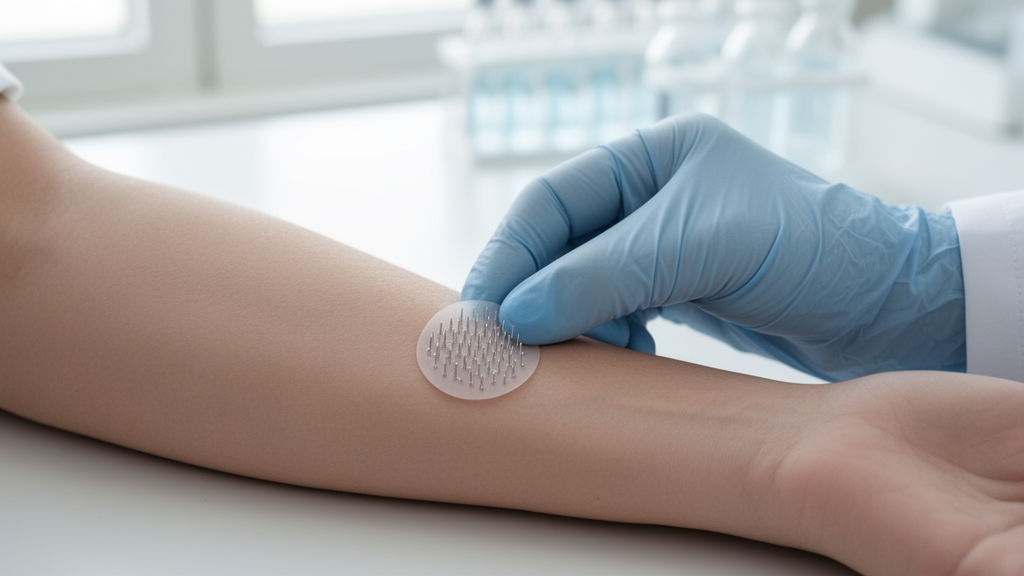
Microneedle technologies offer a controlled and minimally invasive interface to the viable epidermis and superficial dermis by breaching the stratum corneum while largely avoiding vascular penetration. These micron-scale projections, typically ranging from about 250 to 1,000 micrometers in height, form transient microchannels into the viable epidermis or superficial dermis, supporting either in situ sensing or localized interstitial fluid extraction depending on device architecture. Needles shorter than about 300 micrometers primarily access the viable epidermis, whereas those in the 600 to 800 micrometer range more consistently penetrate into the superficial dermis, where interstitial fluid volume and vascular proximity are greater. However, increasing penetration depth does not necessarily translate to improved macromolecular recovery, as transport remains limited by extracellular matrix constraints, and deeper insertion increases the risk of nociceptor activation and potential blood mixture.
The review identifies six distinct microneedle-enabled transport mechanisms for accessing dermal interstitial fluid biomacromolecules, each with its own advantages and inherent biases. Passive bulk withdrawal through hollow needles hydraulically connects the interstitium to an external collector, with flow driven by local interstitial pressure, capillary forces in collection tubing, and transient fluid redistribution following puncture. One team assembled an array of five ultrafine nano pen needles in a 3D-printed holder and attached microcapillaries to each needle to collect small volumes of interstitial fluid from human forearm skin, yielding bulk samples suitable for downstream proteomics but limited to less than 20 microliters and necessitating high-sensitivity workflows. Capillary-driven extraction using porous polylactic acid microneedles fabricated from heat-bonded microspheres creates interconnected micropores that wick interstitial fluid by capillary effect, enabling rapid anti-SARS-CoV-2 IgG and IgM detection within minutes without external actuation, though transport through tortuous pores introduces size-dependent filtration and sensitivity to fluid viscosity.
Pressure-gradient-driven bulk extraction represents a more active strategy grounded in Darcy’s law-governed fluid flow in porous media. In one configuration termed Puncture-Out-and-Press, a solid microneedle array punctures the skin through aligned apertures in a collection plate, and after needle removal, external compression is applied to the surrounding skin while leaving the puncture sites uncompressed. This generates a lateral pressure gradient that directs interstitial fluid toward the punctures, where it accumulates and is collected via surface tension. Under optimized conditions, this approach enabled extraction of 15.5 plus or minus 7 milligrams of interstitial fluid within 5 minutes in human participants, corresponding to microliter-scale sampling volumes. The recovered fluid was subjected to untargeted LC-MS/MS proteomic profiling, identifying a broad interstitial fluid proteome and enabling quantitative comparison with plasma. The authors demonstrated that extraction efficiency and proteomic composition are sensitive to applied pressure distribution, with this method outperforming needle-in and vacuum-assisted variants in both yield and reproducibility.
Swelling hydrogel microneedles absorb interstitial fluid into a polymer network after insertion, with osmotic forces and polymer swelling drawing water and solutes into the expanding network. One team developed superabsorbent acrylate-based hydrogel microneedle patches that collect up to 6 microliters of dermal interstitial fluid in 10 minutes in vivo, enabling proteomic analysis from swelling-based collection. Importantly, the researchers explicitly identified that the extraction fingerprint is strongly dependent on microneedle chemistry, implying that hydrogel formulation does not merely collect interstitial fluid but selectively partitions biomolecules depending on polymer composition and interactions. Electro-assisted extraction combines reverse iontophoresis with hydrogel microneedle capture to enrich negatively charged cell-free DNA toward the collection interface, using reverse iontophoresis conditions of 10 volts for 10 minutes coupled with microneedle insertion. Affinity capture on functionalized microneedles represents a fundamentally different paradigm, relying on selective binding rather than bulk interstitial fluid extraction. One team developed a stellate silicon microneedle platform called ExoPatch, consisting of a 13 by 13 array of silicon microneedles each approximately 600 micrometers in height, coated with a thin alginate-polyvinyl alcohol hydrogel layer functionalized with Annexin V, which binds phosphatidylserine enriched on the membrane of tumor-derived exosomes. This system enabled sensitive detection of melanoma-associated exosomes in murine melanoma models and distinguished tumor-bearing from healthy samples using a lateral flow immunoassay readout.
Across these platforms, a consistent set of design trade-offs emerges between sampling efficiency, selectivity, and system complexity. Passive approaches, including hydrogel and porous microneedles, offer simplicity and minimal invasiveness but are constrained by diffusion-limited transport and low recovery efficiency for biomacromolecules. Active strategies such as pressure-assisted and electrokinetic systems improve extraction rates and access to larger or low-abundance analytes but require external actuation and may perturb the local interstitial fluid environment. Affinity-based platforms avoid bulk fluid extraction entirely by selectively capturing target molecules, enabling high specificity at the expense of representativeness. No single platform currently achieves high-efficiency, unbiased, and fully integrated sampling and sensing, highlighting the need for hybrid approaches that balance these competing design requirements.
The analytical challenge is not only whether biomacromolecules can be detected but what type of measurement each platform fundamentally produces and how that relates to physiological interstitial fluid composition. Volumetric sampling approaches are the most compatible with absolute or relative concentration measurements because they are based on physical fluid recovery, but this advantage depends on whether extraction volume is sufficiently defined and whether the recovered sample remains compositionally representative of native interstitial fluid. Capture-based systems do not primarily measure the composition of extracted interstitial fluid but rather the extent to which target molecules reach and bind to a functionalized interface, with output governed by local analyte flux, affinity interactions, binding capacity, and residence time rather than recovered fluid volume. Neither approach is intrinsically superior; bulk extraction is more appropriate when broader molecular profiling or downstream multianalyte analysis is desired, whereas capture-based systems are better suited to targeted detection when specificity is more important than representativeness. A key limitation across microneedle-based interstitial fluid biomacromolecule platforms remains the gap between analytical performance and clinical validation, as relatively few systems have been validated in humans using standardized protocols, and calibration between interstitial fluid and plasma remains a fundamental challenge due to size-dependent transport, protein binding, and local tissue effects. Future development should focus on resolving these gaps through coordinated advances in device design, analytical integration, and validation frameworks, with standardized sampling and reporting protocols that consistently document insertion depth, sampling duration, applied pressure, and transport mechanism to enable cross-study comparison and reproducibility.
Subject of Research: Microneedle-based sampling of dermal interstitial fluid biomacromolecules: transport constraints, design principles, and diagnostic translation
Article Title: Microneedle-based sampling of dermal interstitial fluid biomacromolecules: transport constraints, design principles, and diagnostic translation
Article References: Malhotra, S., & Kumar, A. H. S. (2026). Microneedle-based sampling of dermal interstitial fluid biomacromolecules: transport constraints, design principles, and diagnostic translation. Frontiers in Sensors, 7, Article 1819441. https://doi.org/10.3389/fsens.2026.1819441
Image Credits: AI Generated
DOI: 10.3389/fsens.2026.1819441
Keywords: microneedles, interstitial fluid, biomacromolecules, diagnostics, biosensors, dermal sampling, extracellular vesicles, proteomics, Microneedle-based, sampling, dermal, interstitial
Cite Scienmag News
Denise Maddox. (October 17, 2026). Microneedle Patches Could Turn Skin Fluid Into the Next Blood Test. Scienmag. https://scienmag.com/microneedle-patches-could-turn-skin-fluid-into-the-next-blood-test/
Denise Maddox. "Microneedle Patches Could Turn Skin Fluid Into the Next Blood Test." Scienmag, 17 October 2026, https://scienmag.com/microneedle-patches-could-turn-skin-fluid-into-the-next-blood-test/. Accessed 17 October 2026.
Denise Maddox. "Microneedle Patches Could Turn Skin Fluid Into the Next Blood Test." Scienmag. October 17, 2026. https://scienmag.com/microneedle-patches-could-turn-skin-fluid-into-the-next-blood-test/


