

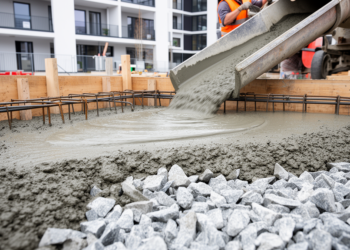
Crushed-sand mortar enables high-fluidity concrete with lower carbon footprint
A laboratory study developed a mortar-rheology method for making high-fluidity concrete with crushed limestone sand, achieving flows above 600 mm ...
A laboratory study developed a mortar-rheology method for making high-fluidity concrete with crushed limestone sand, achieving flows above 600 mm ...

A new integrated life cycle assessment and system dynamics study of 214 Chinese port projects finds that material manufacturing drives ...
A new study applies ecological network analysis to ASEAN's trade data, revealing a net export of embodied carbon and structural ...
A new spatiotemporal life cycle assessment reveals that China's provincial power grids vary so widely in carbon intensity that the ...
New University of Bath research shows the UK's 9.9 million tonnes of annual straw surplus could supply up to 300,000 ...
Researchers have built a deterministic IFC-based workflow that evaluates whole-building material choices for both embodied carbon and circularity, reducing 150 ...
A new study shows that concrete made with up to 80 percent less cement develops a denser, stronger interfacial transition ...
A systematic analysis of 40 concrete mixes shows that activators synthesized from waste glass and rice husk ash match commercial ...
Researchers have shown that blending stiff alkali-resistant glass fibres with ductile polyethylene fibres in a low-clinker magnesia-slag binder produces crack-resistant, ...
A new systematic review of 40 building life cycle assessment studies reveals that conventional LCA cannot measure resilience, and proposes ...

Embark on a thrilling journey of discovery with Scienmag.com—your ultimate source for cutting-edge breakthroughs. Immerse yourself in a world where curiosity knows no limits and tomorrow’s possibilities become today’s reality!