


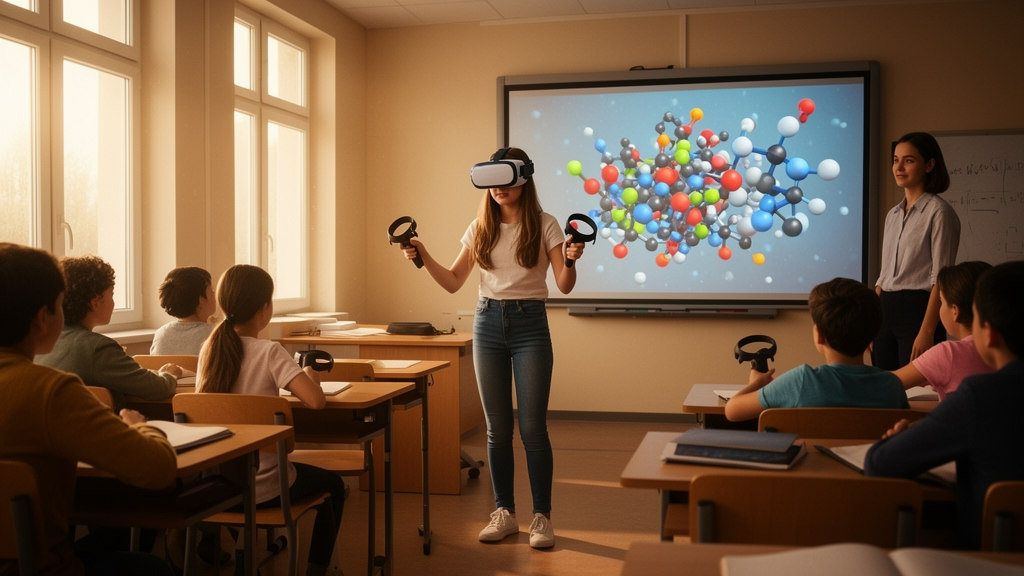
Virtual reality headsets, gamified quizzes, and artificial intelligence tutors are transforming science classrooms around the world, turning abstract equations into explorable three-dimensional worlds and homework into point-scoring challenges. But according to a new scoping review published in Discover Education, one group of learners has been almost entirely left out of that revolution: students with speech impairments, especially those attending school in low-resource settings such as Ghana. The review, authored by Daniel Appiah Gyekye of the University of Oregon, systematically mapped five years of research and found that while immersive and gamified technologies show genuine promise for inclusive science education, speech impairment remains a nearly invisible category in the literature.
The scale of the omission is striking. Following the PRISMA-ScR reporting guidelines, the review searched five major academic databases—Scopus, ERIC, Web of Science, EBSCO, and JSTOR—and identified 2,501 records. After removing 142 duplicates, excluding 680 ineligible publication types such as conference abstracts, editorials, and non-peer-reviewed or non-English works, and screening 1,679 titles and abstracts, only 220 studies advanced to full-text assessment. Of those, 180 were excluded for reasons including lack of relevance to virtual reality or gamification in education, absence of a Ghanaian or comparable low-resource context, or failure to address disability. Just 40 studies published between 2020 and 2024 made the final synthesis.
That funnel tells a story in itself. The overwhelming majority of research on virtual reality and gamification in education originates from Europe, North America, and Asia, with minimal representation from African countries or other low-resource contexts. Most studies also lump communication-related conditions into broad disability categories rather than treating speech impairment as a distinct accessibility challenge. This matters because speech impairment—encompassing articulation disorders and fluency disorders such as stuttering—creates barriers that differ fundamentally from those faced by learners with visual, hearing, or cognitive disabilities. STEM classrooms routinely assume verbal communication: oral presentations, spoken questions, discussion-based problem solving. A student who cannot produce clear or fluent speech, whether because of developmental delays, neurological conditions, physical anomalies, or trauma, is structurally disadvantaged in ways that generic ‘disability-friendly’ design rarely anticipates.
Yet the theoretical case for immersive and gamified technologies as a solution is compelling. The review grounds its analysis in constructivist and experiential learning theory, which holds that knowledge is built through active participation rather than passive reception, and in the Universal Design for Learning framework, which calls for multiple means of engagement, representation, and expression. Virtual reality fits these principles naturally: it lets learners manipulate virtual objects, visualize complex scientific structures, and practice skills in safe, controllable environments. The Cognitive-Affective Model of Immersive Learning adds a mechanistic layer, proposing that immersion enhances both cognitive processing and emotional engagement, which in turn improves motivation, participation, and knowledge retention. Gamification complements this by layering rewards, challenges, feedback, and progression systems onto learning tasks to sustain engagement over time.
Crucially, these technologies can reduce dependence on spoken language. STEM activities such as coding, robotics, and data visualization are inherently non-verbal, allowing students to demonstrate understanding through what they build and manipulate rather than what they say. Immersive environments can integrate visual, spatial, and kinesthetic interaction channels, and features such as speech-to-text systems, symbol-based communication supports, and alternative input methods could, in principle, give speech-impaired learners full participation in lessons that would otherwise exclude them. The review notes that related work with Deaf and hard-of-hearing learners—gesture recognition, avatar-based communication, and immersive sign-language environments—demonstrates what is technically feasible. Speech-to-text and AI-assisted communication tools could serve speech-impaired learners in analogous ways, but almost nobody has studied whether they actually do.
The Ghanaian evidence that does exist points in an encouraging direction while underscoring the gap. Systems incorporating transcription and visual communication tools have improved accessibility for hearing-impaired learners in Ghana. Augmented reality applications have been shown to enhance motivation, conceptual understanding, and participation in STEM learning, and gamification has boosted motivation and engagement in Ghanaian classrooms. Chatbot-based learning systems have improved outcomes in Ghanaian higher education, and immersive virtual reality environments have been used for safety training and experiential learning. Internationally, virtual reality, augmented reality, and AI-supported tools consistently improve knowledge acquisition, feedback, and engagement. Taken together, the review concludes, immersive and gamified environments can support more inclusive, ‘speech-light’ STEM learning—but these benefits are rarely evaluated specifically for speech-impaired learners.
The barriers to implementation in Ghana are formidable and interconnected. Many schools contend with unreliable electricity, limited internet connectivity, and scarce digital devices, conditions that make headset-based virtual reality deployments difficult to sustain. Virtual reality hardware, software, and content development remain expensive, pushing researchers and practitioners toward more feasible alternatives such as mobile-based platforms, augmented reality applications, and AI-driven tools. Pedagogical divides compound the problem: STEM education and inclusive education have largely developed as separate fields, so accessibility features are seldom integrated into curriculum design from the start. Cultural beliefs and stigma surrounding disability further affect inclusion, and many existing technologies are not localized to Ghanaian curricula or cultural realities. Western-designed tools often arrive without alignment to local content, and teacher preparedness—educators’ beliefs, skills, and familiarity with digital tools—shapes whether any technology is meaningfully adopted in the classroom.
The review’s most pointed criticism is that accessibility is treated as an afterthought rather than a core design principle. Most virtual reality and gamified systems lack basic features such as speech-to-text conversion, visual communication interfaces, and customizable interaction modes, limiting their usability for speech-impaired learners even when the systems are deployed. Meanwhile, clinical and social research shows that individuals with communication disorders in Ghana face limited access to diagnosis, rehabilitation, and support services, with communication-related services fragmented and concentrated in urban areas. Technology-enhanced learning is typically evaluated for general engagement rather than for its capacity to address speech-related barriers, so even well-intentioned studies cannot answer the question that matters most for this population.
The practical recommendations that emerge are correspondingly concrete. National STEM strategies led by the Ghana Education Service and the Ministry of Education should explicitly incorporate assistive and inclusive technologies with attention to the specific needs of speech-impaired learners rather than treating disability as a generic category. Technology integration should be tied to inclusive education planning, backed by investment in infrastructure and cross-sector coordination among schools, disability services, and rehabilitation providers. Teacher education needs strengthening in both inclusive pedagogy and digital competence, so that educators can design multimodal, speech-light learning experiences instead of reproducing speech-dependent instructional models in digital form. For developers, the message is that accessibility features—speech-to-text, symbol-based supports, adaptive interaction modes—must be built in from the first design sketch, and that evaluations should measure communication support and participation for speech-impaired learners specifically, not just aggregate engagement scores.
The review acknowledges its own limitations: it covered only English-language literature from 2020 to 2024, excluded grey literature that may be particularly relevant for policy in resource-constrained settings, and relied on a single reviewer for screening without inter-rater reliability checks. As a scoping review, it maps patterns and gaps rather than judging intervention effectiveness. But its central finding stands as a challenge to the booming field of educational technology: strong technological potential currently coexists with limited accessibility by design and insufficient empirical attention to the learners who might benefit most. Initiatives such as Young at Heart Ghana, which uses African folklore to build gamified STEM learning tools, hint at what culturally grounded, affordable solutions could look like—though even these have not yet explicitly targeted speech-impaired students. Until researchers disaggregate speech impairment from broader disability categories and design for communication accessibility from the ground up, the promise of immersive, gamified STEM education risks remaining unevenly distributed, excluding precisely the learners for whom non-verbal, multimodal learning could be most transformative.
Subject of Research: The use of virtual reality and gamification in inclusive STEM education for speech-impaired learners in Ghana and other low-resource settings
Article Title: Virtual reality and gamification for STEM learning among speech impaired learners in Ghana
Article References: Gyekye, D. A. (2026). Virtual reality and gamification for STEM learning among speech impaired learners in Ghana. Discover Education, 5(1), Article 1134. https://doi.org/10.1007/s44217-026-02104-6
Image Credits: AI Generated
DOI: 10.1007/s44217-026-02104-6
Keywords: virtual reality, gamification, STEM education, speech impairment, inclusive education, Ghana, assistive technology, accessibility, scoping review, educational technology, low-resource settings, Universal Design for Learning
Cite Scienmag News
Courtney Benton. (October 8, 2026). Virtual Reality and Gamification Could Open STEM Classrooms to Speech-Impaired Learners, but the Evidence Barely Mentions Them. Scienmag. https://scienmag.com/virtual-reality-and-gamification-could-open-stem-classrooms-to-speech-impaired-learners-but-the-evidence-barely-mentions-them/
Courtney Benton. "Virtual Reality and Gamification Could Open STEM Classrooms to Speech-Impaired Learners, but the Evidence Barely Mentions Them." Scienmag, 8 October 2026, https://scienmag.com/virtual-reality-and-gamification-could-open-stem-classrooms-to-speech-impaired-learners-but-the-evidence-barely-mentions-them/. Accessed 8 October 2026.
Courtney Benton. "Virtual Reality and Gamification Could Open STEM Classrooms to Speech-Impaired Learners, but the Evidence Barely Mentions Them." Scienmag. October 8, 2026. https://scienmag.com/virtual-reality-and-gamification-could-open-stem-classrooms-to-speech-impaired-learners-but-the-evidence-barely-mentions-them/


