


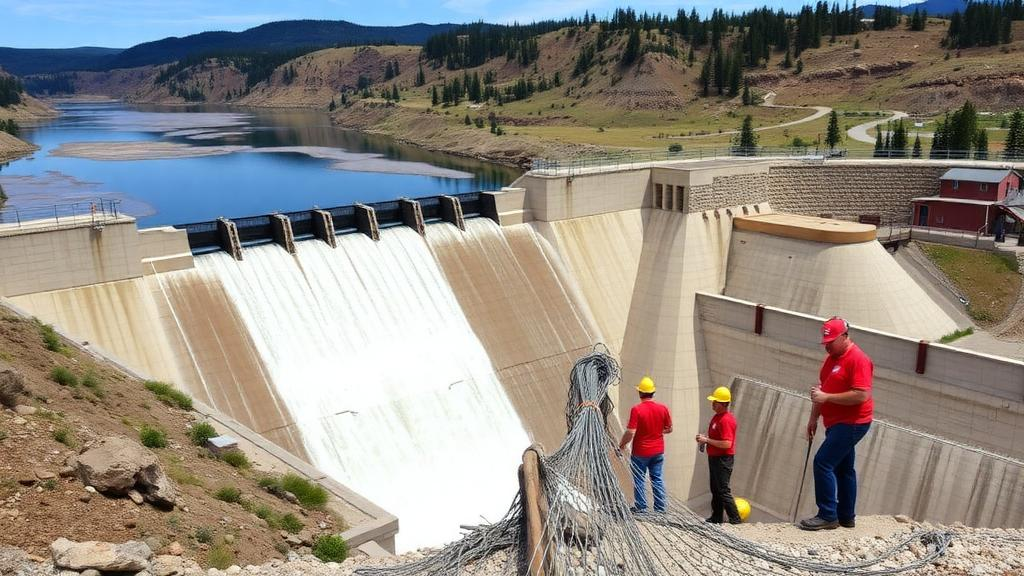
When engineers dismantled a small concrete dam on Rattlesnake Creek near Missoula, Montana, in 2020, they ended more than a century of obstruction on a stream that supplies drinking water to a growing mountain city. But the most remarkable part of the story may not be the dam removal itself. It is who was watching. For eight years, spanning three years before the removal and four years after, an army of ordinary volunteers—families, students, retirees, and weekend hikers—waded into the creek every Sunday from August through November to count pebbles and pick insects from the streambed. Their data, analyzed in a new study published in Geoscience Communication, now offers one of the longest continuous records ever assembled around a small dam removal in the western United States, and it delivers a surprising verdict: the removal of the dam was, ecologically speaking, almost a non-event.
The research, conducted by Bethany Blakey of Utah State University and Natalie Bursztyn of James Madison University, examined citizen science data collected by the Watershed Education Network, a Missoula-based nonprofit whose Stream Team program has monitored local creeks for over two decades. Hundreds of volunteers contributed more than 4,000 hours of fieldwork between 2017 and 2024, measuring streambed sediments and tallying aquatic macroinvertebrates at ten sites—two upstream of the former dam as reference locations and eight downstream as impact sites. The dam, built in 1901, stood 18 meters wide and 3 meters tall, blocking 95 percent of the 210-square-kilometer watershed. It once supplied Missoula’s drinking water, but by the time of its removal it had been slated for demolition over safety and conservation concerns, with the project costing 1.1 million dollars and requiring the reconstruction of more than 300 meters of channel.
The scientific logic of the study rests on a well-established framework known as before-after-control-impact, or BACI. The idea is elegant: if a disturbance causes a real change, the difference between control sites and impacted sites should shift after the event. Upstream reaches, unaffected by the dam removal, serve as the control; downstream reaches are the impact zone. The researchers compared grain size distributions from Wolman pebble counts—a technique in which at least 100 stones are measured along their intermediate axis across the channel—and a macroinvertebrate biotic index adapted from the Hilsenhoff Biotic Index, which scores stream health based on the pollution tolerance of the insects living there. Because the number of observations was small, particularly at the upstream reference sites, the team relied on descriptive statistics rather than formal hypothesis tests, calculating the magnitude of change alongside its standard error.
The results were strikingly uneventful. Before the removal, median grain sizes upstream averaged 105.9 millimeters, while downstream sites averaged 100.1 millimeters—essentially indistinguishable given natural variability. After the removal, the upstream mean was 92.9 millimeters and the downstream mean 93.3 millimeters, still nearly identical. Every BACI value for every grain size percentile fell below its own standard error, meaning no detectable difference could be attributed to the dam coming down. The macroinvertebrate data told the same story. Biotic index values hovered within the good water quality range both before and after removal, upstream and downstream alike, with an overall post-removal difference of minus 0.13, well within the margin of error. For a stream that had been dammed since 1901, the absence of ecological upheaval demanded an explanation.
The authors point to two factors. First, the dam’s sluice gates had been permanently opened in 2012, eight years before the full removal, allowing water, fish, and sediment to pass freely during low to moderate flows. In effect, the creek had already undergone a staged removal—a strategy known from previous research to dramatically reduce erosion and sediment pulses compared with instantaneous breaching. By the time the concrete came out, the river had largely adjusted to a free-flowing condition. Second, no major flood occurred during the study period. Dam removal science describes a two-phase response: an initial rapid flush of reservoir sediment, followed by a slower, event-driven phase in which further erosion requires high flows. The first phase may have played out during the sluice gate opening, and without significant floods afterward, the second phase never really began. Peak flows in the two years after removal, around 21 to 25 cubic meters per second, were lower than the roughly 29 to 32 cubic meters per second peaks recorded before removal.
That null result is scientifically valuable in itself. Most dam removal studies capture only short-term post-removal impacts, and many collect no pre-removal data at all. Research on small historic dams has concentrated heavily on the eastern United States, even though the majority of the estimated 2.5 million dams in the country are under 1.83 meters tall and removals of these small structures are far more common than headline-grabbing demolitions of large dams. Montana alone has hundreds of small dams. The Rattlesnake Creek findings suggest that when a small dam has been effectively decommissioned through a staged opening, its physical removal may cause minimal detectable harm—or benefit—to sediment transport and aquatic life on a timescale of years. That insight matters directly for the nine remaining wilderness dams upstream in the Rattlesnake watershed, built between 1911 and 1923, whose potential removal is now under discussion.
Just as significant is what the study says about the volunteers who gathered the data. Skepticism about citizen science data quality has long shadowed the field, with some researchers finding volunteer datasets more variable than professional ones and others arguing that direct comparisons are inherently unfair. Yet the pebble count and macroinvertebrate datasets proved complete and analytically viable across all eight years. The authors attribute this success to field verification of data, well-designed paper datasheets, and the relative simplicity of the collection protocols—volunteers worked in teams, cross-checked tallies, and followed procedures rehearsed at the start of every outing. One volunteer described the experience as fulfilling childhood dreams of looking at bugs and counting rocks, adding that the work would matter for something. Another reflected that the program revealed science is not all organic chemistry; it can be fun things in the stream.
The study is equally candid about failure. The cross-section profiles, which would have revealed changes in channel shape and depth, proved unusable because of systematic data gaps. Before 2021, volunteers recorded numeric intervals without noting the measurement increments across the stream, and datasheets frequently failed to identify which of two required cross-sections was upstream and which was downstream. Without in-situ verification before leaving the field, the errors went unnoticed until analysis. From these shortcomings, the authors distilled four best practices: ensure every required measurement has a designated place on the datasheet and verify completeness before leaving the site; design digital datasheets that make data entry unambiguous; keep each data type in a single column or row; and create an easily accessible summary page that analysis software can read directly. The Watershed Education Network is now developing a tablet app with required entry fields to address exactly these vulnerabilities.
Beyond the data, the project illustrates the quieter power of community science. Stream Team outings became social events in a heavily recreated corridor, where hikers stopped to ask what bugs the volunteers had found and were invited to join the next outing. Participation in such programs has been shown to improve understanding of the scientific process and give voice to people otherwise excluded from environmental decisions. The study’s authors emphasize that citizen science can achieve spatial and temporal coverage that would be prohibitively expensive for professional researchers alone, provided that meticulous data management underpins the enthusiasm. As dam removals accelerate across Europe and North America, the Rattlesnake Creek experiment offers a dual lesson: staged decommissioning can defuse the ecological drama of removing a small dam, and a committed community of volunteers, given good protocols and honest accounting of their mistakes, can document the outcome with rigor that would make any professional monitoring team take notice.
Subject of Research: Citizen science monitoring of stream sediment and macroinvertebrate responses to a small dam removal on Rattlesnake Creek, Montana
Article Title: Citizen science as a long-term environmental baseline: assessing impacts of a small dam removal in Montana, USA
Article References: Blakey, B., & Bursztyn, N. (2026). Citizen science as a long-term environmental baseline: assessing impacts of a small dam removal in Montana, USA. Geoscience Communication, 9(3), 401-413. https://doi.org/10.5194/gc-9-401-2026
Image Credits: AI Generated
Keywords: citizen science, dam removal, Rattlesnake Creek, Montana, stream ecology, macroinvertebrates, pebble counts, sediment transport, BACI design, river restoration, Watershed Education Network, long-term monitoring
Cite Scienmag News
Violet Maxwell. (October 8, 2026). Volunteers Prove Their Worth in Eight-Year Study of a Montana Dam Removal. Scienmag. https://scienmag.com/volunteers-prove-their-worth-in-eight-year-study-of-a-montana-dam-removal/
Violet Maxwell. "Volunteers Prove Their Worth in Eight-Year Study of a Montana Dam Removal." Scienmag, 8 October 2026, https://scienmag.com/volunteers-prove-their-worth-in-eight-year-study-of-a-montana-dam-removal/. Accessed 8 October 2026.
Violet Maxwell. "Volunteers Prove Their Worth in Eight-Year Study of a Montana Dam Removal." Scienmag. October 8, 2026. https://scienmag.com/volunteers-prove-their-worth-in-eight-year-study-of-a-montana-dam-removal/


